




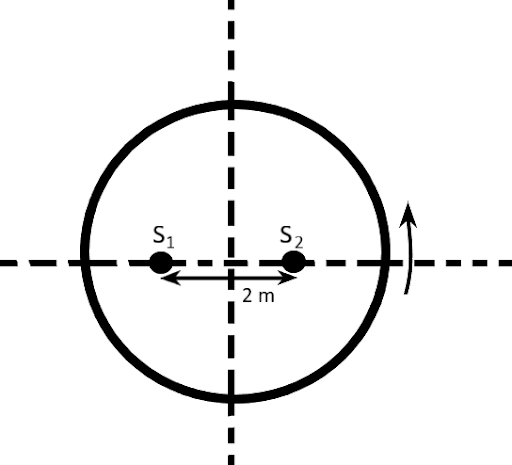
Two points sources separated by $2.0\,m$ are radiating in phase with $\lambda = 0.50\,m$. A detector moves in a circular path around the two sources in a plane containing them. How many maxima are detected?
A. $16$
B. $20$
C. $24$
D. $32$
Answer
 Verified
232.8k+ views
Hint:When the two waves superimpose on each other to give a wave of greater amplitude, that is interference. A spot in an interference pattern where the interfering waves are maximally constructive. Interference maxima occurs at angles $\theta $such that $d\,\sin \theta = m\lambda $where $m$ is an integer. To determine the total number of maxima, you need to observe the given figure and then use the interference maxima.
Formula used:
Interference maxima occurs at angles \[\theta \] such that \[d\,\sin \theta = m\lambda \] where \[m\] is an integer.
Complete step by step solution:
In the question, two sources ${S_1}$and ${S_2}$ are given which are separated by $d = 2.0\,m$ and are radiating in phase with wavelength $\lambda = 0.50\,m$. As we know that the Interference maxima occur at angles $\theta $ such that,
$d\,\sin \theta = m\lambda $,
Here, the total number of maxima is $m$ which is an integer.
Apply the constructive interference for maxima and put the given information in the interference maxima, then:
$(2.0)\,\sin \theta = m(0.50) \\$
$\Rightarrow \sin \theta = \dfrac{{0.50}}{{2.0}}m \\$
$\Rightarrow \sin \theta = 0.25m $
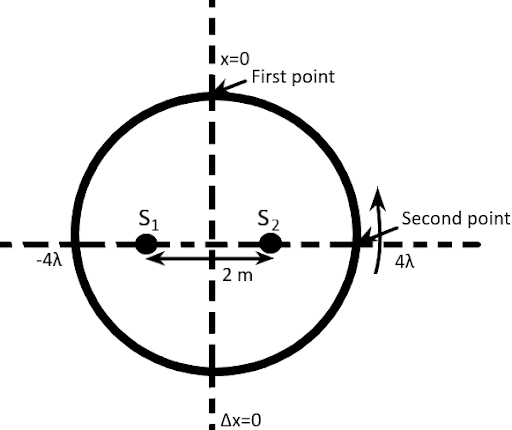
As $\sin \theta $ lies between $ - 1$ and $1$, so we need to find all values of $m$ for which $|0.25m| \leqslant 1$. Here $m$ is an integer, then: these values are $ - 4, - 3, - 2, - 1,0,1,2,3,4$. For each of these there are $2$ different values of $\theta $ except for $ - 4$ and $ + 4$, we get the single value of $\theta $. Thus at the second point there is a path difference of $4\lambda $ and at the first point there is a path difference of zero. So, between ${0^{th}}$ order and ${4^{th}}$ order will lie $1st,\,2nd,\,3rd$ maxima. This same procedure repeats in all other quadrants also. Therefore, a total of $16$ maxima points.
Thus, the correct option is A.
Note: At point second, the path difference is $2.0\,m$ and at the first point, the path difference is zero. While moving from first point to second point, the path difference changes from $2.0\,m$to zero, making two maxima exclude the second point. Second point is common for both upper quarter circles so there are $16$ angels at different angles in all.
Formula used:
Interference maxima occurs at angles \[\theta \] such that \[d\,\sin \theta = m\lambda \] where \[m\] is an integer.
Complete step by step solution:
In the question, two sources ${S_1}$and ${S_2}$ are given which are separated by $d = 2.0\,m$ and are radiating in phase with wavelength $\lambda = 0.50\,m$. As we know that the Interference maxima occur at angles $\theta $ such that,
$d\,\sin \theta = m\lambda $,
Here, the total number of maxima is $m$ which is an integer.
Apply the constructive interference for maxima and put the given information in the interference maxima, then:
$(2.0)\,\sin \theta = m(0.50) \\$
$\Rightarrow \sin \theta = \dfrac{{0.50}}{{2.0}}m \\$
$\Rightarrow \sin \theta = 0.25m $
As $\sin \theta $ lies between $ - 1$ and $1$, so we need to find all values of $m$ for which $|0.25m| \leqslant 1$. Here $m$ is an integer, then: these values are $ - 4, - 3, - 2, - 1,0,1,2,3,4$. For each of these there are $2$ different values of $\theta $ except for $ - 4$ and $ + 4$, we get the single value of $\theta $. Thus at the second point there is a path difference of $4\lambda $ and at the first point there is a path difference of zero. So, between ${0^{th}}$ order and ${4^{th}}$ order will lie $1st,\,2nd,\,3rd$ maxima. This same procedure repeats in all other quadrants also. Therefore, a total of $16$ maxima points.
Thus, the correct option is A.
Note: At point second, the path difference is $2.0\,m$ and at the first point, the path difference is zero. While moving from first point to second point, the path difference changes from $2.0\,m$to zero, making two maxima exclude the second point. Second point is common for both upper quarter circles so there are $16$ angels at different angles in all.
Recently Updated Pages
JEE Main 2023 April 6 Shift 1 Question Paper with Answer Key

JEE Main 2023 April 6 Shift 2 Question Paper with Answer Key
JEE Main 2023 (January 31 Evening Shift) Question Paper with Solutions [PDF]
JEE Main 2023 January 30 Shift 2 Question Paper with Answer Key
JEE Main 2023 January 25 Shift 1 Question Paper with Answer Key
JEE Main 2023 January 24 Shift 2 Question Paper with Answer Key
Trending doubts
JEE Main 2026: Session 2 Registration Open, City Intimation Slip, Exam Dates, Syllabus & Eligibility
JEE Main 2026 Application Login: Direct Link, Registration, Form Fill, and Steps
Understanding the Angle of Deviation in a Prism
Hybridisation in Chemistry – Concept, Types & Applications
How to Convert a Galvanometer into an Ammeter or Voltmeter
Understanding Uniform Acceleration in Physics
Other Pages
JEE Advanced Marks vs Ranks 2025: Understanding Category-wise Qualifying Marks and Previous Year Cut-offs
Dual Nature of Radiation and Matter Class 12 Physics Chapter 11 CBSE Notes - 2025-26
Understanding the Electric Field of a Uniformly Charged Ring
JEE Advanced Weightage 2025 Chapter-Wise for Physics, Maths and Chemistry
Derivation of Equation of Trajectory Explained for Students
Understanding Electromagnetic Waves and Their Importance