




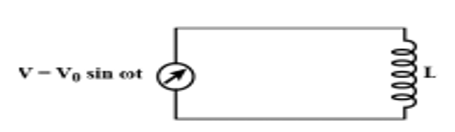
There is no resistance in the inductive circuit. Kirchhoff’s voltage law for the circuit is
A. $V + L\dfrac{{di}}{{dt}} = 0$
B. $V = L\dfrac{{di}}{{dt}}$
C. $V - {L^2}\dfrac{{di}}{{dt}} = 0$
D. None of these
Answer
 Verified
232.8k+ views
Hint We know that if there is no resistance in an R-L circuit then it is a pure inductor connected to the supply. So, it will be a simple L circuit. At first, we will calculate the voltage drop across the inductor. Then we will apply Kirchhoff laws for finding the appropriate expression.
Complete step by step answer
We know that a RL circuit with no resistance behaves as a purely inductive circuit.
So, we will find the voltage drop across the inductor which is $L\dfrac{{di}}{{dt}}$
Now applying Kirchoff's law for the given circuit with no resistance, we get
$V - L\dfrac{{di}}{{dt}} = 0$
$V = L\dfrac{{di}}{{dt}}$
Where,
V is the voltage drop across the resistor
Therefore, the Kirchoff law for given circuit is $V = L\dfrac{{di}}{{dt}}$
Hence the correct solution is option B
Additional information
In case of time varying input, the inductor opposes the change in current instantaneously. So, the current in the inductor will fall behind and lag with respect to the original. Also, in the pure inductive circuit the phase shift is 90 degrees on considering sinusoidal input.
Note
In the given question no resistance is assumed while writing the Kirchhoff’s law but there is a small resistance of the inductor too which we have neglected in this question.
The above equation is valid for an alternating current as for direct current it behaves as a short circuit and for that current will be zero and simultaneously the voltage drop will be zero.
Complete step by step answer
We know that a RL circuit with no resistance behaves as a purely inductive circuit.
So, we will find the voltage drop across the inductor which is $L\dfrac{{di}}{{dt}}$
Now applying Kirchoff's law for the given circuit with no resistance, we get
$V - L\dfrac{{di}}{{dt}} = 0$
$V = L\dfrac{{di}}{{dt}}$
Where,
V is the voltage drop across the resistor
Therefore, the Kirchoff law for given circuit is $V = L\dfrac{{di}}{{dt}}$
Hence the correct solution is option B
Additional information
In case of time varying input, the inductor opposes the change in current instantaneously. So, the current in the inductor will fall behind and lag with respect to the original. Also, in the pure inductive circuit the phase shift is 90 degrees on considering sinusoidal input.
Note
In the given question no resistance is assumed while writing the Kirchhoff’s law but there is a small resistance of the inductor too which we have neglected in this question.
The above equation is valid for an alternating current as for direct current it behaves as a short circuit and for that current will be zero and simultaneously the voltage drop will be zero.
Recently Updated Pages
JEE Main 2023 April 6 Shift 1 Question Paper with Answer Key

JEE Main 2023 April 6 Shift 2 Question Paper with Answer Key
JEE Main 2023 (January 31 Evening Shift) Question Paper with Solutions [PDF]
JEE Main 2023 January 30 Shift 2 Question Paper with Answer Key
JEE Main 2023 January 25 Shift 1 Question Paper with Answer Key
JEE Main 2023 January 24 Shift 2 Question Paper with Answer Key
Trending doubts
JEE Main 2026: Session 2 Registration Open, City Intimation Slip, Exam Dates, Syllabus & Eligibility
JEE Main 2026 Application Login: Direct Link, Registration, Form Fill, and Steps
JEE Main Marking Scheme 2026- Paper-Wise Marks Distribution and Negative Marking Details
Understanding the Angle of Deviation in a Prism
Hybridisation in Chemistry – Concept, Types & Applications
How to Convert a Galvanometer into an Ammeter or Voltmeter
Other Pages
JEE Advanced Marks vs Ranks 2025: Understanding Category-wise Qualifying Marks and Previous Year Cut-offs
Dual Nature of Radiation and Matter Class 12 Physics Chapter 11 CBSE Notes - 2025-26
Understanding Uniform Acceleration in Physics
Understanding the Electric Field of a Uniformly Charged Ring
JEE Advanced Weightage 2025 Chapter-Wise for Physics, Maths and Chemistry
Derivation of Equation of Trajectory Explained for Students