




The radius of curvature of the convex surface of a thin plano-convex lens (refractive index 1.5) is 20cm (i) Calculate the focal length of the lens. (ii) Also calculate the distance of the image of a pin placed on the axis 80cm from the lens and draw a ray diagram. (iii) Determine the magnification of the image.
(A) (a)40cm
(b)$80c{m^2}$, on the other side of the
(c) $+ 1$
(B) (a)50cm
(b)$700cm$, on the other side of the
(c) $ + 1$
(C) (a)40cm
(b)$80cm$, on the other side of the
(c)$ - 1$
(D) (a)$40c{m^2}$
(b)$80cm$, on the other side of the
(c)$ - 1$
Answer
 Verified
233.4k+ views
Hint In Optics, magnification is simply the size of an image relative to the size of the object creating it. Magnification refers to the ratio of the length of image to the length of object measured in the plane perpendicular to the optical axis. The distance between the centre of a lens or curved mirror is known as its focal length.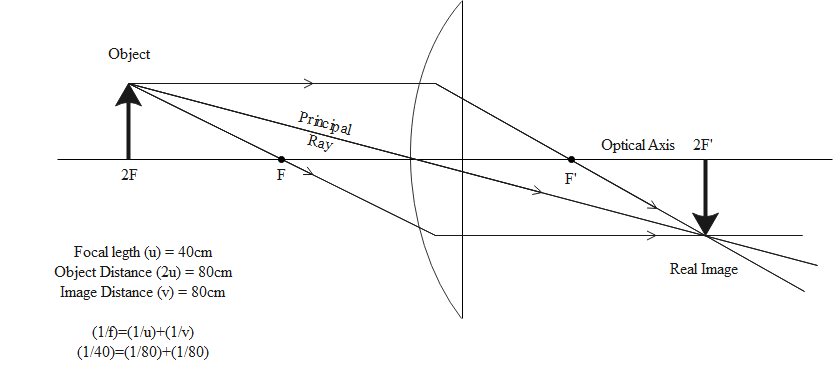
Complete step by step answer: In optics, the lens makers formula states that
$\dfrac{1}{f} = \left( {\mu - 1} \right)\left( {\dfrac{1}{{{R_1}}} - \dfrac{1}{{{R_2}}}} \right)$
Where f is the focal length.
${R_1} = \infty $
${R_2} = 20cm$
Therefore, we can put the given information in the above equation and derive,
(i)$\dfrac{1}{f} = \left( {1 \cdot 5 - 1} \right)\left( {\dfrac{1}{{20}}} \right)$
Hence,
f = 40cm
(ii) Since, focal length (f) = 40cm
Let v = distance of image and let u = distance of object
Therefore,
$\dfrac{1}{u} + \dfrac{1}{v} = \dfrac{1}{f}$
$ \Rightarrow \dfrac{1}{{80}} + \dfrac{1}{v} = \dfrac{1}{{40}}$
$\Rightarrow v = 80cm$
The given diagram clearly demonstrates the solution.
(iii) Let magnification = m
$m = - \dfrac{v}{u}$
$\Rightarrow m = - \dfrac{{80}}{{80}}$
$ m = - 1$
Hence, the correct answer is Option C.
Note We must carefully understand if the lens is silvered anywhere as that would bring reflection in the question and the solution for which would completely be different. Other than that, the complexity of the question increases with involvement of more than one lens in case of which the formula used will be relative.
Complete step by step answer: In optics, the lens makers formula states that
$\dfrac{1}{f} = \left( {\mu - 1} \right)\left( {\dfrac{1}{{{R_1}}} - \dfrac{1}{{{R_2}}}} \right)$
Where f is the focal length.
${R_1} = \infty $
${R_2} = 20cm$
Therefore, we can put the given information in the above equation and derive,
(i)$\dfrac{1}{f} = \left( {1 \cdot 5 - 1} \right)\left( {\dfrac{1}{{20}}} \right)$
Hence,
f = 40cm
(ii) Since, focal length (f) = 40cm
Let v = distance of image and let u = distance of object
Therefore,
$\dfrac{1}{u} + \dfrac{1}{v} = \dfrac{1}{f}$
$ \Rightarrow \dfrac{1}{{80}} + \dfrac{1}{v} = \dfrac{1}{{40}}$
$\Rightarrow v = 80cm$
The given diagram clearly demonstrates the solution.
(iii) Let magnification = m
$m = - \dfrac{v}{u}$
$\Rightarrow m = - \dfrac{{80}}{{80}}$
$ m = - 1$
Hence, the correct answer is Option C.
Note We must carefully understand if the lens is silvered anywhere as that would bring reflection in the question and the solution for which would completely be different. Other than that, the complexity of the question increases with involvement of more than one lens in case of which the formula used will be relative.
Recently Updated Pages
JEE Main 2023 April 6 Shift 1 Question Paper with Answer Key

JEE Main 2023 April 6 Shift 2 Question Paper with Answer Key
JEE Main 2023 (January 31 Evening Shift) Question Paper with Solutions [PDF]
JEE Main 2023 January 30 Shift 2 Question Paper with Answer Key
JEE Main 2023 January 25 Shift 1 Question Paper with Answer Key
JEE Main 2023 January 24 Shift 2 Question Paper with Answer Key
Trending doubts
JEE Main 2026: Session 2 Registration Open, City Intimation Slip, Exam Dates, Syllabus & Eligibility
JEE Main 2026 Application Login: Direct Link, Registration, Form Fill, and Steps
Understanding the Angle of Deviation in a Prism
Hybridisation in Chemistry – Concept, Types & Applications
How to Convert a Galvanometer into an Ammeter or Voltmeter
Understanding Uniform Acceleration in Physics
Other Pages
JEE Advanced Marks vs Ranks 2025: Understanding Category-wise Qualifying Marks and Previous Year Cut-offs
Dual Nature of Radiation and Matter Class 12 Physics Chapter 11 CBSE Notes - 2025-26
Understanding the Electric Field of a Uniformly Charged Ring
JEE Advanced Weightage 2025 Chapter-Wise for Physics, Maths and Chemistry
Derivation of Equation of Trajectory Explained for Students
Understanding Electromagnetic Waves and Their Importance