




The kinetic energy needed to project a body of mass $m$ from the earth’s surface to infinity is:
A) $\dfrac{1}{4}mgR$
B) $\dfrac{1}{2}mgR$
C) $mgR$
D) $2mgR$
Answer
 Verified
232.8k+ views
Hint: To find out the kinetic energy of the mass, first write the formula of the kinetic energy and substitute the formula for the escaping velocity of the mass to move it out of gravitational force in it. The simplification of the equation provides the answer.
Formula used:
(1) The formula of the kinetic energy is given by
$KE = \dfrac{1}{2}m{V^2}$
Where $KE$ is the kinetic energy of the mass, $m$ is the mass and $V$ is the velocity at which the mass is thrown.
(2) The escape velocity is given by
${V_{esc}} = \sqrt {2gR} $
Where ${V_{esc}}$ is the escaping velocity of the mass, $g$ is the acceleration due to gravity and the $R$ is the radius of the earth.
Complete step by step solution:
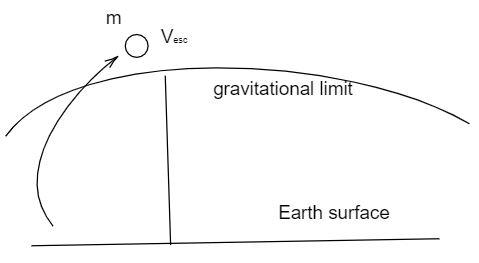
It is given that the mass projects to infinity from the earth surface. It means the mass destination is known but it is not returning back to the point of the projection. Hence the mass escapes the earth’s gravitational force that causes the mass to return back to the earth, after the force of the mass is zero. Hence this velocity that makes escape of the mass from the gravity is called escaping velocity.
The formula of the kinetic energy is considered.
$KE = \dfrac{1}{2}m{V^2}$
$KE = \dfrac{1}{2}m{V_{esc}}^2$ ------------------(1)
Substituting the formula (2) in the equation (1).
${V_{esc}} = \sqrt {2gR} $
$KE = \dfrac{1}{2}m{\left( {\sqrt {2gR} } \right)^2}$
By simplifying the above equation,
$KE = \dfrac{2}{2}mgR$
By the further simplification, we get
$KE = mgR$
Hence the kinetic energy of the mass is $mgR$ .
Thus the option (C) is correct.
Note: If the mass has the normal velocity, when the velocity at which the mass is projected up becomes zero, the mass again returns back to the original surface due to the gravity. This gravitational force is limited up to a certain distance, after this the objects can move with escape velocity.
Formula used:
(1) The formula of the kinetic energy is given by
$KE = \dfrac{1}{2}m{V^2}$
Where $KE$ is the kinetic energy of the mass, $m$ is the mass and $V$ is the velocity at which the mass is thrown.
(2) The escape velocity is given by
${V_{esc}} = \sqrt {2gR} $
Where ${V_{esc}}$ is the escaping velocity of the mass, $g$ is the acceleration due to gravity and the $R$ is the radius of the earth.
Complete step by step solution:
It is given that the mass projects to infinity from the earth surface. It means the mass destination is known but it is not returning back to the point of the projection. Hence the mass escapes the earth’s gravitational force that causes the mass to return back to the earth, after the force of the mass is zero. Hence this velocity that makes escape of the mass from the gravity is called escaping velocity.
The formula of the kinetic energy is considered.
$KE = \dfrac{1}{2}m{V^2}$
$KE = \dfrac{1}{2}m{V_{esc}}^2$ ------------------(1)
Substituting the formula (2) in the equation (1).
${V_{esc}} = \sqrt {2gR} $
$KE = \dfrac{1}{2}m{\left( {\sqrt {2gR} } \right)^2}$
By simplifying the above equation,
$KE = \dfrac{2}{2}mgR$
By the further simplification, we get
$KE = mgR$
Hence the kinetic energy of the mass is $mgR$ .
Thus the option (C) is correct.
Note: If the mass has the normal velocity, when the velocity at which the mass is projected up becomes zero, the mass again returns back to the original surface due to the gravity. This gravitational force is limited up to a certain distance, after this the objects can move with escape velocity.
Recently Updated Pages
Circuit Switching vs Packet Switching: Key Differences Explained

Dimensions of Pressure in Physics: Formula, Derivation & SI Unit
JEE General Topics in Chemistry Important Concepts and Tips
JEE Extractive Metallurgy Important Concepts and Tips for Exam Preparation
JEE Amino Acids and Peptides Important Concepts and Tips for Exam Preparation
JEE Atomic Structure and Chemical Bonding important Concepts and Tips
Trending doubts
JEE Main 2026: Session 2 Registration Open, City Intimation Slip, Exam Dates, Syllabus & Eligibility
JEE Main 2026 Application Login: Direct Link, Registration, Form Fill, and Steps
JEE Main Marking Scheme 2026- Paper-Wise Marks Distribution and Negative Marking Details
Understanding the Angle of Deviation in a Prism
Hybridisation in Chemistry – Concept, Types & Applications
How to Convert a Galvanometer into an Ammeter or Voltmeter
Other Pages
JEE Advanced Marks vs Ranks 2025: Understanding Category-wise Qualifying Marks and Previous Year Cut-offs
Laws of Motion Class 11 Physics Chapter 4 CBSE Notes - 2025-26
Waves Class 11 Physics Chapter 14 CBSE Notes - 2025-26
Mechanical Properties of Fluids Class 11 Physics Chapter 9 CBSE Notes - 2025-26
Thermodynamics Class 11 Physics Chapter 11 CBSE Notes - 2025-26
Units And Measurements Class 11 Physics Chapter 1 CBSE Notes - 2025-26