




The image formed by a plane mirror is always:
A) Real
B) Inverted
C) Virtual
D) Distorted
Answer
 Verified
232.8k+ views
Hint: To answer this question we should carefully see and understand the ray diagram for a plane mirror. Also, we should try to understand the meaning of all the options given in the question.
Complete step by step answer:
First of all, let’s analyze the options.
Real image- When in a ray diagram, the image formed is due to the actual intersection of rays of light, we can say the image is real. A real image can be taken on a screen.
Inverted image- When the image formed in a ray diagram is upside down of the actual image, we can say the image is inverted.
Virtual image- When in a ray diagram, the image formed is due to the extension of the rays of light, we can say the image is virtual. A virtual image cannot be taken on a screen. Here the light rays either meet behind the mirror or do not meet at all.
Distorted image- An image can be called distorted when it is completely different in shape and size from the object.
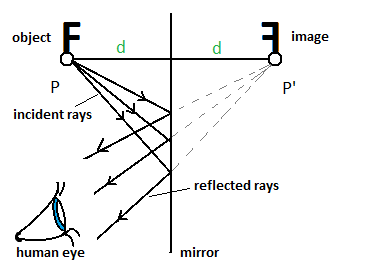
From the ray diagram given in the above figure, it is clear that the image formed here is virtual. Also if we will make a ray diagram for any other position we will get a virtual image. Hene we can say for a ray diagram the image is always virtual.
So option (C) is the correct answer.
Note: Real image and virtual image are the two basic classifications used to differentiate between the different types of images formed either by reflection or refraction of light rays. The most important difference between the real image and a virtual image is that real images are formed when light rays actually meet after getting reflected or refracted from a mirror whereas virtual images are formed when light rays appear to meet at a point in the vicinity beyond the mirror.
Complete step by step answer:
First of all, let’s analyze the options.
Real image- When in a ray diagram, the image formed is due to the actual intersection of rays of light, we can say the image is real. A real image can be taken on a screen.
Inverted image- When the image formed in a ray diagram is upside down of the actual image, we can say the image is inverted.
Virtual image- When in a ray diagram, the image formed is due to the extension of the rays of light, we can say the image is virtual. A virtual image cannot be taken on a screen. Here the light rays either meet behind the mirror or do not meet at all.
Distorted image- An image can be called distorted when it is completely different in shape and size from the object.
From the ray diagram given in the above figure, it is clear that the image formed here is virtual. Also if we will make a ray diagram for any other position we will get a virtual image. Hene we can say for a ray diagram the image is always virtual.
So option (C) is the correct answer.
Note: Real image and virtual image are the two basic classifications used to differentiate between the different types of images formed either by reflection or refraction of light rays. The most important difference between the real image and a virtual image is that real images are formed when light rays actually meet after getting reflected or refracted from a mirror whereas virtual images are formed when light rays appear to meet at a point in the vicinity beyond the mirror.
Recently Updated Pages
JEE Main 2023 April 6 Shift 1 Question Paper with Answer Key

JEE Main 2023 April 6 Shift 2 Question Paper with Answer Key
JEE Main 2023 (January 31 Evening Shift) Question Paper with Solutions [PDF]
JEE Main 2023 January 30 Shift 2 Question Paper with Answer Key
JEE Main 2023 January 25 Shift 1 Question Paper with Answer Key
JEE Main 2023 January 24 Shift 2 Question Paper with Answer Key
Trending doubts
JEE Main 2026: Session 2 Registration Open, City Intimation Slip, Exam Dates, Syllabus & Eligibility
JEE Main 2026 Application Login: Direct Link, Registration, Form Fill, and Steps
Understanding the Angle of Deviation in a Prism
Hybridisation in Chemistry – Concept, Types & Applications
How to Convert a Galvanometer into an Ammeter or Voltmeter
Understanding Uniform Acceleration in Physics
Other Pages
JEE Advanced Marks vs Ranks 2025: Understanding Category-wise Qualifying Marks and Previous Year Cut-offs
Dual Nature of Radiation and Matter Class 12 Physics Chapter 11 CBSE Notes - 2025-26
Understanding the Electric Field of a Uniformly Charged Ring
JEE Advanced Weightage 2025 Chapter-Wise for Physics, Maths and Chemistry
Derivation of Equation of Trajectory Explained for Students
Understanding Electromagnetic Waves and Their Importance