




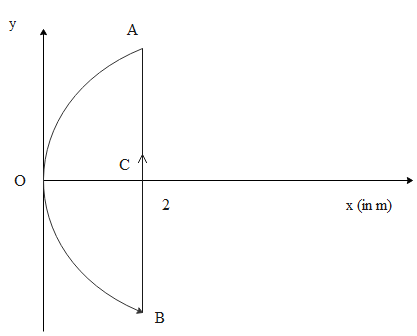
The field created by the current in the loop at point C will be
(A) $-\dfrac{\mu_{0}}{4 \pi} \hat{k}$
(B) $-\dfrac{\mu_{0}}{8 \pi} \hat{k}$
(C) $-\dfrac{\mu_{0} \sqrt{2}}{\pi} \hat{k}$
(D) none
Answer
 Verified
232.8k+ views
Hint: We know that electric field, an electric property associated with each point in space when charge is present in any form. The magnitude and direction of the electric field are expressed by the value of E, called electric field strength or electric field intensity or simply the electric field. Electric fields are caused by electric charges, described by Gauss's law, and time varying magnetic fields, described by Faraday's law of induction. Together, these laws are enough to define the behaviour of the electric field.
Complete step by step answer
We know that Fleming's right-hand rule (for generators) shows the direction of induced current when a conductor attached to a circuit moves in a magnetic field. When a conductor such as a wire attached to a circuit moves through a magnetic field, an electric current is induced in the wire due to Faraday's law of induction.
The right-hand rule states that: to determine the direction of the magnetic force on a positive moving charge, ƒ, point the thumb of the right hand in the direction of v, the fingers in the direction of B, and a perpendicular to the palm points in the direction of F.
From Fleming's right-hand rule, as the current is in an anti-clockwise direction, the field should be towards the positive z axis, i.e. $\hat{\mathrm{k}}$.
Hence, the correct option is option D.
Note: We know that the electric field is produced by stationary charges, and the magnetic field by moving charges (currents); these two are often described as the sources of the field. The way in which charges and currents interact with the electromagnetic field is described by Maxwell's equations and the Lorentz force law. The relative magnitude of the electric field is proportional to the density of the field lines. Where the field lines are close together the field is strongest; where the field lines are far apart the field is weakest. If the lines are uniformly-spaced and parallel, the field is uniform. Electric field is not negative. It is a vector and thus has negative and positive directions. An electron being negatively charged experiences a force against the direction of the field. For a positive charge, the force is along the field.
Complete step by step answer
We know that Fleming's right-hand rule (for generators) shows the direction of induced current when a conductor attached to a circuit moves in a magnetic field. When a conductor such as a wire attached to a circuit moves through a magnetic field, an electric current is induced in the wire due to Faraday's law of induction.
The right-hand rule states that: to determine the direction of the magnetic force on a positive moving charge, ƒ, point the thumb of the right hand in the direction of v, the fingers in the direction of B, and a perpendicular to the palm points in the direction of F.
From Fleming's right-hand rule, as the current is in an anti-clockwise direction, the field should be towards the positive z axis, i.e. $\hat{\mathrm{k}}$.
Hence, the correct option is option D.
Note: We know that the electric field is produced by stationary charges, and the magnetic field by moving charges (currents); these two are often described as the sources of the field. The way in which charges and currents interact with the electromagnetic field is described by Maxwell's equations and the Lorentz force law. The relative magnitude of the electric field is proportional to the density of the field lines. Where the field lines are close together the field is strongest; where the field lines are far apart the field is weakest. If the lines are uniformly-spaced and parallel, the field is uniform. Electric field is not negative. It is a vector and thus has negative and positive directions. An electron being negatively charged experiences a force against the direction of the field. For a positive charge, the force is along the field.
Recently Updated Pages
JEE Main 2023 April 6 Shift 1 Question Paper with Answer Key

JEE Main 2023 April 6 Shift 2 Question Paper with Answer Key
JEE Main 2023 (January 31 Evening Shift) Question Paper with Solutions [PDF]
JEE Main 2023 January 30 Shift 2 Question Paper with Answer Key
JEE Main 2023 January 25 Shift 1 Question Paper with Answer Key
JEE Main 2023 January 24 Shift 2 Question Paper with Answer Key
Trending doubts
JEE Main 2026: Session 2 Registration Open, City Intimation Slip, Exam Dates, Syllabus & Eligibility
JEE Main 2026 Application Login: Direct Link, Registration, Form Fill, and Steps
Understanding the Angle of Deviation in a Prism
Hybridisation in Chemistry – Concept, Types & Applications
How to Convert a Galvanometer into an Ammeter or Voltmeter
Understanding Uniform Acceleration in Physics
Other Pages
JEE Advanced Marks vs Ranks 2025: Understanding Category-wise Qualifying Marks and Previous Year Cut-offs
Dual Nature of Radiation and Matter Class 12 Physics Chapter 11 CBSE Notes - 2025-26
Understanding the Electric Field of a Uniformly Charged Ring
JEE Advanced Weightage 2025 Chapter-Wise for Physics, Maths and Chemistry
Derivation of Equation of Trajectory Explained for Students
Understanding Electromagnetic Waves and Their Importance