




The differential equation of all circles which passes through the origin and whose center lie on \[y\]-axis, is
A. \[\left( {{x^2} - {y^2}} \right)\frac{{dy}}{{dx}} - 2xy = 0\]
B. \[\left( {{x^2} - {y^2}} \right)\frac{{dy}}{{dx}} + 2xy = 0\]
C. \[\left( {{x^2} - {y^2}} \right)\frac{{dy}}{{dx}} - xy = 0\]
D. \[\left( {{x^2} - {y^2}} \right)\frac{{dy}}{{dx}} + xy = 0\]
Answer
 Verified
232.8k+ views
HINT:
In order to obtain the circle's resulting equation, we employ the assumption that the circle passes through the origin and only touches the\[y\]-axis there to begin the problem-solving process. Then, in order to determine the values of any arbitrary constants included in the equation, we begin differentiating the acquired equation of circles on both sides with respect to\[y\]. In order to reach the desired result, we then substitute this calculated value for the arbitrary constant into the equation of circles and do the appropriate calculations.
Formula use:
\[y = {x^n}\]
Differentiate with respect to x
\[\frac{{dy}}{{dx}} = n{x^{n-1}}\]
Complete step-by-step solution:
The issue requires us to identify every circle's differential equation that touches the y-axis at the origin.
Let's start by determining the equation of the circle at the origin that touches the x-axis.
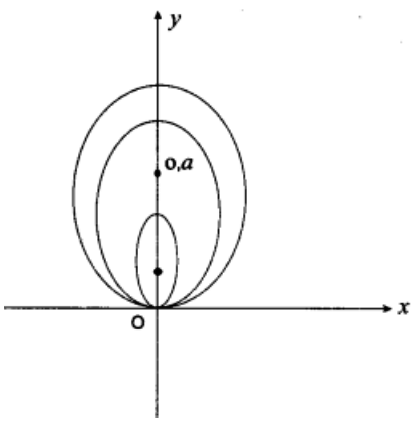
The circles pass through the origin, they have their centers at \[\left( {0,a} \right)\]
The circles have radius.
So, the equation of the family of circles in given by
\[{x^2} + {(y - a)^2} = {a^2}\]
In the above equation, ‘a’ is said to be any arbitrary constant.
\[{x^2} + {y^2} - 2ay + {a^2} = {a^2}\]
\[{x^2} + {y^2} = 2ay \ldots \ldots .(1)\]
As the above equation has only one arbitrary constant, we can obtain first order differential equation:
Differentiating the equation (1) with respect to x
\[2x + 2y\frac{{dy}}{{dx}} = 2a\frac{{dy}}{{dx}}\]
\[ \Rightarrow a = \frac{{x + y\frac{{dy}}{{dx}}}}{{\frac{{dy}}{{dx}}}} \ldots \ldots \ldots \ldots (2)\]
Substituting the value of \[{\rm{a}}\] in equation\[{\rm{2}}\]we get:
\[{x^2} + {\left( {y - y - \frac{x}{{\frac{{dy}}{{dx}}}}} \right)^2} = {\left( {y + \frac{x}{{\frac{{dy}}{{dx}}}}} \right)^2}\]
Solve the square root for the above equation:
\[ \Rightarrow {x^2} + \frac{{{x^2}}}{{{{\left( {\frac{{dy}}{{dx}}} \right)}^2}}} = {y^2} + 2\frac{{xy}}{{\frac{{dy}}{{dx}}}} + \frac{{{x^2}}}{{{{\left( {\frac{{dy}}{{dx}}} \right)}^2}}}\]
Simplify the above equation to make it less complicated:
\[ \Rightarrow {x^2} = {y^2} + 2\frac{{xy}}{{\frac{{dy}}{{dx}}}}\]
Let's restructure the equation above to specifically get \[2xy\] on one side. The result is as follows:
\[ \Rightarrow \left( {{x^2} - {y^2}} \right)\frac{{dy}}{{dx}} = 2xy\]
Therefore, \[\left( {{x^2} - {y^2}} \right)\frac{{dy}}{{dx}} = 2xy\] is the required differential equation of all circles which passes through the origin and whose center lie on \[y\]-axis.
Hence, the option A is correct.
Note:
We should be aware that the centers of all circles touching the x-axis at the origin will be on the y-axis. Given that it reflects the equations of all the circles matching the specified criteria, q is known as an arbitrary constant. We differentiate the equation 'n' times to obtain the values of all arbitrary constants if the equation has 'n' arbitrary constants. Finding the differential equation of the circles that intersect the y-axis at the origin will also likely present challenges.
In order to obtain the circle's resulting equation, we employ the assumption that the circle passes through the origin and only touches the\[y\]-axis there to begin the problem-solving process. Then, in order to determine the values of any arbitrary constants included in the equation, we begin differentiating the acquired equation of circles on both sides with respect to\[y\]. In order to reach the desired result, we then substitute this calculated value for the arbitrary constant into the equation of circles and do the appropriate calculations.
Formula use:
\[y = {x^n}\]
Differentiate with respect to x
\[\frac{{dy}}{{dx}} = n{x^{n-1}}\]
Complete step-by-step solution:
The issue requires us to identify every circle's differential equation that touches the y-axis at the origin.
Let's start by determining the equation of the circle at the origin that touches the x-axis.
The circles pass through the origin, they have their centers at \[\left( {0,a} \right)\]
The circles have radius.
So, the equation of the family of circles in given by
\[{x^2} + {(y - a)^2} = {a^2}\]
In the above equation, ‘a’ is said to be any arbitrary constant.
\[{x^2} + {y^2} - 2ay + {a^2} = {a^2}\]
\[{x^2} + {y^2} = 2ay \ldots \ldots .(1)\]
As the above equation has only one arbitrary constant, we can obtain first order differential equation:
Differentiating the equation (1) with respect to x
\[2x + 2y\frac{{dy}}{{dx}} = 2a\frac{{dy}}{{dx}}\]
\[ \Rightarrow a = \frac{{x + y\frac{{dy}}{{dx}}}}{{\frac{{dy}}{{dx}}}} \ldots \ldots \ldots \ldots (2)\]
Substituting the value of \[{\rm{a}}\] in equation\[{\rm{2}}\]we get:
\[{x^2} + {\left( {y - y - \frac{x}{{\frac{{dy}}{{dx}}}}} \right)^2} = {\left( {y + \frac{x}{{\frac{{dy}}{{dx}}}}} \right)^2}\]
Solve the square root for the above equation:
\[ \Rightarrow {x^2} + \frac{{{x^2}}}{{{{\left( {\frac{{dy}}{{dx}}} \right)}^2}}} = {y^2} + 2\frac{{xy}}{{\frac{{dy}}{{dx}}}} + \frac{{{x^2}}}{{{{\left( {\frac{{dy}}{{dx}}} \right)}^2}}}\]
Simplify the above equation to make it less complicated:
\[ \Rightarrow {x^2} = {y^2} + 2\frac{{xy}}{{\frac{{dy}}{{dx}}}}\]
Let's restructure the equation above to specifically get \[2xy\] on one side. The result is as follows:
\[ \Rightarrow \left( {{x^2} - {y^2}} \right)\frac{{dy}}{{dx}} = 2xy\]
Therefore, \[\left( {{x^2} - {y^2}} \right)\frac{{dy}}{{dx}} = 2xy\] is the required differential equation of all circles which passes through the origin and whose center lie on \[y\]-axis.
Hence, the option A is correct.
Note:
We should be aware that the centers of all circles touching the x-axis at the origin will be on the y-axis. Given that it reflects the equations of all the circles matching the specified criteria, q is known as an arbitrary constant. We differentiate the equation 'n' times to obtain the values of all arbitrary constants if the equation has 'n' arbitrary constants. Finding the differential equation of the circles that intersect the y-axis at the origin will also likely present challenges.
Recently Updated Pages
JEE Main 2023 April 6 Shift 1 Question Paper with Answer Key

JEE Main 2023 April 6 Shift 2 Question Paper with Answer Key
JEE Main 2023 (January 31 Evening Shift) Question Paper with Solutions [PDF]
JEE Main 2023 January 30 Shift 2 Question Paper with Answer Key
JEE Main 2023 January 25 Shift 1 Question Paper with Answer Key
JEE Main 2023 January 24 Shift 2 Question Paper with Answer Key
Trending doubts
JEE Main 2026: Session 2 Registration Open, City Intimation Slip, Exam Dates, Syllabus & Eligibility
JEE Main 2026 Application Login: Direct Link, Registration, Form Fill, and Steps
Understanding the Angle of Deviation in a Prism
Hybridisation in Chemistry – Concept, Types & Applications
How to Convert a Galvanometer into an Ammeter or Voltmeter
Understanding the Electric Field of a Uniformly Charged Ring
Other Pages
JEE Advanced Marks vs Ranks 2025: Understanding Category-wise Qualifying Marks and Previous Year Cut-offs
NCERT Solutions For Class 11 Maths Chapter 12 Limits and Derivatives (2025-26)
NCERT Solutions For Class 11 Maths Chapter 10 Conic Sections (2025-26)
JEE Advanced Weightage 2025 Chapter-Wise for Physics, Maths and Chemistry
Derivation of Equation of Trajectory Explained for Students
Understanding Electromagnetic Waves and Their Importance