




The colour code of a resistor is brown, black and brown. Then the value of resistance is
A. \[10{\text{ }}\Omega \]
B. \[100{\text{ m}}\Omega \]
C. \[0.1{\text{ k}}\Omega \]
D. \[1000{\text{ }}\Omega \]
Answer
 Verified
233.1k+ views
Hint Usually, all the leaded resistors with power ratings up to one watt are very tiny and it is very difficult to print the resistance values on them. That’s why bands of different colours are printed on the resistors to identify its value of resistance. These bands of colours are called resistor colour code.
In the figure given below the codes for different colours is given. For 3 colour bands, the resistance is given by $R = \left( {{\text{1st colour digit}}} \right)\left( {{\text{2nd colour digit}}} \right)\left( {{\text{3rd colour multiplier}}} \right)\Omega $ .
Complete step by step answer
A resistor is an electrical component which when connected in a circuit resists the flow of current through it.
Now let us discuss how colour code is important for the resistors.
Usually, all the leaded resistors with power ratings up to one watt are very tiny and it is very difficult to print the resistance values on them. That’s why bands of different colours are printed on the resistors to identify its value of resistance. These bands of colours are called resistor colour code.
In the figure given below the codes for different colours is given.
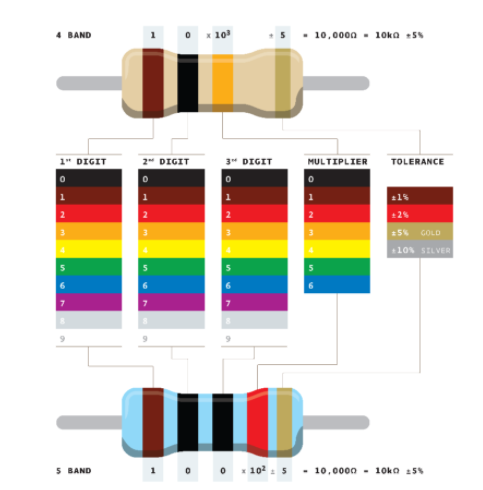
As given in the question that the colour code of the resistor is brown, black and brown and for 3 colour bands, the resistance is given by $R = \left( {{\text{1st colour digit}}} \right)\left( {{\text{2nd colour digit}}} \right)\left( {{\text{3rd colour multiplier}}} \right)\Omega $. The multiplier is the $10$ raised to the power of the digit of that colour.
From the figure we can say that the colour code brown is $1$ and that for black is $0$. Then for the resistor with colour code brown, black and brown will be $10 \times {10^1}{\text{ }}\Omega = 0.1{\text{ k}}\Omega $.
Hence, option C is correct.
Note To read the resistor colour code, hold the resistor in such a way that the tolerance colour band is on the right most side of the rest of the colour bands. The tolerance band is normally silver or gold in colour. Now, note the colours from left to right side. The band which is just before the tolerance band is called the multiplier band. Now, use the table of colour code to find the value of resistance.
The number of colour bands usually varies from three to six in a resistor.
In the figure given below the codes for different colours is given. For 3 colour bands, the resistance is given by $R = \left( {{\text{1st colour digit}}} \right)\left( {{\text{2nd colour digit}}} \right)\left( {{\text{3rd colour multiplier}}} \right)\Omega $ .
Complete step by step answer
A resistor is an electrical component which when connected in a circuit resists the flow of current through it.
Now let us discuss how colour code is important for the resistors.
Usually, all the leaded resistors with power ratings up to one watt are very tiny and it is very difficult to print the resistance values on them. That’s why bands of different colours are printed on the resistors to identify its value of resistance. These bands of colours are called resistor colour code.
In the figure given below the codes for different colours is given.
As given in the question that the colour code of the resistor is brown, black and brown and for 3 colour bands, the resistance is given by $R = \left( {{\text{1st colour digit}}} \right)\left( {{\text{2nd colour digit}}} \right)\left( {{\text{3rd colour multiplier}}} \right)\Omega $. The multiplier is the $10$ raised to the power of the digit of that colour.
From the figure we can say that the colour code brown is $1$ and that for black is $0$. Then for the resistor with colour code brown, black and brown will be $10 \times {10^1}{\text{ }}\Omega = 0.1{\text{ k}}\Omega $.
Hence, option C is correct.
Note To read the resistor colour code, hold the resistor in such a way that the tolerance colour band is on the right most side of the rest of the colour bands. The tolerance band is normally silver or gold in colour. Now, note the colours from left to right side. The band which is just before the tolerance band is called the multiplier band. Now, use the table of colour code to find the value of resistance.
The number of colour bands usually varies from three to six in a resistor.
Recently Updated Pages
JEE Main 2023 April 6 Shift 1 Question Paper with Answer Key

JEE Main 2023 April 6 Shift 2 Question Paper with Answer Key
JEE Main 2023 (January 31 Evening Shift) Question Paper with Solutions [PDF]
JEE Main 2023 January 30 Shift 2 Question Paper with Answer Key
JEE Main 2023 January 25 Shift 1 Question Paper with Answer Key
JEE Main 2023 January 24 Shift 2 Question Paper with Answer Key
Trending doubts
JEE Main 2026: Session 2 Registration Open, City Intimation Slip, Exam Dates, Syllabus & Eligibility
JEE Main 2026 Application Login: Direct Link, Registration, Form Fill, and Steps
Understanding the Angle of Deviation in a Prism
Hybridisation in Chemistry – Concept, Types & Applications
How to Convert a Galvanometer into an Ammeter or Voltmeter
Understanding Uniform Acceleration in Physics
Other Pages
JEE Advanced Marks vs Ranks 2025: Understanding Category-wise Qualifying Marks and Previous Year Cut-offs
Dual Nature of Radiation and Matter Class 12 Physics Chapter 11 CBSE Notes - 2025-26
Understanding the Electric Field of a Uniformly Charged Ring
JEE Advanced Weightage 2025 Chapter-Wise for Physics, Maths and Chemistry
Derivation of Equation of Trajectory Explained for Students
Understanding Electromagnetic Waves and Their Importance