




The capacitance between adjacent plates shown in Fig $20.95(a)$ is 50 nF. A $1\mu C$ charge is placed on the middle plate. Find the charge on the outer surface of upper plate and the potential difference between upper and middle plates:

A. $0.5\mu C,10V$
B. $1\mu C,20V$
C. $0.5 \mu C, 20 V$
D. $1.0\mu ,40V$
Answer
 Verified
232.8k+ views
Solution: Hint: To solve such questions, we must understand the fundamental concept of how a capacitor works. Moreover, we must also predict how the system will react in the presence of an extra charge placed within the system. We should apply the electric field equation to calculate the electric field present in the plate P.
Complete step by step answer:
We can clearly see the distribution of charge in the plates from the diagram given below. From the given diagram, we can determine that,
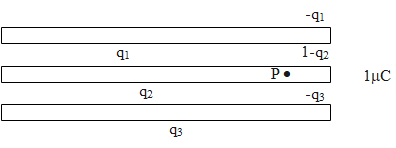
As the electric field inside the plate at p is $\dfrac{1}{2A{{\epsilon}_{0}}}\left[-{{q}_{1}}+q+1-{{q}_{2}}-{{q}_{2}}+{{q}_{3}}-{{q}_{3}} \right]=0$
or $2 \mathrm{q}_{2}=1 \Rightarrow \mathrm{q}_{2}=0.5 \mu \mathrm{C}$
Here we note that,
$q_{1}=-\left(1-q_{2}\right)=-(1-0.5)=-0.5 \mu C$
Thus, we can calculate the charge on the outer surface of the upper plate as $-q_{1}=0.5 \mu C$.
Therefore, the potential difference between upper and middle plates is observed to be $\text{V}=\dfrac{{{q}_{1}}}{\text{V}}=\dfrac{0.5\times {{10}^{-6}}}{50\times {{10}^{-9}}}=10\text{V}$.
Hence, the correct answer is Option A.
Note: Long before batteries, capacitors were used to store charge. Even nowadays, capacitors are a better alternative to batteries because of ease in control of the charge flow. Capacitors tend to discharge quickly which is its greatest disadvantage.
Complete step by step answer:
We can clearly see the distribution of charge in the plates from the diagram given below. From the given diagram, we can determine that,
As the electric field inside the plate at p is $\dfrac{1}{2A{{\epsilon}_{0}}}\left[-{{q}_{1}}+q+1-{{q}_{2}}-{{q}_{2}}+{{q}_{3}}-{{q}_{3}} \right]=0$
or $2 \mathrm{q}_{2}=1 \Rightarrow \mathrm{q}_{2}=0.5 \mu \mathrm{C}$
Here we note that,
$q_{1}=-\left(1-q_{2}\right)=-(1-0.5)=-0.5 \mu C$
Thus, we can calculate the charge on the outer surface of the upper plate as $-q_{1}=0.5 \mu C$.
Therefore, the potential difference between upper and middle plates is observed to be $\text{V}=\dfrac{{{q}_{1}}}{\text{V}}=\dfrac{0.5\times {{10}^{-6}}}{50\times {{10}^{-9}}}=10\text{V}$.
Hence, the correct answer is Option A.
Note: Long before batteries, capacitors were used to store charge. Even nowadays, capacitors are a better alternative to batteries because of ease in control of the charge flow. Capacitors tend to discharge quickly which is its greatest disadvantage.
Recently Updated Pages
JEE Main 2023 April 6 Shift 1 Question Paper with Answer Key

JEE Main 2023 April 6 Shift 2 Question Paper with Answer Key
JEE Main 2023 (January 31 Evening Shift) Question Paper with Solutions [PDF]
JEE Main 2023 January 30 Shift 2 Question Paper with Answer Key
JEE Main 2023 January 25 Shift 1 Question Paper with Answer Key
JEE Main 2023 January 24 Shift 2 Question Paper with Answer Key
Trending doubts
JEE Main 2026: Session 2 Registration Open, City Intimation Slip, Exam Dates, Syllabus & Eligibility
JEE Main 2026 Application Login: Direct Link, Registration, Form Fill, and Steps
Understanding the Angle of Deviation in a Prism
Hybridisation in Chemistry – Concept, Types & Applications
How to Convert a Galvanometer into an Ammeter or Voltmeter
Understanding Uniform Acceleration in Physics
Other Pages
JEE Advanced Marks vs Ranks 2025: Understanding Category-wise Qualifying Marks and Previous Year Cut-offs
Dual Nature of Radiation and Matter Class 12 Physics Chapter 11 CBSE Notes - 2025-26
Understanding the Electric Field of a Uniformly Charged Ring
JEE Advanced Weightage 2025 Chapter-Wise for Physics, Maths and Chemistry
Derivation of Equation of Trajectory Explained for Students
Understanding Electromagnetic Waves and Their Importance