




Where the object should be placed to get the virtual image in the case of a convex lens?
A) Object should be placed between ${\text{ F }}$and ${\text{ 2F }}.$
B) Object should be placed between ${\text{ F }}$and ${\text{ O }}.$
C) The object should be placed beyond ${\text{ 2F }}.$
D) The object should be placed at ${\text{ O }}.$
Answer
 Verified
232.8k+ views
Hint: A transparent medium bounded by two surfaces with at least one spherical surface is called a lens. A lens that converges the light beam passing through it is called a convex lens or a converging lens. The light rays approaching the lens will be refracted after passing through the lens. The refraction will depend on the angle of incidence.
Complete step by step solution:
In a convex lens, the image formation will depend on the distance between the object and the optic centre of the lens. The image will be virtual, erect, and magnified when the object is placed between the focus of the lens and the optic centre of the lens. The image is formed on the same side of the lens where the object is placed. The ray diagram for image formation is given below.
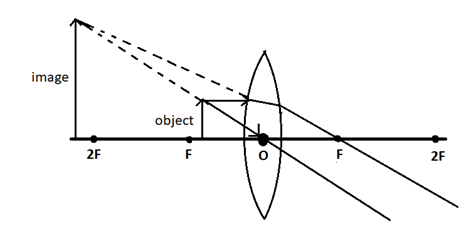
We are considering two rays starting from the top of the object. One of the rays is refracted and will pass through the second focus (the focus on the opposite side of the object). The second ray will be passing through the optic centre of the lens without being refracted. Both rays will not cross their paths. But we will get our virtual image by joining the rays by extending them backwards as shown in the ray diagram.
The answer is Option (B): Object placed between ${\text{ F }}$and ${\text{ O }}.$
Note: The point on the principal axis where all the incident rays converge is called the focal point or the focus. If a ray of light is incident on a lens in such a way that the emerging ray and the incident ray are parallel, the path of the ray will be cutting a particular point on the principal axis and that point is called the optic centre of the lens. The rays passing through the optic centre will not be refracted.
Complete step by step solution:
In a convex lens, the image formation will depend on the distance between the object and the optic centre of the lens. The image will be virtual, erect, and magnified when the object is placed between the focus of the lens and the optic centre of the lens. The image is formed on the same side of the lens where the object is placed. The ray diagram for image formation is given below.
We are considering two rays starting from the top of the object. One of the rays is refracted and will pass through the second focus (the focus on the opposite side of the object). The second ray will be passing through the optic centre of the lens without being refracted. Both rays will not cross their paths. But we will get our virtual image by joining the rays by extending them backwards as shown in the ray diagram.
The answer is Option (B): Object placed between ${\text{ F }}$and ${\text{ O }}.$
Note: The point on the principal axis where all the incident rays converge is called the focal point or the focus. If a ray of light is incident on a lens in such a way that the emerging ray and the incident ray are parallel, the path of the ray will be cutting a particular point on the principal axis and that point is called the optic centre of the lens. The rays passing through the optic centre will not be refracted.
Recently Updated Pages
JEE Main 2023 April 6 Shift 1 Question Paper with Answer Key

JEE Main 2023 April 6 Shift 2 Question Paper with Answer Key
JEE Main 2023 (January 31 Evening Shift) Question Paper with Solutions [PDF]
JEE Main 2023 January 30 Shift 2 Question Paper with Answer Key
JEE Main 2023 January 25 Shift 1 Question Paper with Answer Key
JEE Main 2023 January 24 Shift 2 Question Paper with Answer Key
Trending doubts
JEE Main 2026: Session 2 Registration Open, City Intimation Slip, Exam Dates, Syllabus & Eligibility
JEE Main 2026 Application Login: Direct Link, Registration, Form Fill, and Steps
Understanding the Angle of Deviation in a Prism
Hybridisation in Chemistry – Concept, Types & Applications
How to Convert a Galvanometer into an Ammeter or Voltmeter
Understanding Uniform Acceleration in Physics
Other Pages
JEE Advanced Marks vs Ranks 2025: Understanding Category-wise Qualifying Marks and Previous Year Cut-offs
Dual Nature of Radiation and Matter Class 12 Physics Chapter 11 CBSE Notes - 2025-26
Understanding the Electric Field of a Uniformly Charged Ring
JEE Advanced Weightage 2025 Chapter-Wise for Physics, Maths and Chemistry
Derivation of Equation of Trajectory Explained for Students
Understanding Electromagnetic Waves and Their Importance