




In the circuit shown figure, $R = \sqrt {\dfrac{L}{C}} $ the switch S is closed at time $t = 0$. The current through the capacitor and inductor will be equal at time $t$ equal to:
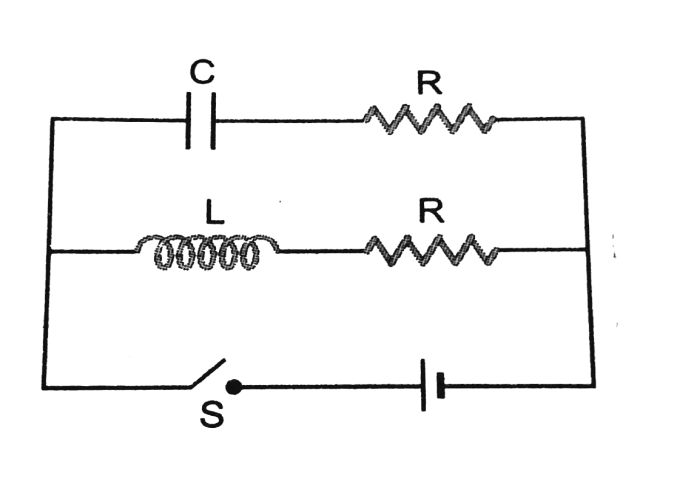
A) $CR$
B) $CR\log 2$
C) $\dfrac{L}{{R\log 2}}$
D) $LR$
Answer
 Verified
232.8k+ views
Hint: A RLC circuit is an electrical circuit consisting of a resistor, an inductor, and a capacitor, associated in arrangement or in equal. A significant property of this circuit is its capacity to resonate at a particular frequency, the reverberation/resonance recurrence. Right now the impedances of the inductor and capacitor at reverberation are equivalent yet of inverse sign and counteract.
Complete step by step solution:
A RLC circuit is an electrical circuit consisting of a resistor, an inductor, and a capacitor, associated in series or in equal parallel. The circuit shapes a consonant oscillator for current, and resounds likewise as a LC circuit. Presenting the resistor expands the rot of these motions, which is otherwise called damping. The resistor additionally diminishes the pinnacle resounding recurrence.
A significant property of this circuit is its capacity to resonate at a particular frequency, the reverberation/resonance recurrence. Reverberation happens on the grounds that energy for this circumstance is put away in two unique manners: in an electric field as the capacitor is charged and in an attractive/magnetic field as flow courses through the inductor. The reverberation recurrence is characterized as the recurrence at which the impedance of the circuit is at least. Proportionately, it tends to be characterized as the recurrence at which the impedance is simply genuine (that is, absolutely resistive). This happens on the grounds that the impedances of the inductor and capacitor at reverberation are equivalent however of inverse sign and counterbalance.
$\therefore {I_C} = {I_L}$
As we know
${I_C}$ = $\dfrac{V}{R}e^{\dfrac{ - t}{RC}}$ and ${I_L}$ = ${\dfrac{V}{R}}({1 - e^{\dfrac{-Rt}{L}}})$
Insert these in above equation
$ \Rightarrow \dfrac{V}{R}e^{\dfrac{ - t}{RC}}$ = ${\dfrac{V}{R}}({1-e^{\dfrac{-Rt}{L}}})$ ……..(1)
But $R = \sqrt {\dfrac{L}{C}} $
$ \Rightarrow {R^2} = \dfrac{L}{C} \Rightarrow RC = \dfrac{L}{R}$
Put the values in equation in (1)
Collect like terms
$ \Rightarrow 2{{{e}}^{\dfrac{{{{ - t}}}}{{{{RC}}}}}}{{ = 1}}$
Therefore,
$ \Rightarrow {{{e}}^{\dfrac{{{{ - t}}}}{{{{RC}}}}}}{{ = }}\dfrac{1}{2}$
At last
$ \Rightarrow t = RC\log 2$
Hence option (B) is correct.
Note: A significant property of RLC circuit is its capacity to resonate at a particular frequency, the reverberation/resonance recurrence. Right now the impedances of the inductor and capacitor at reverberation are equivalent yet of inverse sign and counteract. So remember the above fact.
$ \Rightarrow {{{e}}^{\dfrac{{{{ - t}}}}{{{{RC}}}}}}{{ = 1 - }}{{{e}}^{\dfrac{{{t}}}{{RC}}}}.$
Complete step by step solution:
A RLC circuit is an electrical circuit consisting of a resistor, an inductor, and a capacitor, associated in series or in equal parallel. The circuit shapes a consonant oscillator for current, and resounds likewise as a LC circuit. Presenting the resistor expands the rot of these motions, which is otherwise called damping. The resistor additionally diminishes the pinnacle resounding recurrence.
A significant property of this circuit is its capacity to resonate at a particular frequency, the reverberation/resonance recurrence. Reverberation happens on the grounds that energy for this circumstance is put away in two unique manners: in an electric field as the capacitor is charged and in an attractive/magnetic field as flow courses through the inductor. The reverberation recurrence is characterized as the recurrence at which the impedance of the circuit is at least. Proportionately, it tends to be characterized as the recurrence at which the impedance is simply genuine (that is, absolutely resistive). This happens on the grounds that the impedances of the inductor and capacitor at reverberation are equivalent however of inverse sign and counterbalance.
$\therefore {I_C} = {I_L}$
As we know
${I_C}$ = $\dfrac{V}{R}e^{\dfrac{ - t}{RC}}$ and ${I_L}$ = ${\dfrac{V}{R}}({1 - e^{\dfrac{-Rt}{L}}})$
Insert these in above equation
$ \Rightarrow \dfrac{V}{R}e^{\dfrac{ - t}{RC}}$ = ${\dfrac{V}{R}}({1-e^{\dfrac{-Rt}{L}}})$ ……..(1)
But $R = \sqrt {\dfrac{L}{C}} $
$ \Rightarrow {R^2} = \dfrac{L}{C} \Rightarrow RC = \dfrac{L}{R}$
Put the values in equation in (1)
Collect like terms
$ \Rightarrow 2{{{e}}^{\dfrac{{{{ - t}}}}{{{{RC}}}}}}{{ = 1}}$
Therefore,
$ \Rightarrow {{{e}}^{\dfrac{{{{ - t}}}}{{{{RC}}}}}}{{ = }}\dfrac{1}{2}$
At last
$ \Rightarrow t = RC\log 2$
Hence option (B) is correct.
Note: A significant property of RLC circuit is its capacity to resonate at a particular frequency, the reverberation/resonance recurrence. Right now the impedances of the inductor and capacitor at reverberation are equivalent yet of inverse sign and counteract. So remember the above fact.
$ \Rightarrow {{{e}}^{\dfrac{{{{ - t}}}}{{{{RC}}}}}}{{ = 1 - }}{{{e}}^{\dfrac{{{t}}}{{RC}}}}.$
Recently Updated Pages
JEE Main 2023 April 6 Shift 1 Question Paper with Answer Key

JEE Main 2023 April 6 Shift 2 Question Paper with Answer Key
JEE Main 2023 (January 31 Evening Shift) Question Paper with Solutions [PDF]
JEE Main 2023 January 30 Shift 2 Question Paper with Answer Key
JEE Main 2023 January 25 Shift 1 Question Paper with Answer Key
JEE Main 2023 January 24 Shift 2 Question Paper with Answer Key
Trending doubts
JEE Main 2026: Session 2 Registration Open, City Intimation Slip, Exam Dates, Syllabus & Eligibility
JEE Main 2026 Application Login: Direct Link, Registration, Form Fill, and Steps
Understanding the Angle of Deviation in a Prism
Hybridisation in Chemistry – Concept, Types & Applications
How to Convert a Galvanometer into an Ammeter or Voltmeter
Understanding Uniform Acceleration in Physics
Other Pages
JEE Advanced Marks vs Ranks 2025: Understanding Category-wise Qualifying Marks and Previous Year Cut-offs
Dual Nature of Radiation and Matter Class 12 Physics Chapter 11 CBSE Notes - 2025-26
Understanding the Electric Field of a Uniformly Charged Ring
JEE Advanced Weightage 2025 Chapter-Wise for Physics, Maths and Chemistry
Derivation of Equation of Trajectory Explained for Students
Understanding Electromagnetic Waves and Their Importance