




In a galvanometer, the deflection becomes one-half when the galvanometer is shunted by a \[20\Omega \] resistor. The galvanometer resistance is
A. \[5\Omega \]
B. \[10\Omega \]
C. \[40\Omega \]
D. \[20\Omega \]
Answer
 Verified
232.8k+ views
Hint:hunt is generated by a resistor with an extremely low resistance value linked in parallel with another resistor. A shunt resistance can be used to broaden the range of an ammeter's readings. In the galvanometer, the shunt is used to measure the big current.
Formula Used:
The ohm’s law formula is used to calculate the resistance of the galvanometer is as follows:
\[I = \dfrac{V}{R}\]
Here, \[I\] is current, \[V\] is voltage, and \[R\] is resistance.
Complete step by step solution:
If the temperature and other physical variables stay constant, Ohm's Law asserts that the current flowing across a conductor is proportional to the potential difference applied across its ends.
Through a resistor, a current is proportional to voltage difference. In that instance, if the current doubles, the voltage doubles as well. A voltage must be applied across a resistance for current to flow through it. From the ohm’s law, we can calculate the voltage by using the equation as follows:
\[V = IR\]
Here, the current is divided but the voltage remains unchanged. From the above equation, we can say that
\[{I_1}{R_1} = {I_2}{R_2}\]
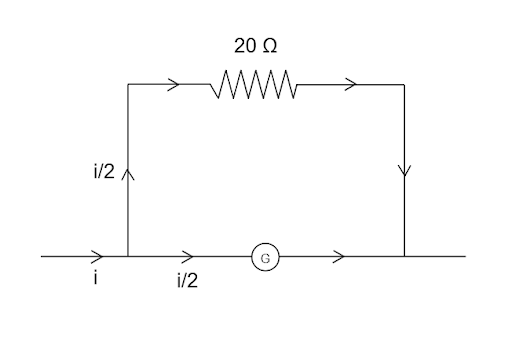
From the given diagram,
Current passing through resistor, \[{I_1} = \dfrac{i}{2}\]
Current passing through galvanometer,\[{I_2} = \dfrac{i}{2}\] \[\]
Resistance of resistor, \[{R_1} = 20\Omega \]
Resistance of galvanometer,\[{R_2} = R\]
Substitute the value as follows:
\[\dfrac{i}{2} \times 20\Omega = \dfrac{i}{2} \times R \\
\therefore R = 20\Omega \\ \]
The galvanometer resistance in the given circuit is \[20\Omega \].
Therefore, the correct answer is option D.
Additional Information: The empirical law known as Ohm's law asserts that current is proportional to the electric field in its most general form. However, this generalisation does not apply to all materials. In the presence of a very strong electric field, some materials can break down, but in the presence of modest electric fields, some materials do not obey this law.
Note:Because unilateral electrical elements like diodes and transistors only allow current to flow in one way, Ohm's law does not apply to them. The ratio of voltage and current will not be constant concerning time for non-linear electrical elements with properties such as capacitance, resistance, and so on, making Ohm's law difficult to apply.
Formula Used:
The ohm’s law formula is used to calculate the resistance of the galvanometer is as follows:
\[I = \dfrac{V}{R}\]
Here, \[I\] is current, \[V\] is voltage, and \[R\] is resistance.
Complete step by step solution:
If the temperature and other physical variables stay constant, Ohm's Law asserts that the current flowing across a conductor is proportional to the potential difference applied across its ends.
Through a resistor, a current is proportional to voltage difference. In that instance, if the current doubles, the voltage doubles as well. A voltage must be applied across a resistance for current to flow through it. From the ohm’s law, we can calculate the voltage by using the equation as follows:
\[V = IR\]
Here, the current is divided but the voltage remains unchanged. From the above equation, we can say that
\[{I_1}{R_1} = {I_2}{R_2}\]
From the given diagram,
Current passing through resistor, \[{I_1} = \dfrac{i}{2}\]
Current passing through galvanometer,\[{I_2} = \dfrac{i}{2}\] \[\]
Resistance of resistor, \[{R_1} = 20\Omega \]
Resistance of galvanometer,\[{R_2} = R\]
Substitute the value as follows:
\[\dfrac{i}{2} \times 20\Omega = \dfrac{i}{2} \times R \\
\therefore R = 20\Omega \\ \]
The galvanometer resistance in the given circuit is \[20\Omega \].
Therefore, the correct answer is option D.
Additional Information: The empirical law known as Ohm's law asserts that current is proportional to the electric field in its most general form. However, this generalisation does not apply to all materials. In the presence of a very strong electric field, some materials can break down, but in the presence of modest electric fields, some materials do not obey this law.
Note:Because unilateral electrical elements like diodes and transistors only allow current to flow in one way, Ohm's law does not apply to them. The ratio of voltage and current will not be constant concerning time for non-linear electrical elements with properties such as capacitance, resistance, and so on, making Ohm's law difficult to apply.
Recently Updated Pages
JEE Main 2023 April 6 Shift 1 Question Paper with Answer Key

JEE Main 2023 April 6 Shift 2 Question Paper with Answer Key
JEE Main 2023 (January 31 Evening Shift) Question Paper with Solutions [PDF]
JEE Main 2023 January 30 Shift 2 Question Paper with Answer Key
JEE Main 2023 January 25 Shift 1 Question Paper with Answer Key
JEE Main 2023 January 24 Shift 2 Question Paper with Answer Key
Trending doubts
JEE Main 2026: Session 2 Registration Open, City Intimation Slip, Exam Dates, Syllabus & Eligibility
JEE Main 2026 Application Login: Direct Link, Registration, Form Fill, and Steps
JEE Main Marking Scheme 2026- Paper-Wise Marks Distribution and Negative Marking Details
Understanding the Angle of Deviation in a Prism
Hybridisation in Chemistry – Concept, Types & Applications
How to Convert a Galvanometer into an Ammeter or Voltmeter
Other Pages
JEE Advanced Marks vs Ranks 2025: Understanding Category-wise Qualifying Marks and Previous Year Cut-offs
Dual Nature of Radiation and Matter Class 12 Physics Chapter 11 CBSE Notes - 2025-26
Understanding Uniform Acceleration in Physics
Understanding the Electric Field of a Uniformly Charged Ring
JEE Advanced Weightage 2025 Chapter-Wise for Physics, Maths and Chemistry
Derivation of Equation of Trajectory Explained for Students