




If the points (0,1,2), (2,-1,3) and (1,-3,1) are the vertices of a triangle, then the triangle is
A. Right-angled
B. Isosceles right-angled
C. Equilateral
D. None of these
Answer
 Verified
233.1k+ views
Hint: Sketch a diagram and then find the distance between all three points using the distance formula given two points $P({x_1},{y_1},{z_1})\,{\text{and }}Q({x_2},{y_2},{z_2})$: \[{\text{distance}}\, = \sqrt {{{({x_1} - {x_2})}^2} + {{({y_1} - {y_2})}^2} + {{({z_1} - {z_2})}^2}} \]. Square the distances and use the Pythagoras Theorem to check whether it is a right-angled triangle.
Formula Used:
If two points $P({x_1},{y_1},{z_1})\,{\text{and }}Q({x_2},{y_2},{z_2})$ then \[PQ = \sqrt {{{({x_1} - {x_2})}^2} + {{({y_1} - {y_2})}^2} + {{({z_1} - {z_2})}^2}}\]
Pythagoras Theorem: $H^2 = B^2 + P^2$
Complete Step by step solution:
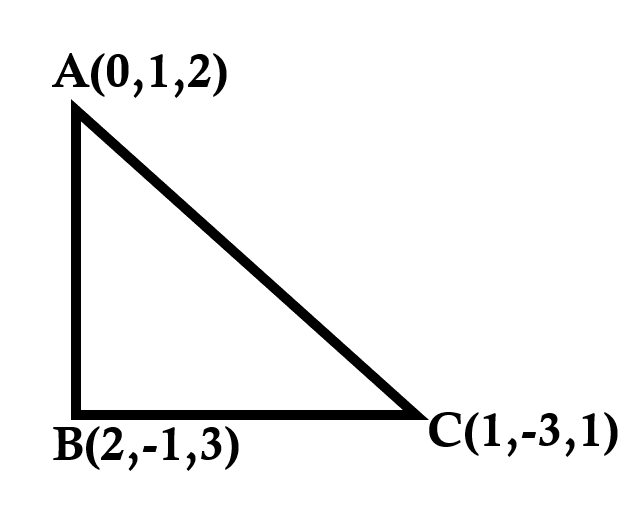
Image: Triangle ABC
Let A be (0,1,2), B be (2,-1,3) and C be (1,-3,1). Let us now find the distances AB, BC, and CA using the distance formula.
Given two points $P({x_1},{y_1},{z_1})\,{\text{and }}Q({x_2},{y_2},{z_2})$ the distance PQ is found using the following formula:
\[{\text{distance}}\, = \sqrt {{{({x_1} - {x_2})}^2} + {{({y_1} - {y_2})}^2} + {{({z_1} - {z_2})}^2}} \].
$AB = \sqrt {{{(0 - 2)}^2} + {{(1 - ( - 1))}^2} + {{(2 - 3)}^2}} = \sqrt {4 + 4 + 1} = \sqrt 9 = 3\,units$
$BC = \sqrt {{{(1 - 2)}^2} + {{( - 3 - ( - 1))}^2} + {{(1 - 3)}^2}} = \sqrt {1 + 4 + 4} = \sqrt 9 = 3\,units$
$CA = \sqrt {{{(0 - 1)}^2} + {{(1 - ( - 3))}^2} + {{(2 - 1)}^2}} = \sqrt {1 + 16 + 1} = \sqrt {18} = 3\sqrt 2 \,units$
$A{B^2} = 9\,unit{s^2}$, $B{C^2} = 9\,unit{s^2}$ and $C{A^2} = 18\,unit{s^2}$
We can see that \[A{B^2} + B{C^2} = C{A^2}\]
From the converse of Pythagoras Theorem, we can say that this is a right-angled triangle.
It is an isosceles right-angled triangle as it has two sides equal and one right angle.
Therefore, option (B) Isosceles right-angled is the correct option.
Note: The converse of Pythagoras theorem states that if the sum of squares of two sides of a triangle is equal to the square of the third side, then the triangle is a right-angled triangle. AB cannot be -3 units as it is distance and distance cannot be negative.
Formula Used:
If two points $P({x_1},{y_1},{z_1})\,{\text{and }}Q({x_2},{y_2},{z_2})$ then \[PQ = \sqrt {{{({x_1} - {x_2})}^2} + {{({y_1} - {y_2})}^2} + {{({z_1} - {z_2})}^2}}\]
Pythagoras Theorem: $H^2 = B^2 + P^2$
Complete Step by step solution:
Image: Triangle ABC
Let A be (0,1,2), B be (2,-1,3) and C be (1,-3,1). Let us now find the distances AB, BC, and CA using the distance formula.
Given two points $P({x_1},{y_1},{z_1})\,{\text{and }}Q({x_2},{y_2},{z_2})$ the distance PQ is found using the following formula:
\[{\text{distance}}\, = \sqrt {{{({x_1} - {x_2})}^2} + {{({y_1} - {y_2})}^2} + {{({z_1} - {z_2})}^2}} \].
$AB = \sqrt {{{(0 - 2)}^2} + {{(1 - ( - 1))}^2} + {{(2 - 3)}^2}} = \sqrt {4 + 4 + 1} = \sqrt 9 = 3\,units$
$BC = \sqrt {{{(1 - 2)}^2} + {{( - 3 - ( - 1))}^2} + {{(1 - 3)}^2}} = \sqrt {1 + 4 + 4} = \sqrt 9 = 3\,units$
$CA = \sqrt {{{(0 - 1)}^2} + {{(1 - ( - 3))}^2} + {{(2 - 1)}^2}} = \sqrt {1 + 16 + 1} = \sqrt {18} = 3\sqrt 2 \,units$
$A{B^2} = 9\,unit{s^2}$, $B{C^2} = 9\,unit{s^2}$ and $C{A^2} = 18\,unit{s^2}$
We can see that \[A{B^2} + B{C^2} = C{A^2}\]
From the converse of Pythagoras Theorem, we can say that this is a right-angled triangle.
It is an isosceles right-angled triangle as it has two sides equal and one right angle.
Therefore, option (B) Isosceles right-angled is the correct option.
Note: The converse of Pythagoras theorem states that if the sum of squares of two sides of a triangle is equal to the square of the third side, then the triangle is a right-angled triangle. AB cannot be -3 units as it is distance and distance cannot be negative.
Recently Updated Pages
JEE Main 2023 April 6 Shift 1 Question Paper with Answer Key

JEE Main 2023 April 6 Shift 2 Question Paper with Answer Key
JEE Main 2023 (January 31 Evening Shift) Question Paper with Solutions [PDF]
JEE Main 2023 January 30 Shift 2 Question Paper with Answer Key
JEE Main 2023 January 25 Shift 1 Question Paper with Answer Key
JEE Main 2023 January 24 Shift 2 Question Paper with Answer Key
Trending doubts
JEE Main 2026: Session 2 Registration Open, City Intimation Slip, Exam Dates, Syllabus & Eligibility
JEE Main 2026 Application Login: Direct Link, Registration, Form Fill, and Steps
Understanding the Angle of Deviation in a Prism
Hybridisation in Chemistry – Concept, Types & Applications
How to Convert a Galvanometer into an Ammeter or Voltmeter
Understanding the Electric Field of a Uniformly Charged Ring
Other Pages
JEE Advanced Marks vs Ranks 2025: Understanding Category-wise Qualifying Marks and Previous Year Cut-offs
JEE Advanced Weightage 2025 Chapter-Wise for Physics, Maths and Chemistry
Derivation of Equation of Trajectory Explained for Students
Understanding Electromagnetic Waves and Their Importance
Understanding How a Current Loop Acts as a Magnetic Dipole
Understanding Average and RMS Value in Electrical Circuits