




Gabriel phthalimide synthesis is used in the preparation of primary amine from phthalimide. Which of the following reagent is not used during the process?
A. $HCl$
B. $NaOH$
C. Alkyl halides
D. $KOH$
Answer
 Verified
658.5k+ views
Hint: In this reaction phthalimide is treated with ethanolic potassium hydroxide to form its potassium salt which is then heated with alkyl halide, followed by alkaline hydrolysis producing the final product.
Complete step by step answer:
-We all know that this reaction is used for the formation of primary amines from primary alkyl halides.
-It is an important method for production of pure primary amines because secondary and tertiary amines are not formed in this process.
-To see the reagents involved in this reaction first we need to see the entire reaction step by step.
-To begin with it is a 3 step reaction:
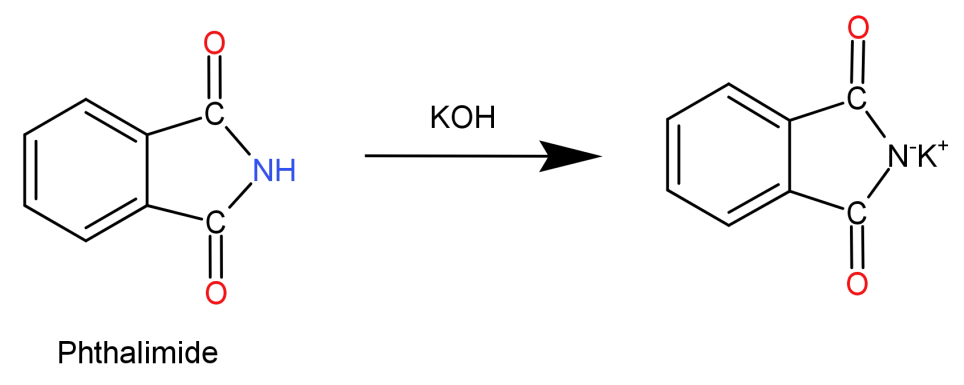
Step 1) In this step an acid base reaction is initiated by reaction of phthalimide with potassium hydroxide ($KOH$). Imide is deprotonated by the hydroxide ion. This forms a potassium salt of phthalimide (imide ion) which is nucleophilic in nature.
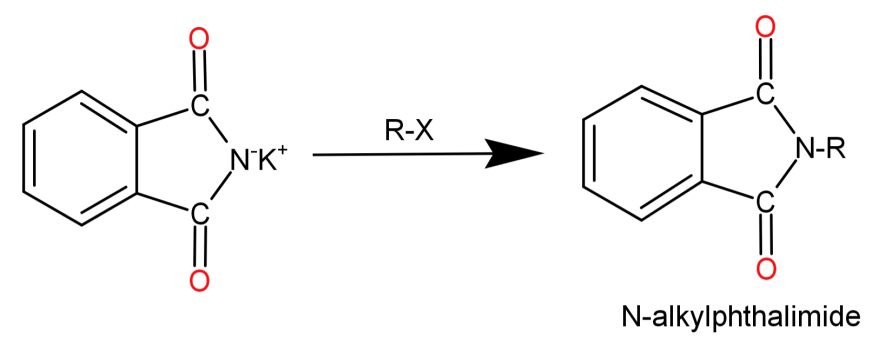
Step 2) Then the obtained imide ion is now treated with alkyl halide ($R - X$).The electrophilic carbon of the alkyl halide is attacked by the nucleophilic imide. Halogen atom of the alkyl halide is removed and replaced by the nitrogen atom which bonds with the carbon itself. N-Alkyl Phthalimide is formed as the product.
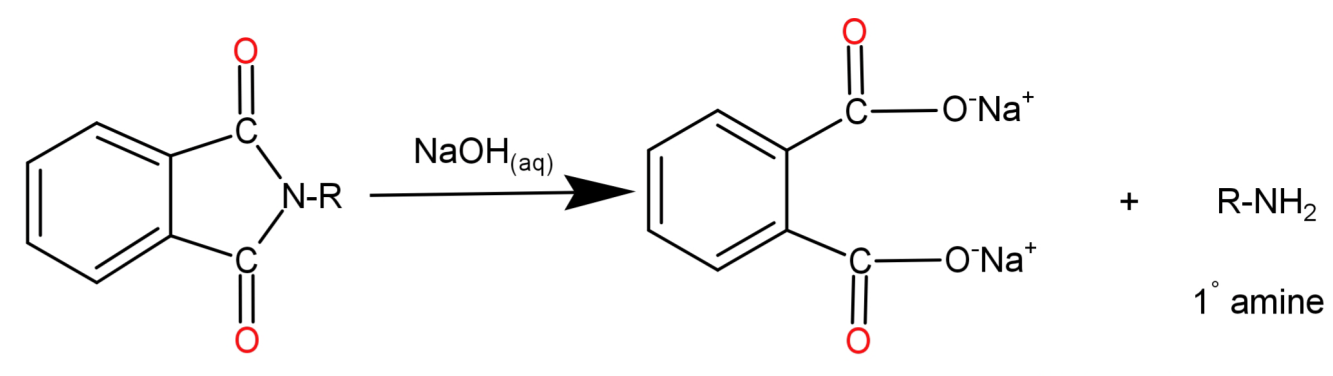
Step 3) The final step is of alkaline hydrolysis: In this step N-alkyl phthalimide undergoes alkaline hydrolysis by reaction with aqueous Sodium Hydroxide ($NaO{H_{(aq)}}$ ). The hydroxide ion from Sodium hydroxide reacts with the carbon atom from the alkyl group causing the cleavage of N-Alkyl Phthalimide and the cation attaches itself to the oxygen atom. When the oxygen atom replaces the nitrogen in phthalimide the ejected hydrogen ions get attached to the nitrogen which was already attached to the alkyl (R) group.
-We have now seen that:
$NaOH$ is used in step 3 during alkaline hydrolysis;
Alkyl halide ($R - X$) is used in step 2 where it reacts with the imide ion to form N-alkyl phthalimide;
$KOH$ is used in step 1 where it reacts with phthalimide to form a potassium salt of phthalimide;
But $HCl$ has not been used anywhere.
So, the correct option is: A) $HCl$ .
Note:
From this reaction only primary aliphatic amines can be formed and not aromatic primary amines. This is so because aryl halides do not undergo the nucleophilic substitution reaction with the anion formed by phthalimide but alkyl halide does.
Complete step by step answer:
-We all know that this reaction is used for the formation of primary amines from primary alkyl halides.
-It is an important method for production of pure primary amines because secondary and tertiary amines are not formed in this process.
-To see the reagents involved in this reaction first we need to see the entire reaction step by step.
-To begin with it is a 3 step reaction:
Step 1) In this step an acid base reaction is initiated by reaction of phthalimide with potassium hydroxide ($KOH$). Imide is deprotonated by the hydroxide ion. This forms a potassium salt of phthalimide (imide ion) which is nucleophilic in nature.
Step 2) Then the obtained imide ion is now treated with alkyl halide ($R - X$).The electrophilic carbon of the alkyl halide is attacked by the nucleophilic imide. Halogen atom of the alkyl halide is removed and replaced by the nitrogen atom which bonds with the carbon itself. N-Alkyl Phthalimide is formed as the product.
Step 3) The final step is of alkaline hydrolysis: In this step N-alkyl phthalimide undergoes alkaline hydrolysis by reaction with aqueous Sodium Hydroxide ($NaO{H_{(aq)}}$ ). The hydroxide ion from Sodium hydroxide reacts with the carbon atom from the alkyl group causing the cleavage of N-Alkyl Phthalimide and the cation attaches itself to the oxygen atom. When the oxygen atom replaces the nitrogen in phthalimide the ejected hydrogen ions get attached to the nitrogen which was already attached to the alkyl (R) group.
-We have now seen that:
$NaOH$ is used in step 3 during alkaline hydrolysis;
Alkyl halide ($R - X$) is used in step 2 where it reacts with the imide ion to form N-alkyl phthalimide;
$KOH$ is used in step 1 where it reacts with phthalimide to form a potassium salt of phthalimide;
But $HCl$ has not been used anywhere.
So, the correct option is: A) $HCl$ .
Note:
From this reaction only primary aliphatic amines can be formed and not aromatic primary amines. This is so because aryl halides do not undergo the nucleophilic substitution reaction with the anion formed by phthalimide but alkyl halide does.
Recently Updated Pages
Which of the following graphs shows the variation of class 12 physics CBSE

Draw a labelled diagram of the human male reproductive class 12 biology CBSE
Describe the experiment to compare the emf of two cells class 12 physics CBSE
What is standard hydrogen electrode
What is conventional current and electric current class 12 physics CBSE
2Bromopentane is treated with an alcoholic KOH solution class 12 chemistry CBSE
Trending doubts
Draw a labelled sketch of the human eye class 12 physics CBSE
Which are the Top 10 Largest Countries of the World?
A member of Simon commission later became Prime Minister class 12 social science CBSE
Draw ray diagrams each showing i myopic eye and ii class 12 physics CBSE
Give one example of a reptile that is viviparous class 12 biology CBSE
Which is the correct genotypic ratio of mendel dihybrid class 12 biology CBSE