




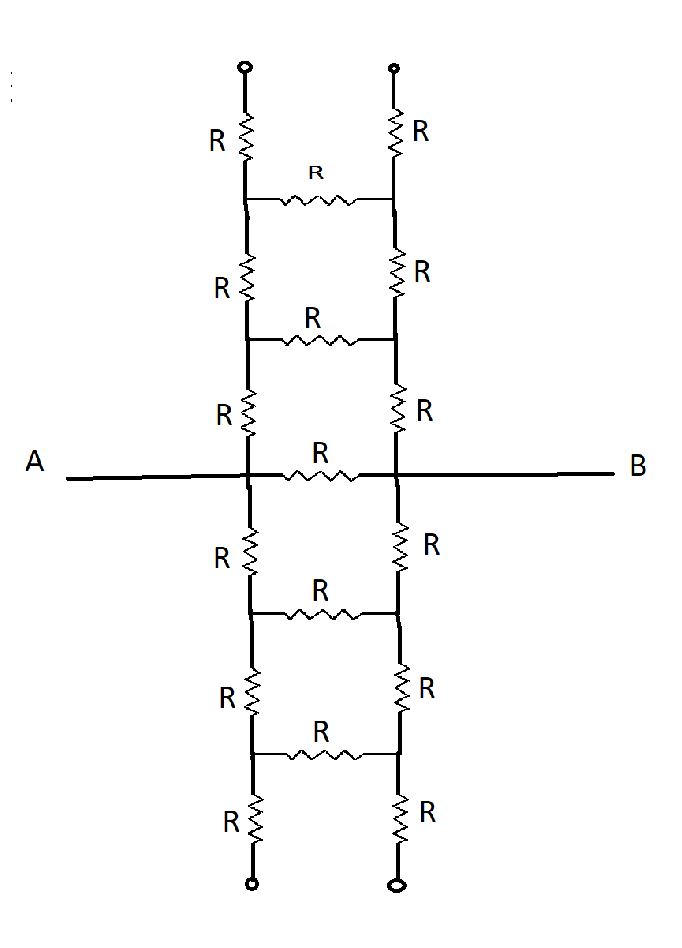
Find the total resistance across AB. Given R=$160\sqrt 3 \Omega $.
Answer
 Verified
233.1k+ views
Hint: 1. This is the recurring circuit where resistance keeps on increasing from the two ends.
2. In series connection the current flows through one resistance then through other resistance hence the total resistance is the sum of both.
3. In a parallel connection, an equivalent Connection is given by \[\dfrac{1}{{{R_{eq}}}} = \dfrac{1}{{{R_{}}}} + \dfrac{1}{{{R_2}}}\].
Complete step by step solution:
Here we need to find the equivalent resistance across A and B
Here we can see that the resistance circuit is symmetrical to AB
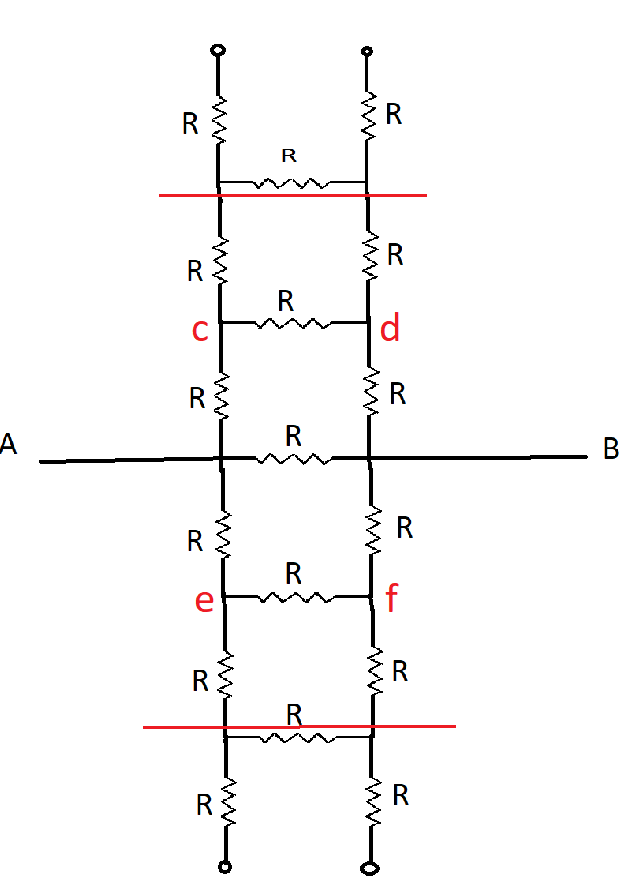
Here we can see that the circuit is infinite and repeats itself above (cd)and below (ef)
The top three resistance marked above the red line are taken as ${R_{eq}}$ the same case is at the bottom also and their values will also be the same, so we substitute ${R_{eq}}$in place of them. So now our image looks like
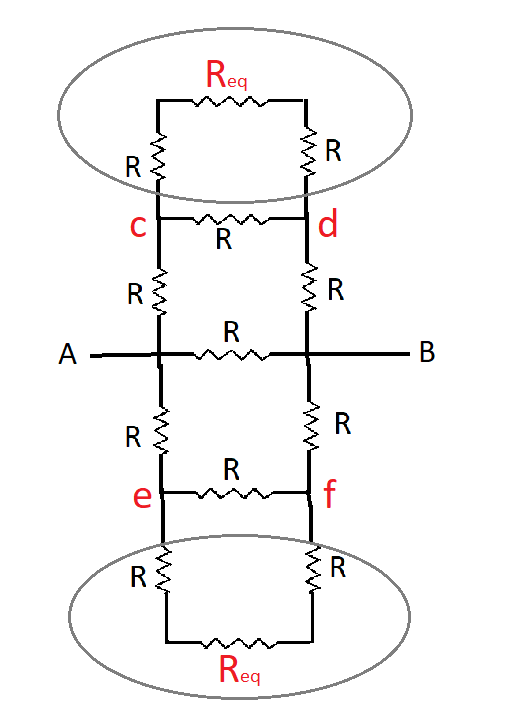
The resistance in top and bottom circles shows series connections so their equivalent resistance is given by
$
{R_{eq`}} = {R_{eq}} + R + R \\
\therefore {R_{eq`}} = {R_{eq}} + 2R \\
$
Now our equivalent diagram looks like
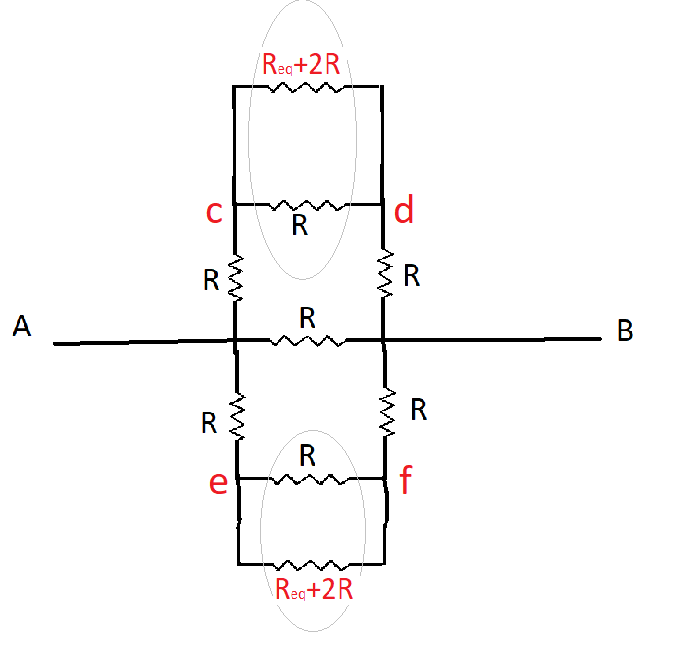
The resistance inside the circle are in parallel so there equivalent will be
\[
{R_{eq}} = \dfrac{{\left( {{\operatorname{R} _{eq}} + 2R} \right)R}}{{{\operatorname{R} _{eq}} + 2R + R}} \\
\Rightarrow {R_{eq}} = \dfrac{{\left( {R \times {\operatorname{R} _{eq}} + 2{R^2}} \right)}}{{{\operatorname{R} _{eq}} + 3R}} \\
\Rightarrow {R_{eq}}^2 + 3R\left( {{R_{eq}}} \right) = {R_{eq}} \times R + 2{R^2} \\
\Rightarrow {R_{eq}}^2 + 2R{R_{eq}} - 2{R^2} = 0 \\
\Rightarrow {R_{eq}}^2 - 2{R^2} + 2R{R_{eq}} = 0 \\
\]
Solving the above quadratic equation we get
\[
{R_{eq}} = \dfrac{{ - 2R \pm \sqrt {4{R^2} - 8{R^2}} }}{2} \\
\Rightarrow {R_{eq}} = - R + \sqrt 3 R \\
\Rightarrow {R_{eq}} = \left( {\sqrt 3 - 1} \right)R \\
\]
Now our equivalent circuit looks like
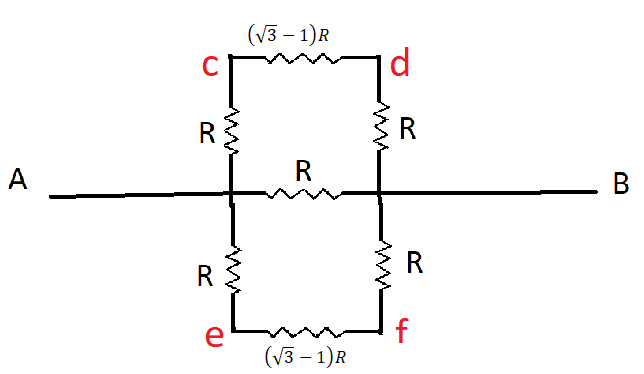
Now we see all the resistance above AB are in series so
The total resistance on each side will be
\[
{R_{eq}} = \left( {\sqrt 3 - 1} \right)R + 2R \\
\therefore {R_{eq}} = \left( {\sqrt 3 + 1} \right)R \\
\]
Now finally our circuit diagram looks like
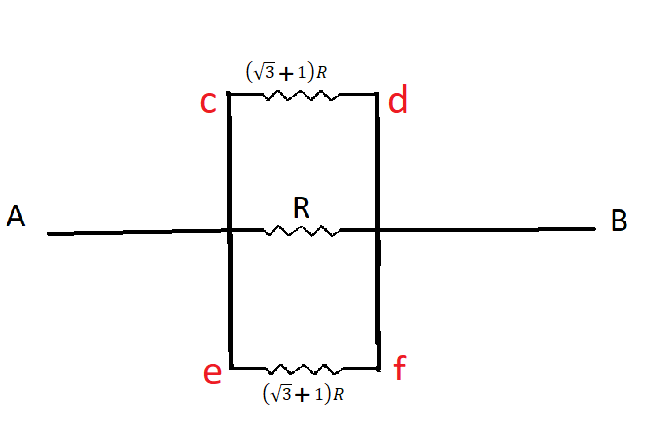
Here we can see that resistance on either side of AB are equal and parallel
AS we know two equivalent resistance of two equal resistance in parallel is half of the resistance of any one side so
${R_{eq}} = \dfrac{{\left( {\sqrt 3 + 1} \right)R}}{2}$
So final resistance will be
\[
{R_{eq}} = \dfrac{{\left( {\sqrt 3 + 1} \right)\dfrac{R}{2} \times R}}{{\left( {\sqrt 3 + 1} \right)\dfrac{R}{2} + R}} \\
\Rightarrow {R_{eq}} = \dfrac{{\left( {\sqrt 3 + 1} \right)\dfrac{R}{2}}}{{\left( {\sqrt 3 + 1} \right)\dfrac{1}{2} + 1}} \\
\Rightarrow {R_{eq}} = \dfrac{{\left( {\sqrt 3 + 1} \right)R}}{{\left( {\sqrt 3 + 3} \right)}} \\
\Rightarrow {R_{eq}} = \dfrac{{\left( {\sqrt 3 + 1} \right)R}}{{\sqrt 3 \left( {1 + \sqrt 3 } \right)}} \\
\Rightarrow {R_{eq}} = \dfrac{R}{{\sqrt 3 }} \\
\]
Here we are given that $R = 160\sqrt 3 \Omega $
Substituting this value we get
$
{R_{eq}} = \dfrac{{160\sqrt 3 }}{{\sqrt 3 }} \\
\therefore {R_{eq}} = 160\Omega \\
$
Final answer is, The equivalent resistance of the above circuit will be $160\Omega$.
Note: In these questions the assumption for ${R_{eq}}$ the repeating resistance which was initially present at top and bottom is necessary.
In Series connection, the current is not divided but in parallel connection, it is divided
In a series connection, if one resistance fails then the circuit will be broken which is not in the case of parallel connection as the current will keep flowing from the other branch.
2. In series connection the current flows through one resistance then through other resistance hence the total resistance is the sum of both.
3. In a parallel connection, an equivalent Connection is given by \[\dfrac{1}{{{R_{eq}}}} = \dfrac{1}{{{R_{}}}} + \dfrac{1}{{{R_2}}}\].
Complete step by step solution:
Here we need to find the equivalent resistance across A and B
Here we can see that the resistance circuit is symmetrical to AB
Here we can see that the circuit is infinite and repeats itself above (cd)and below (ef)
The top three resistance marked above the red line are taken as ${R_{eq}}$ the same case is at the bottom also and their values will also be the same, so we substitute ${R_{eq}}$in place of them. So now our image looks like
The resistance in top and bottom circles shows series connections so their equivalent resistance is given by
$
{R_{eq`}} = {R_{eq}} + R + R \\
\therefore {R_{eq`}} = {R_{eq}} + 2R \\
$
Now our equivalent diagram looks like
The resistance inside the circle are in parallel so there equivalent will be
\[
{R_{eq}} = \dfrac{{\left( {{\operatorname{R} _{eq}} + 2R} \right)R}}{{{\operatorname{R} _{eq}} + 2R + R}} \\
\Rightarrow {R_{eq}} = \dfrac{{\left( {R \times {\operatorname{R} _{eq}} + 2{R^2}} \right)}}{{{\operatorname{R} _{eq}} + 3R}} \\
\Rightarrow {R_{eq}}^2 + 3R\left( {{R_{eq}}} \right) = {R_{eq}} \times R + 2{R^2} \\
\Rightarrow {R_{eq}}^2 + 2R{R_{eq}} - 2{R^2} = 0 \\
\Rightarrow {R_{eq}}^2 - 2{R^2} + 2R{R_{eq}} = 0 \\
\]
Solving the above quadratic equation we get
\[
{R_{eq}} = \dfrac{{ - 2R \pm \sqrt {4{R^2} - 8{R^2}} }}{2} \\
\Rightarrow {R_{eq}} = - R + \sqrt 3 R \\
\Rightarrow {R_{eq}} = \left( {\sqrt 3 - 1} \right)R \\
\]
Now our equivalent circuit looks like
Now we see all the resistance above AB are in series so
The total resistance on each side will be
\[
{R_{eq}} = \left( {\sqrt 3 - 1} \right)R + 2R \\
\therefore {R_{eq}} = \left( {\sqrt 3 + 1} \right)R \\
\]
Now finally our circuit diagram looks like
Here we can see that resistance on either side of AB are equal and parallel
AS we know two equivalent resistance of two equal resistance in parallel is half of the resistance of any one side so
${R_{eq}} = \dfrac{{\left( {\sqrt 3 + 1} \right)R}}{2}$
So final resistance will be
\[
{R_{eq}} = \dfrac{{\left( {\sqrt 3 + 1} \right)\dfrac{R}{2} \times R}}{{\left( {\sqrt 3 + 1} \right)\dfrac{R}{2} + R}} \\
\Rightarrow {R_{eq}} = \dfrac{{\left( {\sqrt 3 + 1} \right)\dfrac{R}{2}}}{{\left( {\sqrt 3 + 1} \right)\dfrac{1}{2} + 1}} \\
\Rightarrow {R_{eq}} = \dfrac{{\left( {\sqrt 3 + 1} \right)R}}{{\left( {\sqrt 3 + 3} \right)}} \\
\Rightarrow {R_{eq}} = \dfrac{{\left( {\sqrt 3 + 1} \right)R}}{{\sqrt 3 \left( {1 + \sqrt 3 } \right)}} \\
\Rightarrow {R_{eq}} = \dfrac{R}{{\sqrt 3 }} \\
\]
Here we are given that $R = 160\sqrt 3 \Omega $
Substituting this value we get
$
{R_{eq}} = \dfrac{{160\sqrt 3 }}{{\sqrt 3 }} \\
\therefore {R_{eq}} = 160\Omega \\
$
Final answer is, The equivalent resistance of the above circuit will be $160\Omega$.
Note: In these questions the assumption for ${R_{eq}}$ the repeating resistance which was initially present at top and bottom is necessary.
In Series connection, the current is not divided but in parallel connection, it is divided
In a series connection, if one resistance fails then the circuit will be broken which is not in the case of parallel connection as the current will keep flowing from the other branch.
Recently Updated Pages
JEE Main 2023 April 6 Shift 1 Question Paper with Answer Key

JEE Main 2023 April 6 Shift 2 Question Paper with Answer Key
JEE Main 2023 (January 31 Evening Shift) Question Paper with Solutions [PDF]
JEE Main 2023 January 30 Shift 2 Question Paper with Answer Key
JEE Main 2023 January 25 Shift 1 Question Paper with Answer Key
JEE Main 2023 January 24 Shift 2 Question Paper with Answer Key
Trending doubts
JEE Main 2026: Session 2 Registration Open, City Intimation Slip, Exam Dates, Syllabus & Eligibility
JEE Main 2026 Application Login: Direct Link, Registration, Form Fill, and Steps
JEE Main Marking Scheme 2026- Paper-Wise Marks Distribution and Negative Marking Details
Understanding the Angle of Deviation in a Prism
Hybridisation in Chemistry – Concept, Types & Applications
How to Convert a Galvanometer into an Ammeter or Voltmeter
Other Pages
JEE Advanced Marks vs Ranks 2025: Understanding Category-wise Qualifying Marks and Previous Year Cut-offs
Dual Nature of Radiation and Matter Class 12 Physics Chapter 11 CBSE Notes - 2025-26
Understanding Uniform Acceleration in Physics
Understanding the Electric Field of a Uniformly Charged Ring
JEE Advanced Weightage 2025 Chapter-Wise for Physics, Maths and Chemistry
Derivation of Equation of Trajectory Explained for Students