




Draw a ray diagram for a concave mirror when the object is between the center of curvature and focus.
Answer
 Verified
643.2k+ views
Hint:Center of curvature is twice as far as the focus of the concave mirror. Any light ray passing through the center of curvature will fall on the spherical surface in a perpendicular manner. Any light ray parallel to the principal axis will pass through the focus after reflection.
Complete step by step solution:
It is given that the object is kept between the center of curvature and focus.
We know that the radius of curvature is twice the focal length. Hence, we can place the object between the focus and center of curvature like we can see in the diagram.
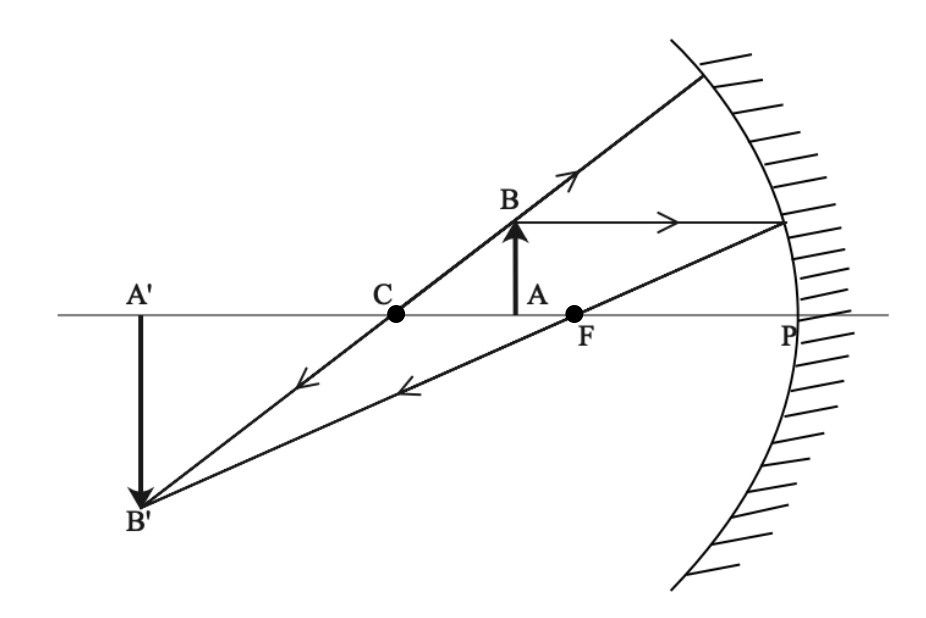
First, draw a light ray passing through the center of curvature of the spherical surface. Any light passing through the center of curvature will fall on the spherical surface in a perpendicular manner. As a result, the light will trace back it’s the path. The BCB’ shows the path of the light ray in the diagram.
From the definition of the focus, we can say that any light, parallel to the principal axis, will go through the focus of the spherical surface after reflection. Hence, draw a light ray that is parallel to the principal axis. The light ray will pass through the focus of the spherical mirror after reflection.
The image of point B will be the point where these two light rays meet. In this case, the point is B’. So, A’B’ is the image of AB. As we can see, the image is real, inverted, and magnified.
Note:The same problem can be solved using the mirror formula. However, the process will take more calculation and mathematical manipulation. This solution uses the properties of spherical surfaces, and thereby, making the solution easy and universal.
Complete step by step solution:
It is given that the object is kept between the center of curvature and focus.
We know that the radius of curvature is twice the focal length. Hence, we can place the object between the focus and center of curvature like we can see in the diagram.
First, draw a light ray passing through the center of curvature of the spherical surface. Any light passing through the center of curvature will fall on the spherical surface in a perpendicular manner. As a result, the light will trace back it’s the path. The BCB’ shows the path of the light ray in the diagram.
From the definition of the focus, we can say that any light, parallel to the principal axis, will go through the focus of the spherical surface after reflection. Hence, draw a light ray that is parallel to the principal axis. The light ray will pass through the focus of the spherical mirror after reflection.
The image of point B will be the point where these two light rays meet. In this case, the point is B’. So, A’B’ is the image of AB. As we can see, the image is real, inverted, and magnified.
Note:The same problem can be solved using the mirror formula. However, the process will take more calculation and mathematical manipulation. This solution uses the properties of spherical surfaces, and thereby, making the solution easy and universal.
Recently Updated Pages
Match columnI with columnII and choose the correct class 12 biology NEET_UG

Match columnI with columnII and choose the correct class 12 biology NEET_UG
Match columnI with columnII and choose the correct class 12 biology NEET_UG
Which plant will lose its economic value if its fruits class 12 biology NEET_UG
Human insulin is being commercially produced from a class 12 biology NEET_UG
Match columnI with columnII and choose the correct class 12 biology NEET_UG
Trending doubts
Which are the Top 10 Largest Countries of the World?
Draw a labelled sketch of the human eye class 12 physics CBSE
Why is the cell called the structural and functional class 12 biology CBSE
Draw ray diagrams each showing i myopic eye and ii class 12 physics CBSE
Differentiate between homogeneous and heterogeneous class 12 chemistry CBSE
Which is the correct genotypic ratio of mendel dihybrid class 12 biology CBSE