




What is data communication and its types?
Answer
 Verified
232.8k+ views
Hint: Data Communication is made up of two words: data and communication. Text, image, audio, video, and multimedia files. The act of sending or receiving information is known as communication.
Complete step by step solution:
Digital communication is the exchange of data between a source and a receiver across a transmission medium such as a wire cable. Data communication is the process of sending and receiving data from one device to another. There are three types of data communication:
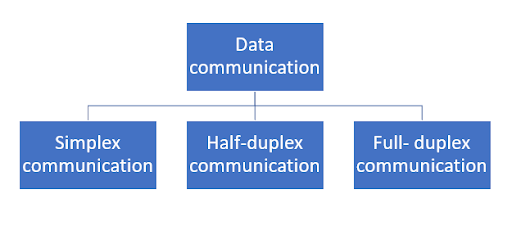
Image: Types of communication
1. Simplex Communication: It is one-way communication, or unidirectional communication, in which one device only receives data and another device only transmits data, and both devices use their whole transmission capacity. For instance, in the Internet of Things, data entry with a keyboard
2. Half-duplex communication: It is two-way or bidirectional communication in which both devices can send and receive data but not at the same time. When one device sends data, the other just receives data and vice versa. For instance, a walkie-talkie.
3. Full-duplex communication: It is two-way or bidirectional communication in which both devices can send and receive data at the same time. For instance, Mobile phones
Note: The transport of data between two sites is the focus of data communication networks. Data starts from the source and ends up at the sink, which is also known as the destination. It can also be categorized based on the medium through which the signal travels.
Complete step by step solution:
Digital communication is the exchange of data between a source and a receiver across a transmission medium such as a wire cable. Data communication is the process of sending and receiving data from one device to another. There are three types of data communication:
Image: Types of communication
1. Simplex Communication: It is one-way communication, or unidirectional communication, in which one device only receives data and another device only transmits data, and both devices use their whole transmission capacity. For instance, in the Internet of Things, data entry with a keyboard
2. Half-duplex communication: It is two-way or bidirectional communication in which both devices can send and receive data but not at the same time. When one device sends data, the other just receives data and vice versa. For instance, a walkie-talkie.
3. Full-duplex communication: It is two-way or bidirectional communication in which both devices can send and receive data at the same time. For instance, Mobile phones
Note: The transport of data between two sites is the focus of data communication networks. Data starts from the source and ends up at the sink, which is also known as the destination. It can also be categorized based on the medium through which the signal travels.
Recently Updated Pages
JEE Main 2023 April 6 Shift 1 Question Paper with Answer Key

JEE Main 2023 April 6 Shift 2 Question Paper with Answer Key
JEE Main 2023 (January 31 Evening Shift) Question Paper with Solutions [PDF]
JEE Main 2023 January 30 Shift 2 Question Paper with Answer Key
JEE Main 2023 January 25 Shift 1 Question Paper with Answer Key
JEE Main 2023 January 24 Shift 2 Question Paper with Answer Key
Trending doubts
JEE Main 2026: Session 2 Registration Open, City Intimation Slip, Exam Dates, Syllabus & Eligibility
JEE Main 2026 Application Login: Direct Link, Registration, Form Fill, and Steps
Understanding the Angle of Deviation in a Prism
Hybridisation in Chemistry – Concept, Types & Applications
How to Convert a Galvanometer into an Ammeter or Voltmeter
Understanding Uniform Acceleration in Physics
Other Pages
JEE Advanced Marks vs Ranks 2025: Understanding Category-wise Qualifying Marks and Previous Year Cut-offs
Dual Nature of Radiation and Matter Class 12 Physics Chapter 11 CBSE Notes - 2025-26
Understanding the Electric Field of a Uniformly Charged Ring
JEE Advanced Weightage 2025 Chapter-Wise for Physics, Maths and Chemistry
Derivation of Equation of Trajectory Explained for Students
Understanding Electromagnetic Waves and Their Importance