




A T.V transmission tower has a height of 140m and the height of the receiving antenna is 40m. What is the maximum distance upto which signal can be broadcasted from this LOS (line of sight) mode? (Given radius of earth = $6.4 \times {10^6}m$).
$
(a){\text{ 80Km}} \\
(b){\text{ 48Km}} \\
(c){\text{ 40Km}} \\
(d){\text{ 65Km}} \\
$
Answer
 Verified
233.1k+ views
Hint: In this question use the direct formula that the maximum distance up to which the signals can be broad casted from this tower in LOS (line of sight) mode is ${D_{\max }} = \sqrt {2R{H_T}} + \sqrt {2R{H_R}} $, where ${H_T}$ is the height of the transmission antenna and ${H_R}$is the height of the receiving antenna. Direct substitution of values into the formula will help getting the right answer for this problem statement.
Complete step-by-step solution -
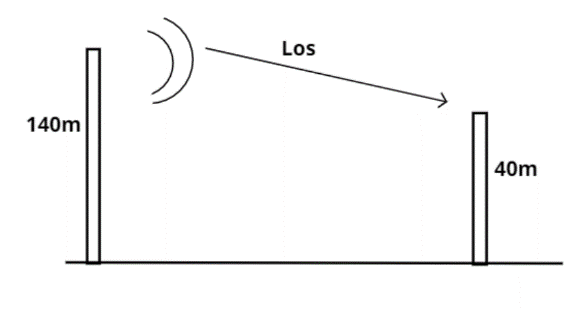
Given data:
Height of the transmission tower = 140 m
Let ${H_T} = 140$ m.
And the height of the receiving antenna = 40 m
Let ${H_R} = 40$ m.
Now the maximum distance up to which the signals can be broad casted from this tower in LOS (line of sight) mode is given by the formula which is given as
$ \Rightarrow {D_{\max }} = \sqrt {2R{H_T}} + \sqrt {2R{H_R}} $
Where r = radius of the earth = 6.4 $ \times {10^6}$m.
Now simply substitute the values in the above equation we have,
$ \Rightarrow {D_{\max }} = \sqrt {2 \times 6.4 \times {{10}^6} \times 140} + \sqrt {2 \times 6.4 \times {{10}^6} \times 40} $
Now simplify this we have, as $\sqrt {{{10}^6}} = 1000$
$ \Rightarrow {D_{\max }} = 1000\sqrt {2 \times 64 \times 14} + 1000\sqrt {2 \times 64 \times 4} $
Now again simplify this we have,
As square root of 64 is 8 and square root of 4 is 2 so we have,
$ \Rightarrow {D_{\max }} = 1000\left( {16\sqrt 7 + 16\sqrt 2 } \right)$
$ \Rightarrow {D_{\max }} = 16000\left( {\sqrt 7 + \sqrt 2 } \right)$
Now as we know that $\sqrt 7 = 2.645$ and $\sqrt 2 = 1.414$ so use this value in above equation we have,
$ \Rightarrow {D_{\max }} = 16000\left( {2.645 + 1.414} \right) = 16000\left( {4.06} \right) = 64959.4$meter.
$ \Rightarrow {D_{\max }} \simeq 65$Km, as 1Km = 1000 m.
So the maximum distance up to which the signals can be broad casted from this tower in LOS (line of sight) mode is 65 km.
So this is the required answer.
Hence option (D) is the correct answer.
Note – The key point here was that the broadcast was made along the line of sight that is line of sight refers to a straight line along which any observer has unobstructed vision. Here the waves from the transmission antenna are travelling directly to the receiving end and are not subjected to any reflections due to the obstacles present in between the path of transmission and receiving antenna.
Complete step-by-step solution -
Given data:
Height of the transmission tower = 140 m
Let ${H_T} = 140$ m.
And the height of the receiving antenna = 40 m
Let ${H_R} = 40$ m.
Now the maximum distance up to which the signals can be broad casted from this tower in LOS (line of sight) mode is given by the formula which is given as
$ \Rightarrow {D_{\max }} = \sqrt {2R{H_T}} + \sqrt {2R{H_R}} $
Where r = radius of the earth = 6.4 $ \times {10^6}$m.
Now simply substitute the values in the above equation we have,
$ \Rightarrow {D_{\max }} = \sqrt {2 \times 6.4 \times {{10}^6} \times 140} + \sqrt {2 \times 6.4 \times {{10}^6} \times 40} $
Now simplify this we have, as $\sqrt {{{10}^6}} = 1000$
$ \Rightarrow {D_{\max }} = 1000\sqrt {2 \times 64 \times 14} + 1000\sqrt {2 \times 64 \times 4} $
Now again simplify this we have,
As square root of 64 is 8 and square root of 4 is 2 so we have,
$ \Rightarrow {D_{\max }} = 1000\left( {16\sqrt 7 + 16\sqrt 2 } \right)$
$ \Rightarrow {D_{\max }} = 16000\left( {\sqrt 7 + \sqrt 2 } \right)$
Now as we know that $\sqrt 7 = 2.645$ and $\sqrt 2 = 1.414$ so use this value in above equation we have,
$ \Rightarrow {D_{\max }} = 16000\left( {2.645 + 1.414} \right) = 16000\left( {4.06} \right) = 64959.4$meter.
$ \Rightarrow {D_{\max }} \simeq 65$Km, as 1Km = 1000 m.
So the maximum distance up to which the signals can be broad casted from this tower in LOS (line of sight) mode is 65 km.
So this is the required answer.
Hence option (D) is the correct answer.
Note – The key point here was that the broadcast was made along the line of sight that is line of sight refers to a straight line along which any observer has unobstructed vision. Here the waves from the transmission antenna are travelling directly to the receiving end and are not subjected to any reflections due to the obstacles present in between the path of transmission and receiving antenna.
Recently Updated Pages
JEE Main 2023 April 6 Shift 1 Question Paper with Answer Key

JEE Main 2023 April 6 Shift 2 Question Paper with Answer Key
JEE Main 2023 (January 31 Evening Shift) Question Paper with Solutions [PDF]
JEE Main 2023 January 30 Shift 2 Question Paper with Answer Key
JEE Main 2023 January 25 Shift 1 Question Paper with Answer Key
JEE Main 2023 January 24 Shift 2 Question Paper with Answer Key
Trending doubts
JEE Main 2026: Session 2 Registration Open, City Intimation Slip, Exam Dates, Syllabus & Eligibility
JEE Main 2026 Application Login: Direct Link, Registration, Form Fill, and Steps
JEE Main Marking Scheme 2026- Paper-Wise Marks Distribution and Negative Marking Details
Understanding the Angle of Deviation in a Prism
Hybridisation in Chemistry – Concept, Types & Applications
How to Convert a Galvanometer into an Ammeter or Voltmeter
Other Pages
JEE Advanced Marks vs Ranks 2025: Understanding Category-wise Qualifying Marks and Previous Year Cut-offs
Understanding Uniform Acceleration in Physics
Dual Nature of Radiation and Matter Class 12 Physics Chapter 11 CBSE Notes - 2025-26
Understanding Electromagnetic Waves and Their Importance
Understanding the Electric Field of a Uniformly Charged Ring
JEE Advanced Weightage 2025 Chapter-Wise for Physics, Maths and Chemistry