




A thin film of refractive index 1.5 and thickness \[4 \times {10^{ - 5}}cm\]illuminated by light normal to the surface. What wavelength within the visible spectrum will be intensified in the reflected beam?
A) 4800 \[\mathop A\limits^o \]
B) 5800 \[\mathop A\limits^o \]
C) 6000 \[\mathop A\limits^o \]
D) 6800 \[\mathop A\limits^o \]
Answer
 Verified
233.1k+ views
Hint: When light falls on a thin film then it reflects back from two different surfaces. First, from the upper surface at the time of entering into the film some light reflects back. Then, at the other boundary where the light tries to exit from the film again it reflects back into the first medium. Now, this two reflected beams interfere due to the extra path length covered by the second reflected beam.
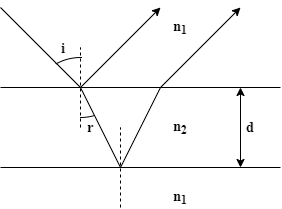
Formula Used: If a light ray reflects back while entering a denser medium from a rarer one its phase changes by an angle \[\pi \]. Hence, in case of thin film to have constructive interference required phase and path difference relation is given as:
$2d\dfrac{{{n_2}}}{{{n_1}}}\cos r = \left( {m - \dfrac{1}{2}} \right)\lambda $ (1)
Where,
d is the thickness of the film,
${n_2}$ is Refractive index(RI) of the film,
${n_1}$ is the refractive index of the rarer medium,
r is the angle of refraction,
m is order of interference,
$\lambda $ is the wavelength of interfering light
Complete step by step answer:
Given:
1. RI of the thin film is ${n_2} = 1.5$, where RI of air is ${n_1} = 1$.
2. Thickness of the thin film is \[d = 4 \times {10^{ - 5}}cm = 4 \times {10^{ - 7}}m\].
3. The light enters normally into the surface. Hence, \[i = r = {90^ \circ }\]. So, \[\cos r = \cos {90^ \circ } = 1\].
To find: The wavelength in the visible spectrum that will be intensified.
Step 1
First rewrite the eq.(1) to find an expression of $\lambda $:
$
2d\dfrac{{{n_2}}}{{{n_1}}}\cos r = \left( {m - \dfrac{1}{2}} \right)\lambda \\
\therefore \lambda = \dfrac{{2d{n_2}\cos r}}{{{n_1}\left( {m - \tfrac{1}{2}} \right)}} \\
$ (2)
Step 2
Now, substitute the values of d, ${n_2}$and $\cos r$into eq.(2) to get the set of solutions for $\lambda $:
$\therefore \lambda = \dfrac{{2 \times 4 \times {{10}^{ - 7}} \times 1.5 \times 1}}{{1 \times \left( {m - \tfrac{1}{2}} \right)}}meter = \dfrac{{1.2 \times {{10}^{ - 6}}}}{{\left( {m - \tfrac{1}{2}} \right)}}meter = \dfrac{{12000}}{{\left( {m - \tfrac{1}{2}} \right)}}\mathop A\limits^o $
As the wavelength of visible light is within 3800\[\mathop A\limits^o \] to 7000\[\mathop A\limits^o \], so to get the wavelength within visible light range, the value of m must be 3. Then the intensified visible wavelength will be:
$\lambda = \dfrac{{12000}}{{\left( {3 - \tfrac{1}{2}} \right)}}\mathop A\limits^o = 12000 \times \dfrac{2}{5}\mathop A\limits^o = 4800\mathop A\limits^o $
Correct answer:
The wavelength within the visible spectrum that will be intensified in the reflected beam is (a) $4800\mathop A\limits^o $.
Note: While using the constructive interference condition a student might get confused noticing the fraction $\dfrac{1}{2}$ subtracted from m-th order. This phase subtraction is necessary to nullify an extra \[\pi \] phase difference that happens when light reflects back while travelling from rarer to denser medium.
Formula Used: If a light ray reflects back while entering a denser medium from a rarer one its phase changes by an angle \[\pi \]. Hence, in case of thin film to have constructive interference required phase and path difference relation is given as:
$2d\dfrac{{{n_2}}}{{{n_1}}}\cos r = \left( {m - \dfrac{1}{2}} \right)\lambda $ (1)
Where,
d is the thickness of the film,
${n_2}$ is Refractive index(RI) of the film,
${n_1}$ is the refractive index of the rarer medium,
r is the angle of refraction,
m is order of interference,
$\lambda $ is the wavelength of interfering light
Complete step by step answer:
Given:
1. RI of the thin film is ${n_2} = 1.5$, where RI of air is ${n_1} = 1$.
2. Thickness of the thin film is \[d = 4 \times {10^{ - 5}}cm = 4 \times {10^{ - 7}}m\].
3. The light enters normally into the surface. Hence, \[i = r = {90^ \circ }\]. So, \[\cos r = \cos {90^ \circ } = 1\].
To find: The wavelength in the visible spectrum that will be intensified.
Step 1
First rewrite the eq.(1) to find an expression of $\lambda $:
$
2d\dfrac{{{n_2}}}{{{n_1}}}\cos r = \left( {m - \dfrac{1}{2}} \right)\lambda \\
\therefore \lambda = \dfrac{{2d{n_2}\cos r}}{{{n_1}\left( {m - \tfrac{1}{2}} \right)}} \\
$ (2)
Step 2
Now, substitute the values of d, ${n_2}$and $\cos r$into eq.(2) to get the set of solutions for $\lambda $:
$\therefore \lambda = \dfrac{{2 \times 4 \times {{10}^{ - 7}} \times 1.5 \times 1}}{{1 \times \left( {m - \tfrac{1}{2}} \right)}}meter = \dfrac{{1.2 \times {{10}^{ - 6}}}}{{\left( {m - \tfrac{1}{2}} \right)}}meter = \dfrac{{12000}}{{\left( {m - \tfrac{1}{2}} \right)}}\mathop A\limits^o $
As the wavelength of visible light is within 3800\[\mathop A\limits^o \] to 7000\[\mathop A\limits^o \], so to get the wavelength within visible light range, the value of m must be 3. Then the intensified visible wavelength will be:
$\lambda = \dfrac{{12000}}{{\left( {3 - \tfrac{1}{2}} \right)}}\mathop A\limits^o = 12000 \times \dfrac{2}{5}\mathop A\limits^o = 4800\mathop A\limits^o $
Correct answer:
The wavelength within the visible spectrum that will be intensified in the reflected beam is (a) $4800\mathop A\limits^o $.
Note: While using the constructive interference condition a student might get confused noticing the fraction $\dfrac{1}{2}$ subtracted from m-th order. This phase subtraction is necessary to nullify an extra \[\pi \] phase difference that happens when light reflects back while travelling from rarer to denser medium.
Recently Updated Pages
JEE Main 2023 April 6 Shift 1 Question Paper with Answer Key

JEE Main 2023 April 6 Shift 2 Question Paper with Answer Key
JEE Main 2023 (January 31 Evening Shift) Question Paper with Solutions [PDF]
JEE Main 2023 January 30 Shift 2 Question Paper with Answer Key
JEE Main 2023 January 25 Shift 1 Question Paper with Answer Key
JEE Main 2023 January 24 Shift 2 Question Paper with Answer Key
Trending doubts
JEE Main 2026: Session 2 Registration Open, City Intimation Slip, Exam Dates, Syllabus & Eligibility
JEE Main 2026 Application Login: Direct Link, Registration, Form Fill, and Steps
Understanding the Angle of Deviation in a Prism
Hybridisation in Chemistry – Concept, Types & Applications
How to Convert a Galvanometer into an Ammeter or Voltmeter
Understanding Uniform Acceleration in Physics
Other Pages
JEE Advanced Marks vs Ranks 2025: Understanding Category-wise Qualifying Marks and Previous Year Cut-offs
Dual Nature of Radiation and Matter Class 12 Physics Chapter 11 CBSE Notes - 2025-26
Understanding the Electric Field of a Uniformly Charged Ring
JEE Advanced Weightage 2025 Chapter-Wise for Physics, Maths and Chemistry
Derivation of Equation of Trajectory Explained for Students
Understanding Electromagnetic Waves and Their Importance