




A point source of light is placed at a depth of $h$ below the surface of water of refractive index $\mu $. A floating opaque disc is placed on the surface of water so that light from the source is not visible from the surface. The minimum diameter of the disc is
A. $\dfrac{{2h}}{{{{({\mu ^2} - 1)}^{\dfrac{1}{2}}}}}$
B. $2h{({\mu ^2} - 1)^{\dfrac{1}{2}}}$
C. $\dfrac{h}{{2{{({\mu ^2} - 1)}^{\dfrac{1}{2}}}}}$
D. $h{({\mu ^2} - 1)^{\dfrac{1}{2}}}$
Answer
 Verified
233.1k+ views
Hint: The light ray will refract back if the incidence angle becomes greater than the critical angle and hence we will use this concept to find the disc diameter. Use basic trigonometry to further solve the question.
Formula used:
${\theta _c} = {\sin ^{ - 1}}\left( {\dfrac{1}{\mu }} \right) \\$
Complete Step-by-Step Explanation:
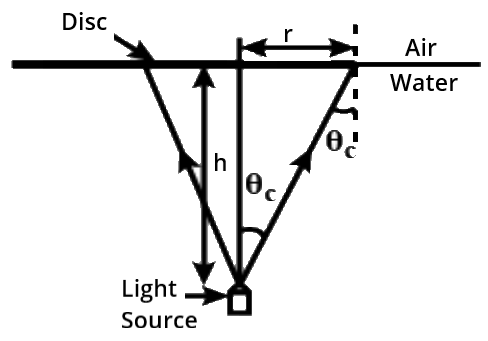
The above illustration depicts incidence from water at a critical angle ${\theta _c}$ limiting angle,
Consequently, the following formula provides the critical angle of a medium:
${\theta _c} = {\sin ^{ - 1}}\left( {\dfrac{1}{\mu }} \right) \\$
$\sin {\theta _c} = \dfrac{1}{\mu } \\$
So that, from the relation in the above equation, the equation can be written as:
$\tan {\theta _c} = \dfrac{1}{{{{({\mu ^2} - 1)}^{\dfrac{1}{2}}}}} \Rightarrow \dfrac{r}{h}$
Where, $r$be the radius of the disc,
Therefore, the diameter of the disc is:
$2r = 2h\,\tan {\theta _c} \\$
$\Rightarrow d = \dfrac{{2h}}{{{{({\mu ^2} - 1)}^{\dfrac{1}{2}}}}} \\$
Thus, the correct option is: (A) $\dfrac{{2h}}{{{{({\mu ^2} - 1)}^{\dfrac{1}{2}}}}}$
Note: for such questions you should be clear with the concept of critical angle and basic laws of refraction. Remember when light goes from denser to rarer the snell’s law applied in opposite manner as compared to the one we study conventionally.
Formula used:
${\theta _c} = {\sin ^{ - 1}}\left( {\dfrac{1}{\mu }} \right) \\$
Complete Step-by-Step Explanation:
The above illustration depicts incidence from water at a critical angle ${\theta _c}$ limiting angle,
Consequently, the following formula provides the critical angle of a medium:
${\theta _c} = {\sin ^{ - 1}}\left( {\dfrac{1}{\mu }} \right) \\$
$\sin {\theta _c} = \dfrac{1}{\mu } \\$
So that, from the relation in the above equation, the equation can be written as:
$\tan {\theta _c} = \dfrac{1}{{{{({\mu ^2} - 1)}^{\dfrac{1}{2}}}}} \Rightarrow \dfrac{r}{h}$
Where, $r$be the radius of the disc,
Therefore, the diameter of the disc is:
$2r = 2h\,\tan {\theta _c} \\$
$\Rightarrow d = \dfrac{{2h}}{{{{({\mu ^2} - 1)}^{\dfrac{1}{2}}}}} \\$
Thus, the correct option is: (A) $\dfrac{{2h}}{{{{({\mu ^2} - 1)}^{\dfrac{1}{2}}}}}$
Note: for such questions you should be clear with the concept of critical angle and basic laws of refraction. Remember when light goes from denser to rarer the snell’s law applied in opposite manner as compared to the one we study conventionally.
Recently Updated Pages
JEE Main 2023 April 6 Shift 1 Question Paper with Answer Key

JEE Main 2023 April 6 Shift 2 Question Paper with Answer Key
JEE Main 2023 (January 31 Evening Shift) Question Paper with Solutions [PDF]
JEE Main 2023 January 30 Shift 2 Question Paper with Answer Key
JEE Main 2023 January 25 Shift 1 Question Paper with Answer Key
JEE Main 2023 January 24 Shift 2 Question Paper with Answer Key
Trending doubts
JEE Main 2026: Session 2 Registration Open, City Intimation Slip, Exam Dates, Syllabus & Eligibility
JEE Main 2026 Application Login: Direct Link, Registration, Form Fill, and Steps
JEE Main Marking Scheme 2026- Paper-Wise Marks Distribution and Negative Marking Details
Understanding the Angle of Deviation in a Prism
Hybridisation in Chemistry – Concept, Types & Applications
How to Convert a Galvanometer into an Ammeter or Voltmeter
Other Pages
JEE Advanced Marks vs Ranks 2025: Understanding Category-wise Qualifying Marks and Previous Year Cut-offs
Dual Nature of Radiation and Matter Class 12 Physics Chapter 11 CBSE Notes - 2025-26
Understanding Uniform Acceleration in Physics
Understanding the Electric Field of a Uniformly Charged Ring
JEE Advanced Weightage 2025 Chapter-Wise for Physics, Maths and Chemistry
Derivation of Equation of Trajectory Explained for Students