




A point mass starts moving in a straight line with constant acceleration "a". At a time t after the beginning of motion, the acceleration changes sign, without change in magnitude. Determine the time \[{t_0}\] from the beginning of the motion in which the point mass returns to the initial position.
A. \[\left( {2 + \sqrt 3 } \right)t\]
B. \[\left( {2 + \sqrt 2 } \right)t\]
C. \[\left( {3 + \sqrt 2 } \right)t\]
D. \[\left( {12 + \sqrt 2 } \right)t\]
Answer
 Verified
232.8k+ views
Hint:Point mass is moving with constant acceleration and after time t it will have negative acceleration, to find the total time for the mass in which it returns to initial point. We have to first calculate the time duration between the different points from beginning to end, then add it to get the total time \[{t_0}\].
Formula used :
The expression of equations of motion are,
$v = u + at$
And, \[{v^2} = {u^2} + 2as\]
Complete step by step solution:
Let the body start moving from a point A with acceleration a and initial velocity u and after time t at point B the acceleration changes sign and velocity is v but the acceleration will not be zero and as a result body will still move further in the straight path. After time $t_1$ at point C it will have final velocity v = o and will start moving backward to the initial point A.
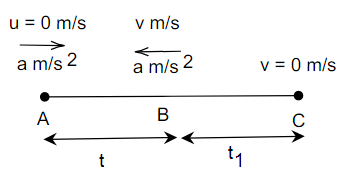
For length AB
$v = u + at$
$\Rightarrow v = 0 + at = at$ m/s
And,
\[{v^2} = {u^2} + 2as\\
\Rightarrow a{t^2} = 0 + 2a(AB)\\
\Rightarrow AB = \dfrac{{a{t^2}}}{2}\]
For length BC
$v = u+ at$
\[\Rightarrow 0 = at - a{t_1} \\
\Rightarrow {t_1} = t\]
And,
\[{v^2} = {u^2} + 2as\\
\Rightarrow 0 = a{t^2} - 2a(BC)\\
\Rightarrow BC = \dfrac{{a{t^2}}}{2}\]
Now, the velocity of the body at point C is zero and it will return back to point A and the time taken is $t_2$. From C to A
\[S = ut + \dfrac{1}{2}a{t^2}\\
\Rightarrow \dfrac{{a{t^2}}}{2} + \dfrac{{a{t^2}}}{2} = 0 + \dfrac{1}{2}at_2^2\\
\Rightarrow a{t^2} = \dfrac{{at_2^2}}{2} \\
\Rightarrow {t_2} = \sqrt 2 t\]
Therefore total time from the beginning in which the point mass returns to initial position will be,
\[{t_0} = t + {t_1} + {t_2} \\
\Rightarrow {t_0} = t + t + \sqrt 2 t \\
\Rightarrow {t_0} = \,2t + \sqrt 2 t \\
\therefore {t_0} = \left( {2 + \sqrt 2 } \right)t\]
Hence, for point mass to start from the beginning and then return to the initial point it will take time \[\left( {2 + \sqrt 2 } \right)t\].
Therefore, option B is the correct answer.
Note: One of the limitations of Newton’s Equation of mechanics is that they are not applicable for bodies having speed near speed of light. Moreover, equations of motion in physics are equations that explain how a physical system behaves in terms of how its motion changes over time. The behaviour of a physical system is described in further detail by the equations of motion as a collection of mathematical functions expressed in terms of dynamic variables. These variables typically consist of space, time, and sometimes elements of momentum.
Formula used :
The expression of equations of motion are,
$v = u + at$
And, \[{v^2} = {u^2} + 2as\]
Complete step by step solution:
Let the body start moving from a point A with acceleration a and initial velocity u and after time t at point B the acceleration changes sign and velocity is v but the acceleration will not be zero and as a result body will still move further in the straight path. After time $t_1$ at point C it will have final velocity v = o and will start moving backward to the initial point A.
For length AB
$v = u + at$
$\Rightarrow v = 0 + at = at$ m/s
And,
\[{v^2} = {u^2} + 2as\\
\Rightarrow a{t^2} = 0 + 2a(AB)\\
\Rightarrow AB = \dfrac{{a{t^2}}}{2}\]
For length BC
$v = u+ at$
\[\Rightarrow 0 = at - a{t_1} \\
\Rightarrow {t_1} = t\]
And,
\[{v^2} = {u^2} + 2as\\
\Rightarrow 0 = a{t^2} - 2a(BC)\\
\Rightarrow BC = \dfrac{{a{t^2}}}{2}\]
Now, the velocity of the body at point C is zero and it will return back to point A and the time taken is $t_2$. From C to A
\[S = ut + \dfrac{1}{2}a{t^2}\\
\Rightarrow \dfrac{{a{t^2}}}{2} + \dfrac{{a{t^2}}}{2} = 0 + \dfrac{1}{2}at_2^2\\
\Rightarrow a{t^2} = \dfrac{{at_2^2}}{2} \\
\Rightarrow {t_2} = \sqrt 2 t\]
Therefore total time from the beginning in which the point mass returns to initial position will be,
\[{t_0} = t + {t_1} + {t_2} \\
\Rightarrow {t_0} = t + t + \sqrt 2 t \\
\Rightarrow {t_0} = \,2t + \sqrt 2 t \\
\therefore {t_0} = \left( {2 + \sqrt 2 } \right)t\]
Hence, for point mass to start from the beginning and then return to the initial point it will take time \[\left( {2 + \sqrt 2 } \right)t\].
Therefore, option B is the correct answer.
Note: One of the limitations of Newton’s Equation of mechanics is that they are not applicable for bodies having speed near speed of light. Moreover, equations of motion in physics are equations that explain how a physical system behaves in terms of how its motion changes over time. The behaviour of a physical system is described in further detail by the equations of motion as a collection of mathematical functions expressed in terms of dynamic variables. These variables typically consist of space, time, and sometimes elements of momentum.
Recently Updated Pages
Circuit Switching vs Packet Switching: Key Differences Explained

Dimensions of Pressure in Physics: Formula, Derivation & SI Unit
JEE General Topics in Chemistry Important Concepts and Tips
JEE Extractive Metallurgy Important Concepts and Tips for Exam Preparation
JEE Amino Acids and Peptides Important Concepts and Tips for Exam Preparation
JEE Atomic Structure and Chemical Bonding important Concepts and Tips
Trending doubts
JEE Main 2026: Session 2 Registration Open, City Intimation Slip, Exam Dates, Syllabus & Eligibility
JEE Main 2026 Application Login: Direct Link, Registration, Form Fill, and Steps
JEE Main Marking Scheme 2026- Paper-Wise Marks Distribution and Negative Marking Details
Understanding the Angle of Deviation in a Prism
Hybridisation in Chemistry – Concept, Types & Applications
How to Convert a Galvanometer into an Ammeter or Voltmeter
Other Pages
JEE Advanced Marks vs Ranks 2025: Understanding Category-wise Qualifying Marks and Previous Year Cut-offs
Laws of Motion Class 11 Physics Chapter 4 CBSE Notes - 2025-26
Waves Class 11 Physics Chapter 14 CBSE Notes - 2025-26
Mechanical Properties of Fluids Class 11 Physics Chapter 9 CBSE Notes - 2025-26
Thermodynamics Class 11 Physics Chapter 11 CBSE Notes - 2025-26
Units And Measurements Class 11 Physics Chapter 1 CBSE Notes - 2025-26