




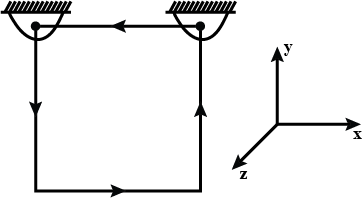
A current carrying a uniform sq. frame is suspended from hinged supports as shown within the figure such that it will freely rotate regarding its top. The length and mass of every facet of the frame are 2m and 4kg respectively. A uniform magnetic field \[\begin{array}{*{20}{c}} {\overrightarrow B }& = &{(3\widehat i + 4\widehat j)} \end{array}\] from vertical and released, it remains in equilibrium. What's the magnitude of current (in A) within the wireframe?
Answer
 Verified
232.8k+ views
Hint: First of all, find the magnitude of the magnetic field that is applied to the wireframe. And then We will apply the Biot Savart law to determine the magnitude of current in the wireframe.
Complete step by step solution:
In the problem, we have given that a uniform magnetic field is applied to the wireframe. There are some parameters such as length and mass, which are also given.
Let us assume that the mass of each side of the frame is m and the length of each side of the frame is \[l\].
Therefore, Magnetic field \[\overrightarrow B \]= \[(3\widehat i + 4\widehat j)\], mass of each side of the frame = 4 kg and the length of each side of the frame = 2 m.
And the angle (\[\theta \]) = \[{45^ \circ }\].
Now we have to determine the magnitude of the current in the wireframe.
Now according to the Biot Savart law,
\[\begin{array}{*{20}{c}}{ \Rightarrow dB}& = &{\dfrac{{Idl\sin \theta }}{{{r^2}}}}\end{array}\] ……. (A)
Now integrate the above equation, therefore, we will get,
\[\begin{array}{*{20}{c}}{ \Rightarrow \int {dB} }& = &{\dfrac{{I\sin \theta }}{{{r^2}}}}\end{array}\int {dl} \]
\[\begin{array}{*{20}{c}}{ \Rightarrow B}& = &{\dfrac{{Il\sin \theta }}{{{r^2}}}}\end{array}\] ………….. (1)
Now determine the magnitude of the magnetic field so we will get,
\[\begin{array}{*{20}{c}}{ \Rightarrow B}& = &{\sqrt {{3^2} + {4^2}} }\end{array}\]
\[\begin{array}{*{20}{c}}{ \Rightarrow B}& = &5\end{array}\] tesla
And r will be the distance of the current carrying wire from the center of the wireframe Therefore r = 1
\[\begin{array}{*{20}{c}}{ \Rightarrow 5}& = &{\dfrac{{I \times 2\sin {{45}^ \circ }}}{{{{(1)}^2}}}}\end{array}\]
\[\begin{array}{*{20}{c}}{ \Rightarrow I}& = &{\dfrac{5}{{\sqrt 2 }}}\end{array}\]
\[\begin{array}{*{20}{c}}{ \Rightarrow I}& = &{3.535A}\end{array}\]
Therefore, the final answer is 3.535 A.
Note: It is important to note that r is the distance of the current carrying wire from the center of the wireframe. In this problem, the quantity of current plays the most important roles in these aspects. So, one should be careful in applying concepts. Both are proportional to the magnetic field created and can be used to generate a strong electromagnetic field. Students are most likely to make mistakes in these types of problems as it includes integral calculations and more formulas.
Complete step by step solution:
In the problem, we have given that a uniform magnetic field is applied to the wireframe. There are some parameters such as length and mass, which are also given.
Let us assume that the mass of each side of the frame is m and the length of each side of the frame is \[l\].
Therefore, Magnetic field \[\overrightarrow B \]= \[(3\widehat i + 4\widehat j)\], mass of each side of the frame = 4 kg and the length of each side of the frame = 2 m.
And the angle (\[\theta \]) = \[{45^ \circ }\].
Now we have to determine the magnitude of the current in the wireframe.
Now according to the Biot Savart law,
\[\begin{array}{*{20}{c}}{ \Rightarrow dB}& = &{\dfrac{{Idl\sin \theta }}{{{r^2}}}}\end{array}\] ……. (A)
Now integrate the above equation, therefore, we will get,
\[\begin{array}{*{20}{c}}{ \Rightarrow \int {dB} }& = &{\dfrac{{I\sin \theta }}{{{r^2}}}}\end{array}\int {dl} \]
\[\begin{array}{*{20}{c}}{ \Rightarrow B}& = &{\dfrac{{Il\sin \theta }}{{{r^2}}}}\end{array}\] ………….. (1)
Now determine the magnitude of the magnetic field so we will get,
\[\begin{array}{*{20}{c}}{ \Rightarrow B}& = &{\sqrt {{3^2} + {4^2}} }\end{array}\]
\[\begin{array}{*{20}{c}}{ \Rightarrow B}& = &5\end{array}\] tesla
And r will be the distance of the current carrying wire from the center of the wireframe Therefore r = 1
\[\begin{array}{*{20}{c}}{ \Rightarrow 5}& = &{\dfrac{{I \times 2\sin {{45}^ \circ }}}{{{{(1)}^2}}}}\end{array}\]
\[\begin{array}{*{20}{c}}{ \Rightarrow I}& = &{\dfrac{5}{{\sqrt 2 }}}\end{array}\]
\[\begin{array}{*{20}{c}}{ \Rightarrow I}& = &{3.535A}\end{array}\]
Therefore, the final answer is 3.535 A.
Note: It is important to note that r is the distance of the current carrying wire from the center of the wireframe. In this problem, the quantity of current plays the most important roles in these aspects. So, one should be careful in applying concepts. Both are proportional to the magnetic field created and can be used to generate a strong electromagnetic field. Students are most likely to make mistakes in these types of problems as it includes integral calculations and more formulas.
Recently Updated Pages
JEE Main 2023 April 6 Shift 1 Question Paper with Answer Key

JEE Main 2023 April 6 Shift 2 Question Paper with Answer Key
JEE Main 2023 (January 31 Evening Shift) Question Paper with Solutions [PDF]
JEE Main 2023 January 30 Shift 2 Question Paper with Answer Key
JEE Main 2023 January 25 Shift 1 Question Paper with Answer Key
JEE Main 2023 January 24 Shift 2 Question Paper with Answer Key
Trending doubts
JEE Main 2026: Session 2 Registration Open, City Intimation Slip, Exam Dates, Syllabus & Eligibility
JEE Main 2026 Application Login: Direct Link, Registration, Form Fill, and Steps
JEE Main Marking Scheme 2026- Paper-Wise Marks Distribution and Negative Marking Details
Understanding the Angle of Deviation in a Prism
Hybridisation in Chemistry – Concept, Types & Applications
How to Convert a Galvanometer into an Ammeter or Voltmeter
Other Pages
JEE Advanced Marks vs Ranks 2025: Understanding Category-wise Qualifying Marks and Previous Year Cut-offs
Dual Nature of Radiation and Matter Class 12 Physics Chapter 11 CBSE Notes - 2025-26
Understanding Uniform Acceleration in Physics
Understanding the Electric Field of a Uniformly Charged Ring
JEE Advanced Weightage 2025 Chapter-Wise for Physics, Maths and Chemistry
Derivation of Equation of Trajectory Explained for Students