




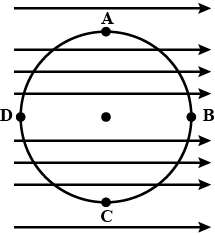
A circle of radius ${\text{R}}$ is drawn in a uniform electric field ${\text{E}}$ as shown in the figure. \[{V_a}\] , \[{V_b}\] , \[{V_c}\] , \[{V_d}\] respectively are the potential of point \[A\] , \[B\] , \[C\] , and $D$ at the periphery of the circle then:
(A) \[{V_A} > {V_C},{V_B} - {V_D}\]
(B) \[{V_A} < {V_C},{V_B} - {V_D}\]
(C) \[{V_A} = {V_C},{V_B} < {V_D}\]
(D) \[{V_A} = {V_C},{V_B} > {V_D}\]
Answer
 Verified
233.1k+ views
Hint: It is possible to consider the electric field as an electrical property associated with each point in the space where a charge is present in any form. The electric force per unit charge is also described as an electric field.
Complete Step-by-Step Solution:
According to the question,
We have been provided with a circle whose radius is ${\text{R}}$
It is also stated in the question that the electric field is ${\text{E}}$
In the given figure of the circle drawn inside the electric field,
It is also given that ${{\text{V}}_{\text{A}}},{{\text{V}}_{\text{B}}},{{\text{V}}_{\text{C}}},{{\text{V}}_{\text{D}}}$ are respectively the potentials of points ${\text{A}},{\text{B}},{\text{C}},{\text{D}}$
Now, let us check the relation between the potentials of point \[B\] and point \[D\] .
In this case, the potential at point \[D\] will be more than the potential at point \[B\] .
That is
${{\text{V}}_{\text{D}}} > {{\text{V}}_{\text{B}}}$ or we can rewrite this as ${{\text{V}}_{\text{B}}} < {{\text{V}}_{\text{D}}}$
This is because electric field lines always flow from higher potential to lower potential.
Now, let us determine the relation about the potentials of the point \[A\] and point \[C\] . The potential of point \[A\] will be equal to the potential of point \[C\] .
That is
${{\text{V}}_{\text{A}}} = {{\text{V}}_{\text{C}}}$
In the above stated situation, the potentials are equal because both these points are situated at the exact same vertical line.
So, we can conclude that the potential at point \[A\] is equal to the potential at point \[C\] . And also, the potential of point \[B\] is less than that of potential at point \[D\] .
That is
\[{V_A} = {V_C}\]
And \[{V_B} < {V_D}\]
Hence, the correct option is (C.)
Note: Mathematically, the electric field is defined as a vector field that can be associated with each point in space, at which point the force per unit charge is exerted on a positive test charge at rest. The electric field is generated by electric charges or by magnetic fields that vary in time. The electric field is responsible for the attractive forces between the atomic nucleus and the electrons that then hold together in the case of the atomic scale.
Complete Step-by-Step Solution:
According to the question,
We have been provided with a circle whose radius is ${\text{R}}$
It is also stated in the question that the electric field is ${\text{E}}$
In the given figure of the circle drawn inside the electric field,
It is also given that ${{\text{V}}_{\text{A}}},{{\text{V}}_{\text{B}}},{{\text{V}}_{\text{C}}},{{\text{V}}_{\text{D}}}$ are respectively the potentials of points ${\text{A}},{\text{B}},{\text{C}},{\text{D}}$
Now, let us check the relation between the potentials of point \[B\] and point \[D\] .
In this case, the potential at point \[D\] will be more than the potential at point \[B\] .
That is
${{\text{V}}_{\text{D}}} > {{\text{V}}_{\text{B}}}$ or we can rewrite this as ${{\text{V}}_{\text{B}}} < {{\text{V}}_{\text{D}}}$
This is because electric field lines always flow from higher potential to lower potential.
Now, let us determine the relation about the potentials of the point \[A\] and point \[C\] . The potential of point \[A\] will be equal to the potential of point \[C\] .
That is
${{\text{V}}_{\text{A}}} = {{\text{V}}_{\text{C}}}$
In the above stated situation, the potentials are equal because both these points are situated at the exact same vertical line.
So, we can conclude that the potential at point \[A\] is equal to the potential at point \[C\] . And also, the potential of point \[B\] is less than that of potential at point \[D\] .
That is
\[{V_A} = {V_C}\]
And \[{V_B} < {V_D}\]
Hence, the correct option is (C.)
Note: Mathematically, the electric field is defined as a vector field that can be associated with each point in space, at which point the force per unit charge is exerted on a positive test charge at rest. The electric field is generated by electric charges or by magnetic fields that vary in time. The electric field is responsible for the attractive forces between the atomic nucleus and the electrons that then hold together in the case of the atomic scale.
Recently Updated Pages
JEE Main 2023 April 6 Shift 1 Question Paper with Answer Key

JEE Main 2023 April 6 Shift 2 Question Paper with Answer Key
JEE Main 2023 (January 31 Evening Shift) Question Paper with Solutions [PDF]
JEE Main 2023 January 30 Shift 2 Question Paper with Answer Key
JEE Main 2023 January 25 Shift 1 Question Paper with Answer Key
JEE Main 2023 January 24 Shift 2 Question Paper with Answer Key
Trending doubts
JEE Main 2026: Session 2 Registration Open, City Intimation Slip, Exam Dates, Syllabus & Eligibility
JEE Main 2026 Application Login: Direct Link, Registration, Form Fill, and Steps
Understanding the Angle of Deviation in a Prism
Hybridisation in Chemistry – Concept, Types & Applications
How to Convert a Galvanometer into an Ammeter or Voltmeter
Understanding Uniform Acceleration in Physics
Other Pages
JEE Advanced Marks vs Ranks 2025: Understanding Category-wise Qualifying Marks and Previous Year Cut-offs
Dual Nature of Radiation and Matter Class 12 Physics Chapter 11 CBSE Notes - 2025-26
Understanding the Electric Field of a Uniformly Charged Ring
JEE Advanced Weightage 2025 Chapter-Wise for Physics, Maths and Chemistry
Derivation of Equation of Trajectory Explained for Students
Understanding Electromagnetic Waves and Their Importance