








What Do 2026 NEET Toppers Say About Focusing on NCERT and PYQP?
For NEET 2026 aspirants aiming for a score of 650 or more, a central question arises: Is thorough study of NCERT textbooks and consistent practice of NEET previous year question papers (PYQP) enough to achieve this ambitious target? This article takes a step-by-step look at the real effectiveness of the 'NCERT + PYQP' strategy, what it covers well, its limitations—subject-wise and overall—and how to make the most of it in your NEET 2026 preparation.
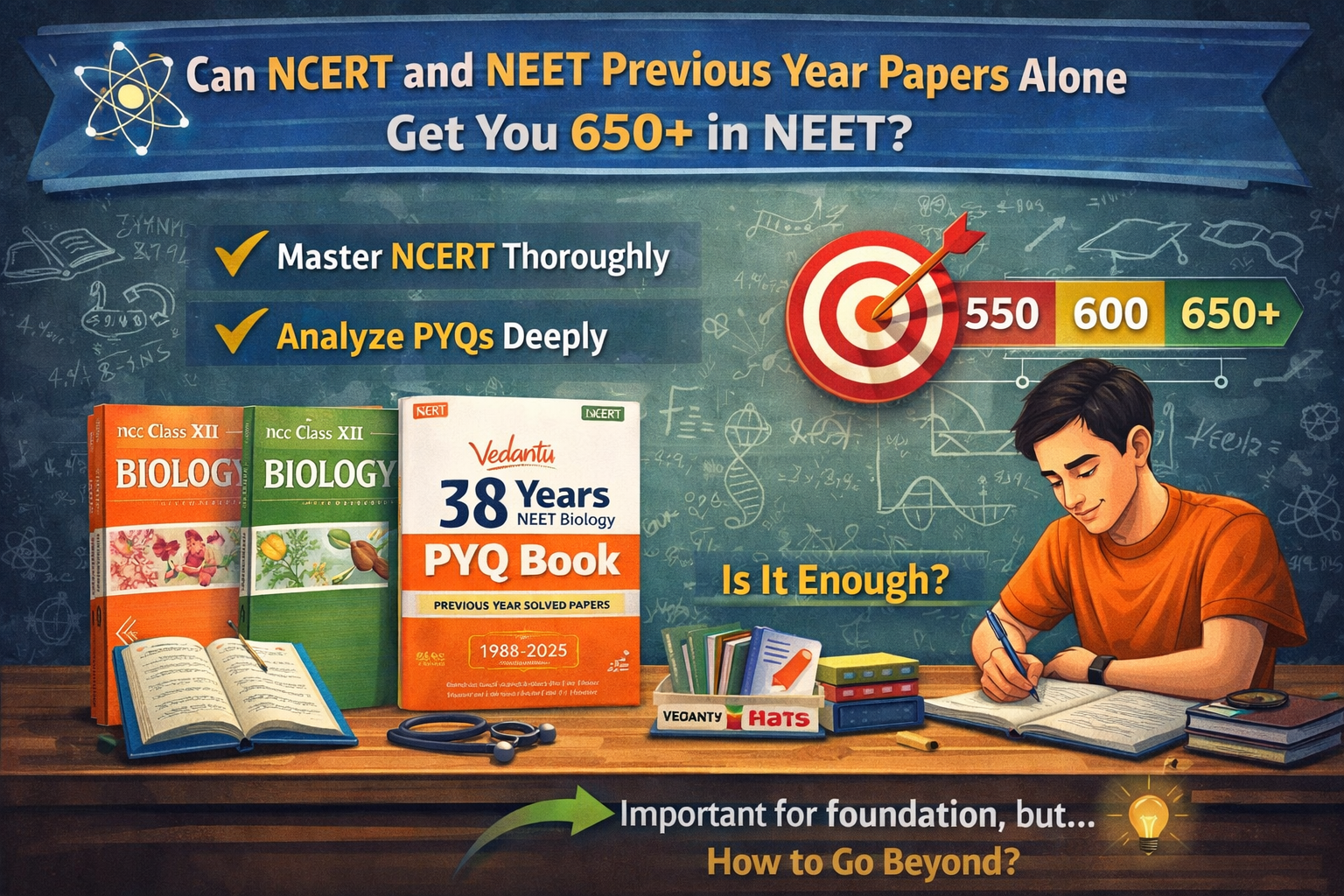
Is NCERT and NEET PYQP Enough to Score 650 in NEET 2026?
Scoring 650 or above in NEET requires not just strong conceptual clarity, but also excellent application and time-management skills. For Biology and Chemistry, NCERT textbooks form the backbone of NEET preparation. Over 80-90% of Biology and a substantial part of Chemistry questions have direct or indirect references to NCERT. Practicing NEET PYQPs helps you understand the exam pattern, frequently asked concepts, and improve your speed and accuracy. However, for Physics, relying only on NCERT theory plus PYQP may not always be sufficient for a safe 650+ score, as application-based questions often extend beyond NCERT theory.
How to Use NCERT and NEET PYQP Effectively
The right approach is not just reading and solving, but mastering and revising. Here’s how NEET 2026 aspirants should structure their preparation with these resources:
For Biology: Read every line, diagram, and table from NCERT repeatedly. Prepare handwritten short notes for last-moment revision. Revise consistently.
For Chemistry: Focus on clarity in theory (especially Inorganic and Organic from NCERT) and memorize key reactions and mechanisms. Pay attention to solved and unsolved examples.
For Physics: Go through the concepts in NCERT, but dedicate more time to solving numerical problems from PYQPs and other standard problem books after covering NCERT basics.
After each chapter, solve NEET previous year questions on that specific chapter to understand exam trends and fill conceptual gaps.
Use PYQP to train your mind for accuracy and speed, and analyse mistakes thoroughly after each mock test or practice session.
To deepen your revision process, students should read guidance on the best ways to revise NCERT Biology for NEET so that memory retention is maximized.
Subject-Wise Discussion: What’s Sufficient and What’s Not
Biology: NCERT and PYQPs are Vital
For NEET Biology, mastering NCERT is imperative. Almost every question has direct roots in NCERT, and exceptions are rare.
Read NCERT multiple times and underline tricky facts.
Solve all Biology PYQPs from the last 10-15 years regularly.
Practice recalling details from NCERT diagrams, flowcharts, and tables.
It is important to read NCERT books multiple times during your NEET preparation to uncover hidden details and develop confidence.
Chemistry: Theory and Practice Go Hand in Hand
NCERT covers a huge chunk of NEET Chemistry, especially in Organic and Inorganic. Physical Chemistry may need some extra practice, especially numericals.
Inorganic: Stick strictly to NCERT for facts and details.
Organic: Understand mechanisms and practice named reactions from NCERT and PYQP.
Physical: Do all solved examples in NCERT, but solve extra numericals if you regularly struggle with calculations.
You can explore more on how NCERT Chemistry books and solutions support effective NEET cracking for further subject-specific tips.
Physics: Is NCERT and PYQ Enough?
This is where most aspirants struggle. While NCERT is useful to understand basic theoretical concepts, NEET Physics often tests application and numerical-solving skills. PYQP helps you identify frequently tested concepts and common question types, but alone they rarely cover the entire spectrum of NEET Physics.
Concepts: Read NCERT for core theory only. Do not skip example problems.
Numerical Practice: Use PYQPs as your foundation, but add more variety from standard problem books for full coverage.
Application: Attempt mixed-chapter practice papers to improve your problem-solving skills and time management.
If you are questioning, "Is NCERT and PYQ enough for NEET Physics?"—the answer is: For foundation and trend understanding, yes, but for a 650+ score, supplemental problem practice is almost always required.
Role of NCERT Exemplar and Revision
For Physics and Chemistry, the NCERT Exemplar can bridge gaps left by basic textbooks. It helps students practice higher-order problems and tricky applications often seen in NEET. Invest time in Exemplar after you are thorough with the main NCERT book and PYQP in Physics and Chemistry. To understand its value, read about the effectiveness of NCERT Exemplar for NEET and how it upgrades your preparation strategy.
Common Mistakes When Relying Only on NCERT and PYQPs
Reading NCERT passively, without making self-notes or revising actively.
Solving PYQP without reviewing and understanding the solutions and learning from mistakes.
Assuming all PYQP patterns will repeat exactly; NEET does introduce twists in familiar topics.
Neglecting mock tests or not simulating the actual exam environment.
Underestimating Physics numericals and skipping advanced practice outside NCERT.
NEET 2026: Recommended Preparation Approach
Every aspirant’s learning style is unique, but here is an optimal plan integrating NCERT, PYQPs, and supplemental practice for a 650+ target:
Read NCERT line by line, making summary notes and marking weak areas.
After each chapter, solve NEET PYQP for that topic to master question trends.
Revise NCERT before and after each PYQP round to ensure fact retention and conceptual clarity.
For Physics especially, include additional problem sets and mock tests to target application-based questions.
Simulate full-length mock exams monthly to test your real-time progress and exam temperament.
To better understand the book’s contribution, refer to the detailed analysis in Are NCERT Books Enough For NEET.
Key Takeaways for NEET 2026 Preparation
NCERT textbooks and NEET PYQP together are a robust foundation, particularly for Biology and Chemistry.
For Physics, extra effort in problem-solving beyond NCERT and PYQP is needed to cross the 650 mark.
Regular revision, simulated mocks, and practice from varied problem sources underpin high scores.
A clear, consistent revision plan unlocks the full benefit of NCERT and PYQP learning.
For more on optimizing your NCERT routine, learn the benefits of NCERT books in NEET exam and how to extract maximum value from every line in your textbooks.
While the combination of NCERT and NEET previous year question papers forms the heart of NEET 2026 preparation—especially for Biology and Chemistry—Physics demands that students go a step further for a 650+ score. Smart, repeated revision, using NCERT Exemplar, closing gaps through mock practice, and a disciplined approach help convert solid knowledge into actual marks. With consistency and critical self-analysis, students can leverage the core NCERT + PYQP method to approach their NEET 2026 dreams confidently.
FAQs on Can NCERT and NEET Previous Year Papers Alone Get You 650+ in NEET 2026?
1. Is studying only NCERT and NEET previous year question papers enough to score 650 in NEET?
Relying solely on NCERT textbooks and NEET previous year question papers can help you cover most of the core syllabus, but may not be enough alone to score 650 in NEET.
2. Why are NCERT books important for NEET preparation?
NCERT books form the backbone of the NEET syllabus and cover the essential concepts needed for the exam.
Most NEET questions are directly based on NCERT content.
They help build strong fundamentals in Biology, Chemistry, and Physics.
3. How can solving NEET PYQP (Previous Year Question Papers) help in scoring high marks?
Solving NEET previous year question papers helps you understand the exam pattern, question types, and frequently asked topics.
It improves time management and accuracy.
You can identify important and repeated concepts.
4. Do I need to study reference books in addition to NCERT for NEET?
While NCERT covers most topics, using reference books can help clarify difficult concepts and provide extra practice for tougher questions.
5. Can focusing only on NCERT syllabus leave out important NEET topics?
Sticking strictly to NCERT may cause you to miss application-based or advanced questions sometimes asked in NEET exam.
6. How can NEET aspirants make the most of NCERT and previous year papers?
Thoroughly revising NCERT and regularly practicing previous year NEET question papers is key to maximizing your score potential.
Revise NCERT line by line, especially Biology diagrams and terminology.
Attempt full-length PYQP mock tests with a timer.
7. Are all NEET questions directly asked from NCERT textbooks?
Many NEET questions are from NCERT, but some are based on application of concepts or may require deeper understanding.
8. What are the advantages of practicing NEET PYQP along with NCERT preparation?
Practicing NEET PYQP helps reinforce concepts learned from NCERT and prepares you for real exam conditions.
Identifies your strengths and weaknesses.
Boosts confidence and exam readiness.
9. Should NEET aspirants focus only on repeated PYQP topics for a high score?
Focusing only on repeated PYQP topics can be risky, as NEET may include new or conceptual questions not asked before.
10. What is the best strategy to score 650+ in NEET with NCERT and PYQP?
The best strategy is to master NCERT thoroughly, solve plenty of NEET PYQP, and also practice mock tests and sample questions for overall preparation.
