









Key Types and Examples in Animal Kingdom Classification for NEET
Classification of Animal Kingdom is a foundational concept in Biology that helps NEET aspirants understand the diversity of life, how animals are grouped based on shared features, and why systematic classification is important for scientific study. This topic not only builds clarity on how organisms are related but also forms the basis for many questions in the NEET Biology section, making it essential for effective preparation and scoring well in the exam.
What is Classification of Animal Kingdom?
Classification of Animal Kingdom refers to the scientific process of arranging all animals into different groups, based on their similarities and differences. It helps biologists understand the evolutionary relationships, physiological structures, and functions among the vast variety of animal species. For NEET students, understanding this concept enables better recall and application of facts about different animal groups and their unique characteristics.
Core Ideas and Fundamentals of Classification
Why Do We Need Classification?
Given the immense diversity of animals on Earth, classification makes it easier to study, remember, and compare their features. It allows scientists and students to identify organisms, recognize evolutionary patterns, and communicate universally accepted information about animals.
Basis of Classification
Animals are classified based on several core criteria. These include:
- Body symmetry (asymmetrical, radial, bilateral)
- Levels of organization (cellular, tissue, organ, organ system)
- Presence or absence of coelom (body cavity)
- Segmentation and body plan (unsegmented, segmented)
- Presence of notochord (chordates vs. non-chordates)
- Reproduction and development patterns
Major Levels of Classification
Classification hierarchies follow a specific order, from broad to specific groups, making it easy to locate any animal in the taxonomic structure:
- Kingdom
- Phylum
- Class
- Order
- Family
- Genus
- Species
Each level, or taxon, reflects a shared set of characteristics, which become more specific as you move down the hierarchy.
Key Sub-Concepts Related to Classification of Animal Kingdom
Non-Chordates and Chordates
A central idea in animal classification is separating animals into chordates (with notochord, such as vertebrates) and non-chordates (without notochord). This distinction is critical for NEET and frequently tested in MCQs.
Phyla under Animal Kingdom
Several major phyla are important. Some of the most significant include:
- Porifera (sponges - simplest animals)
- Coelenterata/Cnidaria (jellyfish, corals)
- Platyhelminthes (flatworms)
- Annelida (segmented worms)
- Arthropoda (insects, crustaceans - largest phylum)
- Mollusca (snails, octopus - soft-bodied)
- Echinodermata (starfish, sea urchins - spiny skin)
- Chordata (vertebrates such as fishes, amphibians, reptiles, birds, mammals)
Knowing the key features and examples of each phylum helps students answer NEET questions quickly and accurately.
Levels of Organization
Animals can show cellular, tissue, organ, or organ system level of organization. Understanding these distinctions helps students identify major animal groups during classification-based questions in NEET.
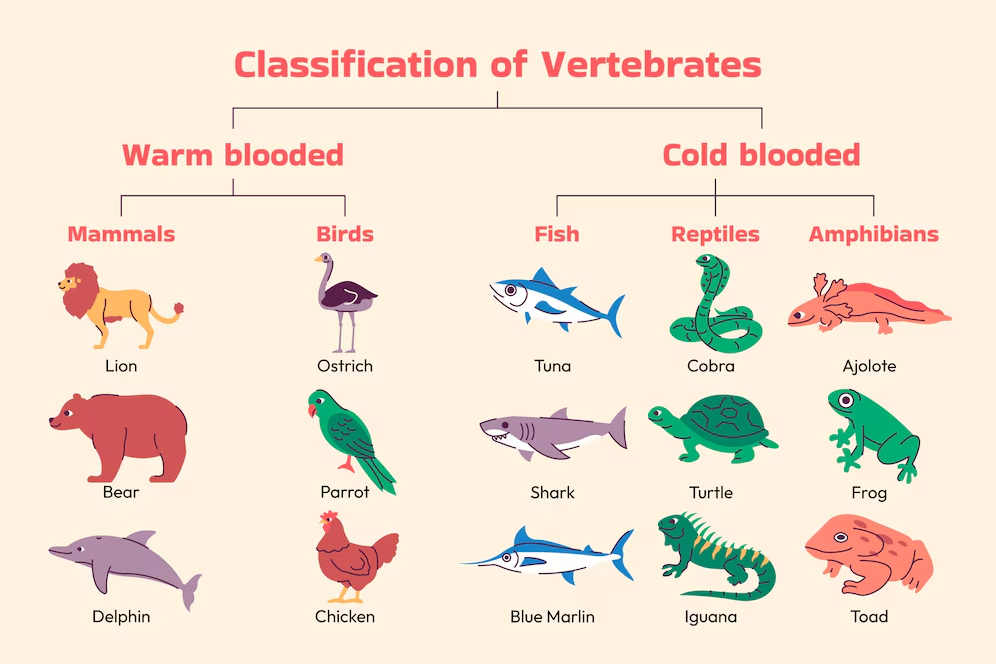
The above diagram summarizes the broad divisions in the Classification of Animal Kingdom and visually represents the major phyla and their relationships.
Important Rules and Relationships in Animal Classification
Certain principles guide how animals are grouped:
- Law of Priority in Nomenclature: The first validly published name is accepted, avoiding multiple names for the same organism.
- Binomial Nomenclature: Every species receives a two-part scientific name (Genus + species), for example, Homo sapiens.
- Phylogenetic Classification: Classification based on evolutionary history and relationships (phylogeny), not just physical features.
These rules ensure clarity and global consistency in identifying and grouping organisms, an idea frequently tested in NEET application questions.
Features and Limitations of Animal Kingdom Classification
Key Features
- Arranges animal diversity systematically for easy study
- Reveals evolutionary relationships
- Helps identify unique and shared characteristics
- Supports better understanding of animal physiology and ecology
Limitations
- Some organisms show features of more than one group, making classification difficult
- Constant discoveries require regular updates to the system
- Traditional systems may not always match new evolutionary data
Why is Classification of Animal Kingdom Important for NEET?
This topic is highly relevant in NEET because:
- It is the backbone of the Animal Kingdom chapter, contributing to a significant number of MCQs each year.
- Questions frequently test identification, features, examples, and distinguishing characters of different phyla and classes.
- Good conceptual clarity helps students apply knowledge in related topics like evolution, physiology, and ecology.
- Understanding classification supports easy memorization and reduces confusion during rapid revision.
How to Study Classification of Animal Kingdom Effectively for NEET
- Start by visualizing the classification chart to understand broad divisions and subgroups.
- Memorize the unique and distinguishing features of each major phylum with suitable examples.
- Create tables or flashcards to compare features of similar groups (e.g., chordates vs. non-chordates).
- Practice MCQs on identifying features, phylum examples, and exceptions as these are commonly asked.
- Revise nomenclature rules and classification hierarchies regularly.
- Go through past NEET questions to understand important patterns and repeated question types.
Common Mistakes Students Make in Animal Kingdom Classification
- Confusing examples between similar-sounding phyla (e.g., Echinodermata and Coelenterata)
- Missing key differentiating features, like notochord presence
- Forgetting the order of taxonomic categories
- Neglecting to revise binomial nomenclature and scientific names
- Not practicing MCQs enough, leading to easy errors during the exam
Quick Revision Points
- Classification organizes animal diversity into hierarchical groups.
- Main criteria: symmetry, levels of organization, coelom, segmentation, and presence of notochord.
- Non-chordates lack notochord; chordates possess it (at least in embryo).
- Porifera - simplest, multicellular, no tissues; Arthropoda - largest phylum.
- Remember phylum-wise key examples and features for quick recall.
- Law of Priority and Binomial Nomenclature are vital rules.
- Practice diagrams and tables for effective last-minute revision.
FAQs on Classification of Animal Kingdom for NEET Students
1. What is the basis of classification of animal kingdom for NEET?
Classification of animal kingdom in NEET is mainly based on structural and functional characteristics of organisms. Key criteria include:
- Level of Organisation (cellular, tissue, organ, organ system)
- Body Symmetry (asymmetrical, radial, bilateral)
- Germ Layers (diploblastic, triploblastic)
- Coelom (acoelomate, pseudocoelomate, coelomate)
- Segmentation (metamerism)
- Notochord presence or absence
2. What are the major phyla of animal kingdom according to NEET syllabus?
The major phyla included in the NEET syllabus for Animal Kingdom are:
- Porifera
- Coelenterata (Cnidaria)
- Ctenophora
- Platyhelminthes
- Nematoda (Aschelminthes)
- Annelida
- Arthropoda
- Mollusca
- Echinodermata
- Hemichordata
- Chordata (including Urochordata, Cephalochordata, Vertebrata)
3. What is the difference between vertebrates and invertebrates in animal classification for NEET?
Vertebrates and invertebrates differ mainly by the presence or absence of a vertebral column. Main differences:
- Vertebrates (Chordata): Have backbone/spinal column, closed circulatory system, complex organ systems. Examples: Fishes, Amphibians, Reptiles, Birds, Mammals.
- Invertebrates: Lack backbone, mostly simpler body structures. Examples: Porifera, Arthropoda, Mollusca.
4. How are animals classified based on body symmetry in NEET Biology?
Animal classification based on body symmetry is important for NEET. Animals show three types:
- Asymmetrical: No symmetry (e.g., Porifera).
- Radial symmetry: Symmetry around a central axis (e.g., Coelenterates, Echinoderms in adults).
- Bilateral symmetry: Divisible into equal left and right halves (e.g., Platyhelminthes to Chordates).
5. What are the main characteristics of the phylum Arthropoda for NEET?
Phylum Arthropoda is the largest animal phylum and is extensively covered in NEET syllabus. Major features include:
- Jointed appendages
- Chitinous exoskeleton
- Shed (moult) exoskeleton (ecdysis)
- Bilateral symmetry and segmentation
- Open circulatory system
- Diverse groups: Insects, Arachnids, Crustaceans, Myriapods
6. What are diploblastic and triploblastic organisms as per NEET animal classification?
Diploblastic organisms have two embryonic germ layers while triploblastic have three. For NEET:
- Diploblastic: Outer ectoderm and inner endoderm (e.g., Coelenterata).
- Triploblastic: Ectoderm, mesoderm, endoderm (e.g., Platyhelminthes to Chordata).
7. What is coelom and its types according to NEET syllabus?
Coelom is the body cavity lined by mesoderm, vital for NEET animal classification. Types include:
- Acoelomate: No body cavity (e.g., Platyhelminthes).
- Pseudocoelomate: Cavity not entirely lined by mesoderm (e.g., Nematoda).
- Coelomate: True coelom entirely within mesoderm (e.g., Annelida, Arthropoda, Chordata).
8. What is the importance of classification of animal kingdom for NEET students?
Classification of animal kingdom simplifies understanding of vast animal diversity for NEET.
- Makes learning animal features, evolution and relationships easier
- Helps in quickly identifying key phyla during NEET exam MCQs
- Clarifies structural and functional differences
9. What are the levels of organisation in animal kingdom for NEET?
Animals in the kingdom show four main levels of organisation, important for NEET:
- Cellular (e.g., Porifera)
- Tissue (e.g., Coelenterata)
- Organ (e.g., Platyhelminthes)
- Organ system (from Aschelminthes onwards)
10. State the criteria for the classification of animals.
The major criteria for classification of animals are:
- Levels of organisation (from cellular to organ system)
- Body symmetry (asymmetrical, radial, bilateral)
- Germ layers (diploblastic/triploblastic)
- Type of coelom (acoelomate, pseudocoelomate, coelomate)
- Segmentation (absent or present)
- Presence or absence of notochord
11. Give the characteristics of phylum Mollusca.
Phylum Mollusca is the second largest in animal kingdom, frequently appearing in NEET questions. Key features:
- Soft, unsegmented body
- Usually covered by a calcareous shell
- Presence of mantle and muscular foot
- Reduced coelom
- Molluscs include snails, mussels, octopuses
