



Stepwise Answers and Exam Tips for NCERT Class 4 English Chapter 11
Class 4 English Chapter 11 A Journey to the Magical Mountains Question Answer
Let us Think (Pages 116-117)
A. Answer the following.
Question 1. Who was Minam, and what did she enjoy to do with her grandfather?
Answer: Minam was a young girl who lived with her grandfather in a village at the base of the majestic Himalayas. She loved listening to his mountain stories, as he had once been a Sherpa.
Question 2. What did Minam’s grandfather say to her one sunny morning?
Answer: One bright morning, Minam’s grandfather told her that she had grown strong and was now able to walk long distances. He said he would take her on a special trip to show her the beauty of the Himalayas.
Question 3. What items did Minam pack for her journey to the mountains?
Answer: Minam filled her bag with rotis and achaar, two bottles of water, and her favourite fruit—apples.
Question 4. Where did Minam and her grandfather stop for lunch? What did they do there?
Answer: Minam and her grandfather paused by a river for lunch to enjoy their rotis. Minam watched the fish swimming, dipped her feet in the cool water, and laughed happily while eating an apple.
Question 5. What was Minam’s reaction when she saw snow for the first time?
Answer: Minam had never seen so much snow before, so she laughed and played as she made small snowmen with her grandfather.
Question 6. What did Minam promise her grandfather at the end of their journey?
Answer: At the end of their journey, Minam promised her grandfather that she would always care for and protect the mountains.
B. Think and discuss
Question 1. Minam enjoyed learning from her grandfather during their walk. Is there someone in your family or community who teaches you special things? What have you learned from them?
Answer: Students should do it by themselves.
Question 2. Minam saw yaks and mountain goats helping people in the mountains. Can you think of animals or things in your surroundings that are very important to the people around you? How do they help?
Answer: Many domestic animals live around us and are very helpful. Cows and buffaloes provide milk, while horses and donkeys carry heavy loads. There are many other useful animals that support us in different ways.
Question 3. Minam promised to protect the mountains. Is there something in nature around your home, school, or neighbourhood that you feel should be protected? What would you do to keep it safe?
Answer: Students should do it by themselves.
C. Match the following based on the story.
Answer:
Let us Learn (Page 117-120)
A. Use the words to complete these sentences.

1. Minam saw the tall peaks of the ________.
2. Her grandfather was once a ________ .
3. They went on a long ________ to the mountains.
4. Yaks are used by mountain people to carry heavy ________ .
5. They saw the snow-covered mountains. She and her grandfather made a small ________ .
6. The day created beautiful ________ for Minam.
Answer:
1. Himalayas
2. Sherpa
3. journey
4. loads
5. snowman
6. memories
B. Solve the crossword puzzle.
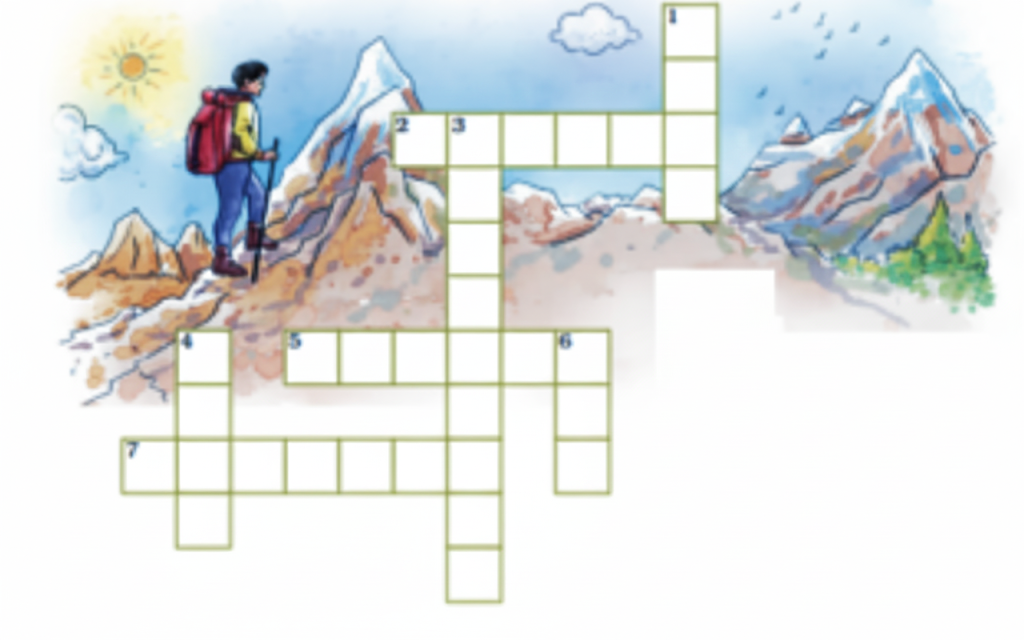
Clues:
Across
2. Guide who helps climbers in the Himalayas.
5. A low area of land between mountains,
7. A trip from one place to another.
Down
1. The pointed top of a mountain.
3. The tallest mountain range in the world.
4. White cover on the top of mountains.
6. A large animal used in mountain regions for milk and wool.
Answer:
Down:
1. Peak
3. Himalayas
4. Snow
6. Yak
Across:
2. Sherpa
5. Valley
7. Journey
C. Match each word with its correct meaning.
Answer:
D. Read these lines from the lesson.
“Once upon a time, in a small village at the foot of the mighty Himalayas, live a young girl name Minam.”
Did you know that we use names of body parts to describe other objects? Below are some examples:
Legs of the table
Hands of the clock
Foot of the mountain
Neck of the bottle
Now, it’s your turn to think creatively! Match the objects below with the correct “body part” they are often compared to.
1. …………….. of the river a) Eye
2. …………….. of the chair b) Mouth
3. …………….. of the city c) Arm
4. …………….. of corn d) Heart
5. …………….. of a needle e) Ear
Answer:
Let us Write (Pages 120-122)
A. Look up a dictionary and find the meaning of the words in the box. Later label the picture.

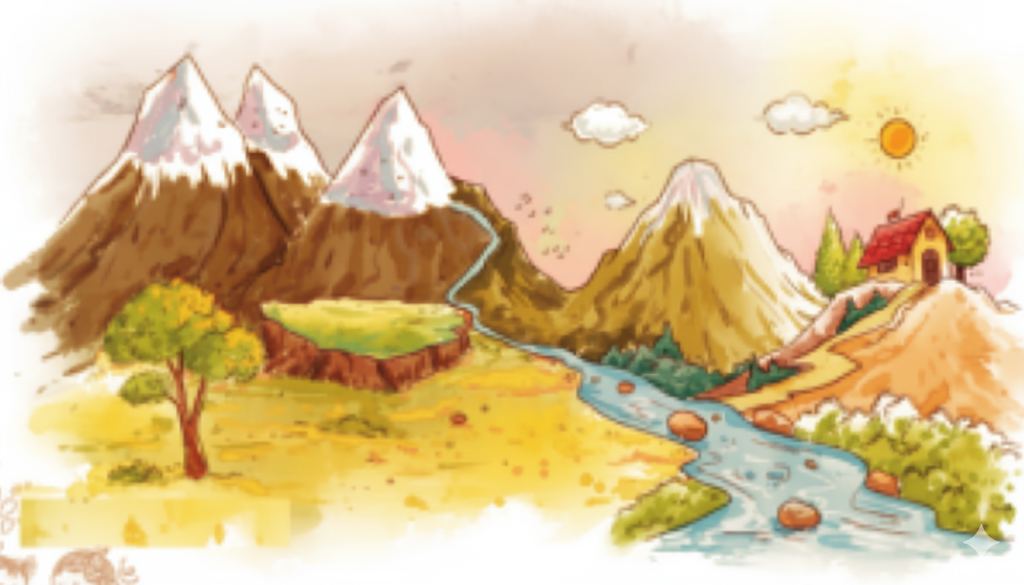
Answer:
Plain: A wide stretch of flat or gently sloping land.
Slope: A surface that rises or falls at an angle.
River: A large natural flow of water that moves through a channel toward a sea, lake, or another river.
Plateau: A high area of land that is mostly flat on top.
Valley: A low-lying area between hills or mountains, often with a river flowing through it.
Hill: A raised area of land that is smaller than a mountain.
Mountain Range: A group or chain of mountains connected together.
Summit: The top or highest point of a mountain or hill.
Foot: The bottom or base part of a hill or mountain.
Label the Picture.
Answer: Students should do it by themselves.
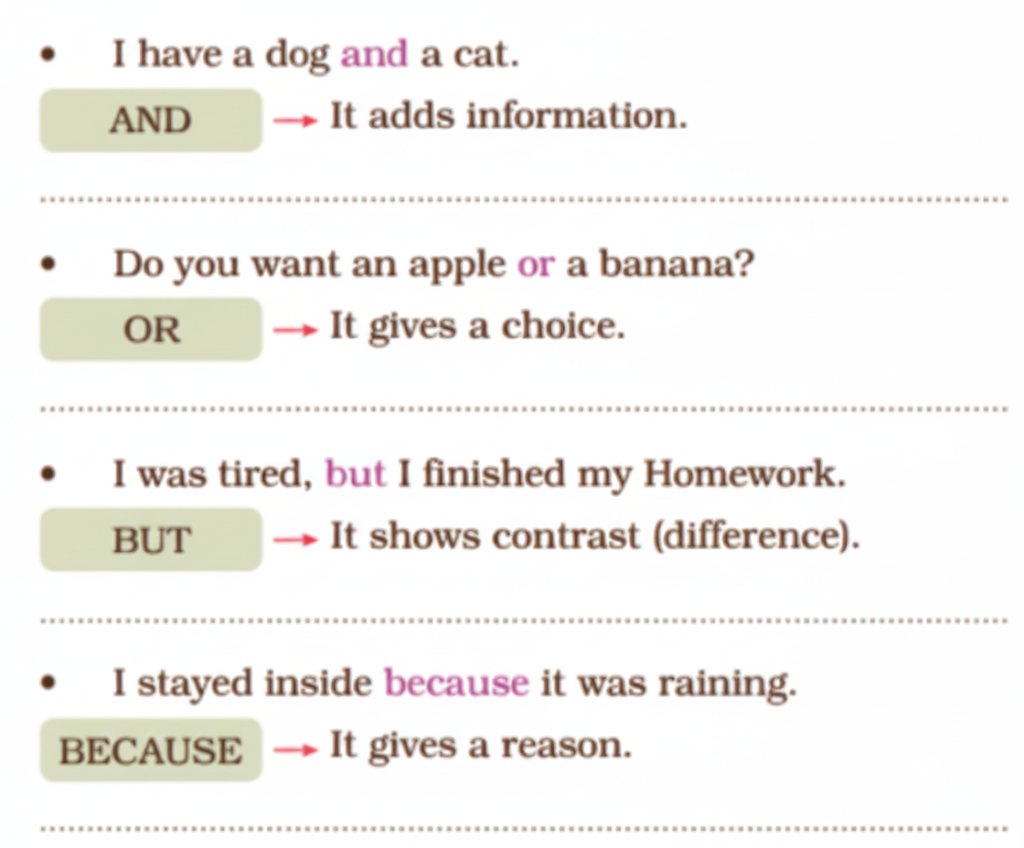
The words that join two or more words, phrases, or sentences together are known as Conjunctions. They help make sentences flow better and add meaning.
Example:
Example:
I have a dog and a cat.
AND → It adds information.
____________________________________
Do you want an apple or a banana?
OR → It gives a choice.
____________________________________
I was tired, but I finished my Homework.
BUT → It shows contrast (difference) .
____________________________________
I stayed inside because it was raining.
BECAUSE → It gives a reason.
____________________________________
B. Join the sentences using the correct conjunction.
1. She was hungry. She ate a sandwich. (or/but/ because)
____________________________________
2. I wanted to go out. It was too late. (or/and/but)
____________________________________
3. He was happy. He got a new toy. (or/and/ because)
____________________________________
4. We can go to the zoo. We can go to the aquarium. (or/but/because)
____________________________________
5. Aman has a pen. Aman has a pencil. Aman has an eraser. (or/because/and)
6. Simran loves to eat mangoes. She loves bananas. (or/and/but)
____________________________________
7. He ran fast. He missed the bus. (and/but/ because)
____________________________________
8. She stayed home. She was not feeling well. (or / and/because)
____________________________________
9. I love chocolate. I love vanilla. (and/but/or)
____________________________________
10. The baby is crying. He is hungry. (but/or/ because)
____________________________________
Answer:
1. She ate a sandwich because she was hungry.
2. I wanted to go out but it was too late.
3. He was happy because he got a new toy.
4. We can go to the zoo or museum.
5. Aman has a pen, pencil and an eraser.
6. Simran loves to eat mangoes and bananas.
7. He ran fast but missed the bus.
8. She stayed at home because she was not feeling well.
9. I love chocolate and vanilla.
10. The baby is crying because he is hungry.
Let us Speak (Page 123)
Form your class into two groups, A and B. Each group will sit facing each other. Follow the instructions to play the ‘Sentence Completion’ game.
1. A child from group A will say the beginning of a sentence such as:
On a bright summer morning, ________
_____________________________
(A child from group B will complete the sentence.)
2. Next, a child from group B, will be invited to say the beginning of another sentence ch as:
One day, a clever squirrel decided _______________
______________________________________
(A child from group A will complete the sentence.)
Answer: Students should do it by themselves.
Let us Do (Page 124)
Pick any one of the given mountain animal or bird.

Find out details about them. You may include their picture, habitat, adaptation, life cycle and lifestyle, as will as how they survive in harsh conditions.
Design a colourful chart with drawings, pictures, and captions about the animal or bird. Make a presentation and present it to the class.
Answer: Students should do it by themselves.
Let us Explore (Page 124)
Collect pictures and facts about the first woman to climb Mount Everest twice.
Answer: Santosh Yadav, an Indian mountaineer, became the first woman to climb Mount Everest twice. She achieved this remarkable feat in 1992 and again in 1993, making her the only woman in the world to reach the summit twice within a year. She was born on 10 October 1967 in a small village called Joniyawas in the Rewari district of Haryana, India.
A Journey to the Magical Mountains – Chapter Highlights
Dive into NCERT Solutions Class 4 English Santoor Chapter 11 A Journey to the Magical Mountains (2026-27) to understand inspiring lessons about courage, nature’s wonders, and strong family bonds. This chapter teaches valuable values through Minam’s memorable mountain adventure.
By exploring NCERT Class 4 English Chapter 11, students discover how nature connects with our lives and why protecting the mountains is important. Careful study of this chapter helps build strong language and comprehension skills for exams.
Use these detailed chapter-wise NCERT solutions to revise important events and strengthen your answers. Regularly practicing exercise-based questions from A Journey to the Magical Mountains ensures strong preparation for your upcoming exams and boosts your confidence.
FAQs on NCERT Solutions For Class 4 English Santoor Chapter 11 A Journey To The Magical Mountains - 2026-27 Free PDF Download (Login Required)
1. What are the main points of Chapter 11 Class 4 English?
Chapter 11, A Journey to the Magical Mountains, teaches important values through an engaging story. Key takeaways include:
- Discovering the wonders of the mountains and nature
- Learning the value of friendship and teamwork
- The importance of helping others and being brave
- Understanding descriptive language used in English
2. How can I download NCERT Solutions for Class 4 English Chapter 11?
You can easily download the NCERT Solutions for Class 4 English Santoor Chapter 11 as a free PDF for offline study. Use platforms offering:
- Single-click PDF download links
- Exercise-wise stepwise answers
- CBSE 2026–27 syllabus-aligned content
3. Are NCERT Solutions sufficient to score well?
NCERT Solutions are the best starting point for CBSE Class 4 English exams. They help you:
- Understand the textbook concepts clearly
- Practice accurate stepwise answers
- Revise key concepts and important questions
4. How to write stepwise NCERT answers to score full marks?
To score full marks in Class 4 English Chapter 11 answers:
- Read the question carefully and include all required points
- Write stepwise, neat answers following NCERT pattern
- Use important keywords and the exact terminology from the chapter
- For long answers, use paragraphs and bullet points to organize your response
5. Where can I get the chapter’s solutions PDF for offline study?
You can get the NCERT Solutions Class 4 English Santoor Chapter 11 PDF from reliable educational websites. Look for:
- Free, single-click downloads
- Updated for CBSE 2026–27
- Exercise-wise, stepwise answers included
6. Are diagrams or definitions mandatory in answers for Chapter 11?
For Class 4 English Chapter 11, diagrams are usually not required but clear definitions of key terms help score better. Tips:
- Write concise, textbook-based definitions where asked
- Label any pictures neatly if needed
- Use glossary terms provided in the NCERT book
7. What are the most important topics from this chapter?
The most important topics in NCERT Class 4 English Chapter 11 A Journey to the Magical Mountains are:
- Main story events and characters
- The message about teamwork and courage
- Key vocabulary words from the chapter
- Exercise-wise questions and answers
8. How do I structure long answers for better marks?
To write high-scoring long answers for Class 4 English Chapter 11:
- Start with an introduction mentioning the chapter and main idea
- Use 2–3 body paragraphs covering points in required order
- Include examples or events from the story
- Conclude with a clear final sentence
9. How to learn diagrams/maps for this chapter?
While NCERT Solutions for Class 4 English Chapter 11 rarely require diagrams, if asked to label a picture:
- Practice neat and accurate labelling
- Use clear headings and map conventions from examples
- Revise common labels related to mountains and nature
10. Do examiners award partial marks for correct steps even if the final answer is wrong?
Yes, in the CBSE marking scheme for Class 4 English, partial marks are often given if your steps are logical, even if the final answer is wrong. Tips:
- Always show each step of your answer
- Use keywords and pointwise format for clarity
- This ensures you still get marks for correct explanations and efforts
11. Which questions are likely from this chapter in school exams?
Frequently asked questions from Class 4 English Chapter 11 A Journey to the Magical Mountains include:
- Main events or moral of the story
- Fill in the blanks or match the following from the chapter
- Word meanings and definitions
- Short and long answer type questions based on exercises
