



Exercise-wise Answers and Key Tips for Maheshwar – Santoor Chapter 12
Class 4 English Chapter 12 Maheshwar Question Answer
Let us Think (Pages 128-129)
A. Answer the following.
Question 1. Who was Ahilya Bai?
Answer: Ahilya Bai was the ruler of Maheshwar, a town in Madhya Pradesh. She belonged to the respected Holkar family.
Question 2. Where is Maheshwar Fort located? What makes its location special?
Answer: Maheshwar Fort is situated about 95 kilometres from Indore on the banks of the Narmada River. The fort she built features overhanging balconies that appear to be suspended in the air.
Question 3. What materials were used to build Maheshwar Fort, and where did they come from?
Answer: The fort was constructed using special red stones brought from Gujarat and Rajasthan.
Question 4. What does the statue of Queen Ahilya Bai in front of the palace represent?
Answer: The statue of Queen Ahilya Bai still stands in front of the palace, like a protector keeping watch over her land.
B. Think and discuss
Question 1. Aarav and Ananya get excited about visiting Maheshwar Fort. What do you think makes historical places like this interesting?
Answer: Historical sites like Maheshwar Fort are fascinating because they make the past feel real. Instead of only reading about history, you can see the places where rulers lived, battles took place, and cultures grew. Each wall, carving, and hallway tells its own story, which makes these places exciting and full of wonder.
Question 2. If you were Aarav or Ananya, what part of the fort would you be most excited to seethe overhanging balconies, the statue, or the temples? Why?
Answer: If I were Aarav or Ananya, I would be most eager to see the overhanging balconies. They must give beautiful views of the Narmada River and the nearby town. I would also love to imagine how it felt to stand there long ago as a ruler or royal visitor. There is something truly special about being in a place where history once came alive.
Let us Learn (Pages 129-130)
A. The words “smiling”, “grinning”, have similar meanings.
Example:
happy, joyful, cheerful
brave, bold, fearless
Given below are sets of words that have similar meaning along with a word that do not fit the group. Circle the odd one out.
1. sad, unhappy, tearful, thrilled
2. talk, discuss, kind, speak
3. noisy, quiet, silent, calm
4. cotton, wooden, silk, woollen
Answer:
1.thrilled
2. kind,
3. noisy
4. wooden,
Find out two such sets of words and write them below.
………………. . ………………. . ………………. .
………………. . ………………. . ………………. .
Answer:
Hen, peacock, sparrow, cuckoo
Pen, pencil, eraser, table
B. Read the word ‘design’ aloud. What did you observe?
The letter ‘ g ‘ is silent.
Now, read the following words. Underline the words that have a silent ‘g ‘ letter.
sign, light, goat, night, sing, sugar, king, high, magnet
Answer: sign, light, sugar, king, goat, high, night, sing, magnet
C. Match the following.
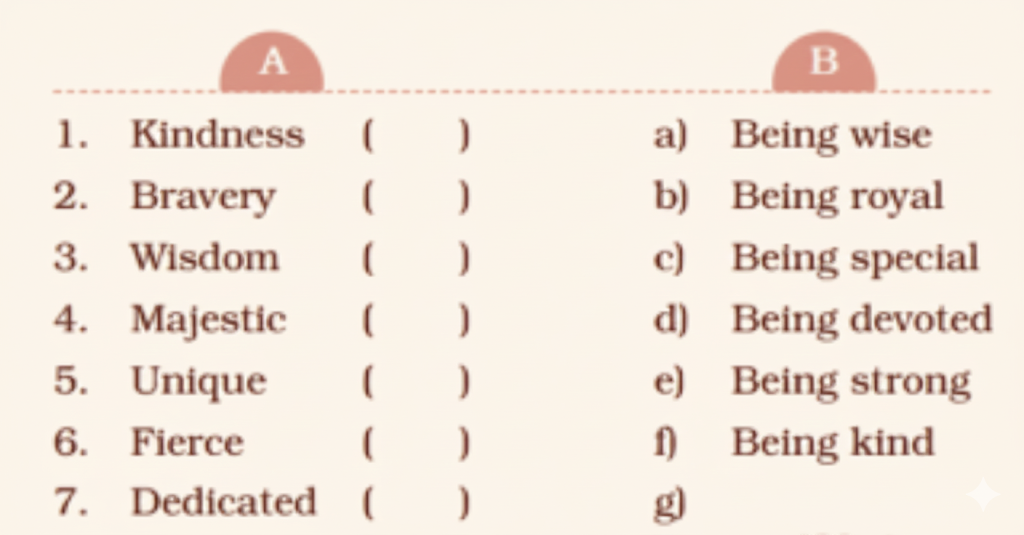
Answer:
Let us Listen (Page 131)
Listen to your teacher narrating the following passage.
The Maheshwari sarees were originally made of pure silk, but cotton yarn was later introduced. As they gained popularity the handloom weaving tradition in Maheshwar began.
These sarees are famous for their unique reversible borders and pallus, showcasing a blend of cotton and silk threads. They are traditionally made in colours like peacock blue, bright yellow, forest green, and an Indian red dye called Aal.
Today, Maheshwari sarees are available in both national and international markets.
Arrange the following sentences in the order in which they appear in the passage.
Later, Maheshwari sarees are made with a blend of silk and cotton. ( )
Today, these sarees are available both in India and other countries. ( )
The weavers originally used pure silk . ( )
The sarees are famous for their reversible borders. ( )
Answer:
The weavers first used only pure silk.
Later, Maheshwari sarees began to be woven using a mix of silk and cotton.
These sarees are well known for their reversible borders.
Today, they are sold in India as well as in other countries.
Let us Speak (Page 132)
A. Find out from the elders of your home and your locality about any historical place that is there in your town or nearby. You may consider more than one place tool Collect information and pictures of that place and present it to the class.
Your presentation must include:
Name of the place
Name of the monument
Historical people associated with that monument
Special features of that monument
How the monument is connected to the people (emotionally)
Any other relevant information.
Answer: Students should do it by themselves.
A. Complete the following passage with suitable Articles (a, an and the)
Once upon _______ time, there live _______ monkey on _______ oak tree. One day, _______ monkey saw _______ old man with _______ bag _______ naughty monkey snatched the bag. Inside _______ bag was _______ apple, _______ pear, _______ olive and _______ carrot.
It gave _______ pear to _______ elephant and _______ carrot to _______ bear. It kept _______ olive and _______ apple inside _______ empty box. While _______ monkey slept, _______ dog found _______ apple and stole it. The monkey was left with only _______ olive to eat.
Answer:
Once upon a time, a monkey lived in an oak tree. One day, he saw an old man carrying a bag, and the naughty monkey quickly grabbed it. Inside the bag were an apple, a pear, an olive, and a carrot. The monkey gave the pear to an elephant and the carrot to a bear. He kept the apple and the olive in an empty box. While the monkey was sleeping, a dog found the apple and took it away. In the end, the monkey was left with only the olive to eat.
Let us Write (Page 133)
A. Imagine you are visiting Maheshwar Fort with your family. Write a short description of what you see and feel as you explore the fort’s balconies and temples.
Answer:
A Visit to Maheshwar Fort
As I enter Maheshwar Fort with my family, it feels like stepping into another time. The high stone walls and old carvings seem to share tales from the past. I walk along the overhanging balconies, enjoying the cool breeze from the Narmada River flowing below. The view is lovely, and I imagine queens once standing here, gazing at the same river.
We visit the temples inside the fort, where the gentle ringing of bells and the fragrance of incense fill the space. The finely carved statues and pillars look so detailed that they almost appear alive. I feel calm and amazed by how grand and well-preserved everything is.
Visiting Maheshwar Fort fills me with pride in our heritage. It is a place rich in stories, beauty, and wonder.
B. Based on the facts that you have learnt in the lesson, write a short paragraph on the Maheshwar Fort.
Answer: Maheshwar Fort is a stunning historical site situated on the banks of the Narmada River in Madhya Pradesh. It once served as the capital of the Holkar dynasty and was ruled by the well-known queen Ahilyabai Holkar. The fort is famous for its stone balconies, beautifully carved temples, and calm river scenery. It is a place rich in history, culture, and architecture. Visiting Maheshwar Fort allows us to understand India’s royal heritage and appreciate the skill of ancient craftsmen.
Let us Do (Page 134)
Form your class into two groups, A and B. Each group will sit facing to each other. Follow the instructions to play the. ‘Sentence Completion’ game.
I. Draw a template of a puzzle like this on thick chart paper/ cardboard.

II. On the back side of the puzzle draw a picture of a fort like this.

III. Cut the puzzle using child friendly scissors along the lines to separate into puzzle pieces.

IV. Mix the puzzle pieces and try rearranging them into a fort. Play with your friends.

Answer: Students should do it by themselves.
Explore Maheshwar Fort with NCERT Solutions Class 4 English Santoor Chapter 12 (2026-27)
Discover the story of Maheshwar Fort and Queen Ahilya Bai in NCERT Solutions Class 4 English Santoor Chapter 12 Maheshwar. Understanding the history, architecture, and culture makes learning fun and prepares you for success in your 2026-27 exams.
Learning about historical monuments like Maheshwar Fort helps students appreciate India's rich heritage. Pay attention to the unique features such as overhanging balconies, special red stones, and the legacy of Maheshwari sarees to answer questions confidently in exams.
Use these chapter-wise NCERT solutions to strengthen your understanding and score high marks. Practice all exercises, revise important points, and remember Queen Ahilya Bai’s inspiring story for lasting exam success.
FAQs on NCERT Solutions For Class 4 English Santoor Chapter 12 Maheshwar - 2026-27 Free PDF Download (Sign-in Required)
1. What are the NCERT Solutions for Class 4 English Santoor Chapter 12 Maheshwar?
NCERT Solutions for Class 4 English Santoor Chapter 12 Maheshwar provide step-by-step answers to all textbook exercises, helping students master the chapter and boost exam scores. Key features include:
- Comprehensive solutions to all in-text and back exercise questions
- Answers written in a student-friendly language, following the CBSE 2026-27 syllabus
- Incorporation of important keywords and definitions for better marks
2. How should I write stepwise answers for Class 4 English Chapter 12 to score full marks?
To score full marks in Chapter 12 Maheshwar, present your answers in a clear, stepwise format as per the CBSE marking scheme:
- Begin with an introduction or main point using chapter keywords
- Break down longer answers into logical steps or list format
- Include definitions, examples, or references when relevant
- Ensure correct grammar, spelling, and neat presentation
3. Which questions from NCERT Class 4 English Chapter 12 Maheshwar are important for exams?
The most important questions from Chapter 12 Maheshwar typically include:
- Short answer questions covering chapter theme and characters
- Definitions of key terms in the story
- Questions requiring descriptions or summaries of chapter events
- Diagram/map labelling if present in the textbook exercise
4. Are diagrams or definitions required in answers for Chapter 12 Maheshwar?
Including definitions and diagrams where asked in Class 4 English Santoor Chapter 12 helps you score higher:
- Definitions: Write clearly, using textbook language for full marks
- Diagrams/Maps: Draw neatly, label all important parts or locations as per instructions
5. How do I structure long answers for Class 4 English exam questions?
Structure your long answers on Maheshwar with an introduction, main content, and conclusion for clarity and step marks:
- Start with a brief opening sentence stating the main idea
- Organise points with bullets or paragraphs for each step or detail
- Use keywords and examples from the text
- End with a conclusive sentence
6. Where can I download the Class 4 English Santoor Chapter 12 Maheshwar solutions PDF for free?
You can download a free PDF of NCERT Solutions for Class 4 English Santoor Chapter 12 Maheshwar from reputed educational websites that provide CBSE resources for 2026-27. Look for download buttons at the top or end of the solutions page for easy offline access.
7. Are NCERT Solutions sufficient for preparing Class 4 English exams?
NCERT Solutions for Class 4 English provide complete coverage of textbook questions, forming the base of exam preparation. For full exam readiness:
- Practice all NCERT exercises thoroughly
- Revise key definitions, summaries, and examples
- Try sample papers and important questions for better revision
8. How can I quickly revise Maheshwar Chapter 12 before exams?
To quickly revise Class 4 English Chapter 12 Maheshwar:
- Read the summary and main points
- Review key definitions and diagrams
- Practice stepwise answers from NCERT Solutions
- Use flash notes or revision planners for last-minute recap
9. What are common mistakes to avoid while answering questions from Maheshwar Chapter 12?
Avoid these common mistakes in Class 4 English Maheshwar answers:
- Missing stepwise details or keywords
- Incomplete or unclear definitions
- Incorrect or missing diagram labels
- Poor handwriting or untidy presentation
10. Do examiners give partial marks for correct steps even if the final answer is wrong?
Yes, in CBSE exams, including Class 4 English, examiners often award partial marks for correct steps or points, even if the final answer is incomplete or slightly incorrect. To maximise scores:
- Always show your steps clearly in longer answers
- Highlight important terms and explanations
11. How does using key definitions and examples in answers help in CBSE marking for Chapter 12?
Including key definitions and relevant examples in your answers demonstrates understanding and meets CBSE’s marking criteria. This approach helps:
- Show subject knowledge and textbook alignment
- Earn full marks for each step or section
12. How do I label diagrams or maps accurately in Class 4 English Chapter 12?
For neat and correct diagram or map labelling in Chapter 12 Maheshwar:
- Use a ruler and pencil for drawing and labelling
- Write labels clearly, using textbook terminology
- Mark all required parts or locations as asked in the question
