



Stepwise Answers for Class 4 English Chapter 5: The Old Stag
Class 4 English Chapter 5 The Old Stag Question Answer
Let us Think (Page 47)
A. Answer the following.
Question 1. Why was the old stag popular?
Answer: The old stag was well-loved for his gentle and caring nature. Every day, he warmly welcomed all the animals and birds, showing them affection, which made him admired and respected by everyone.
Question 2. Why did the old stag not go down the hillock to meet his friends?
Answer: The old stag had grown so weak from illness that he could no longer walk down the hillock. Although he wished to move, his legs refused to support him.
Question 3. Why did the green cover of the hillock slowly vanish?
Answer: The hillock lost its green cover as many of the visiting animals grazed on its grass.
Question 4. Did the animals realise their mistake towards the end? What did they do?
Answer: Yes, the animals did realise their mistake. Filled with guilt, they stopped grazing on the hillock and instead began bringing fresh leaves for the stag. It was their sincere apology—expressed through leaves.
B. Think and Discuss.
Question 1. Did the animals do the right thing in the end? Why do you think so?
Answer: Yes, they certainly did the right thing. Once they understood their careless behaviour, they made efforts to set things right. They respected the stag’s space, let the grass grow back, and even helped in his recovery. It is never too late to correct one’s mistakes.
Question 2. What would happen to the green plants around us if each one of us thought only of our own needs?
Answer: If everyone focused only on their own needs, the greenery around us would slowly vanish—much like cookies at a children’s party. The balance of nature would be disrupted, and resources would eventually be exhausted. Even a small amount of greed can lead us far in the wrong direction.
Let us Learn (Pages 47-49)
A. Match the words to their meaning.
Answer:
B. Look at the following words.
lush forest, friendly animals, shaded spot, tender grass, healthy food
These words are descriptive words that give us more details about scenes, people and objects. These words are used to make writing more interesting.
Draw the image that comes to your mind when you read the following.

Answer: Students should do it by themselves.
C. Read the following sentence.
Each day, he warmly greeted his fellow animals and birds.
The word ‘warmly’ is an adverb. Here, ‘warmly’ tells the way or the manner of the stag’s greeting.
Let’s take a look at some more examples:
The old stag slowly recovered.
The rabbit quickly ate the carrots.
The adverbs in the above sentences describe:
how the old stag recovered.
how the rabbit ate the carrots.
Encircle the adverbs that describe how something is done.
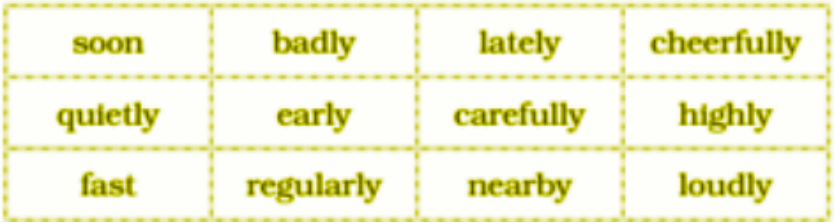
Answer: All the words given in the table are adverbs.
Now, work with your partner and write one sentence for each encircled adverb.
Answer: Sentences using each adverb:
Soon: I will be home soon.
Badly: He performed badly because he did not practice enough.
Lately: I have been feeling very busy lately.
Cheerfully: She cheerfully welcomed her friends every morning.
Quietly: The cat moved quietly through the grass.
Carefully: The artist carefully painted the picture.
Highly: The teacher highly praised the student’s efforts.
Fast: The dog ran fast to catch the ball.
Regularly: He exercises regularly to remain healthy.
Nearby: The bicycle is parked nearby.
Loudly: The children sang loudly at the school concert.
Let us Write (Pages 50-52)
A. Complete the story by writing dialogues in the speech blurbs.
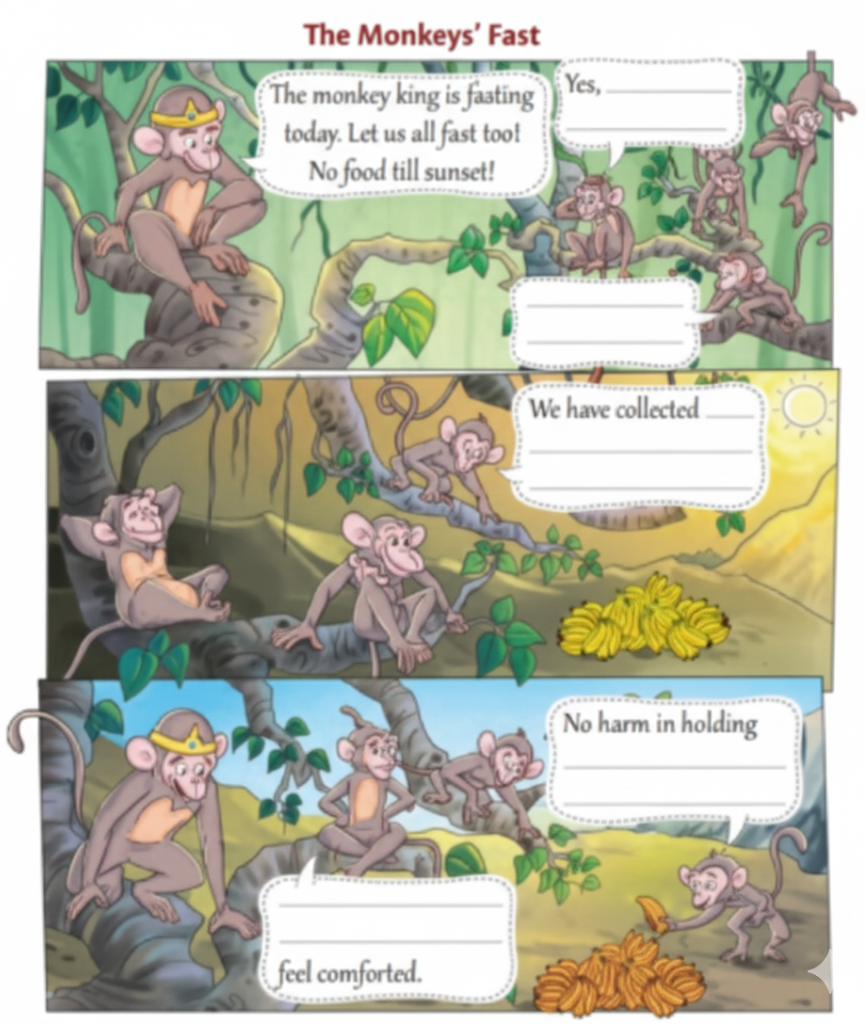
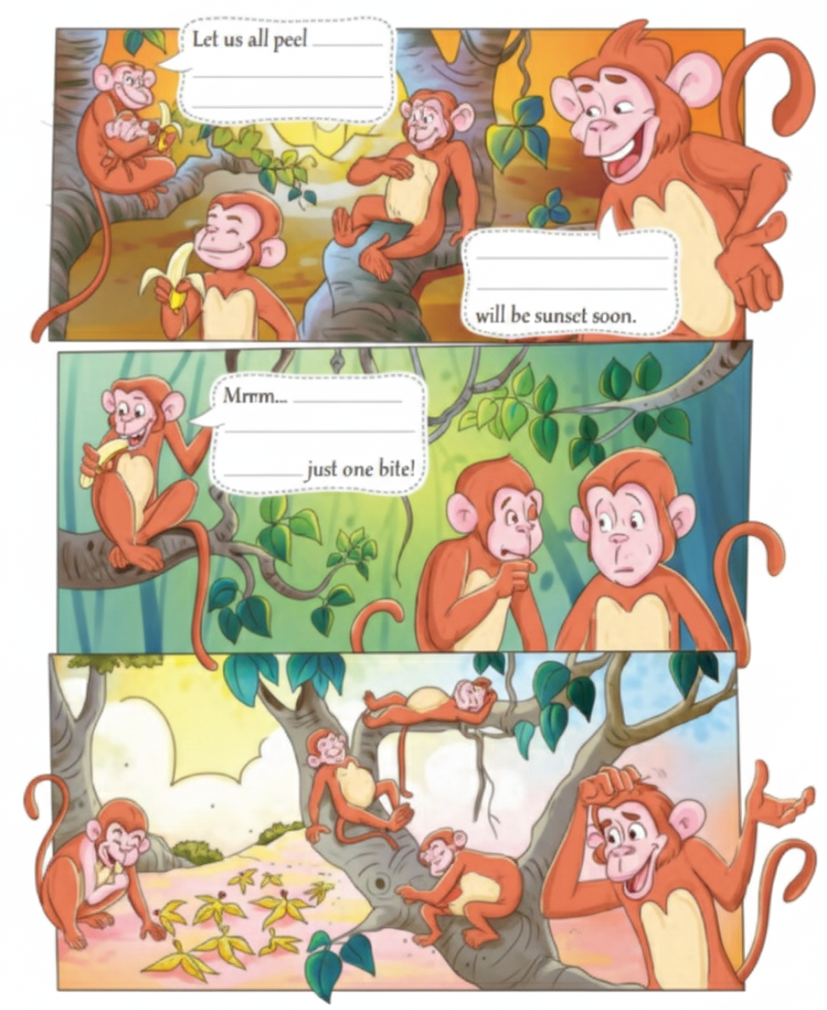
Answer: immmmmmmmmmm
B. Write about your best friend and complete the paragraph.
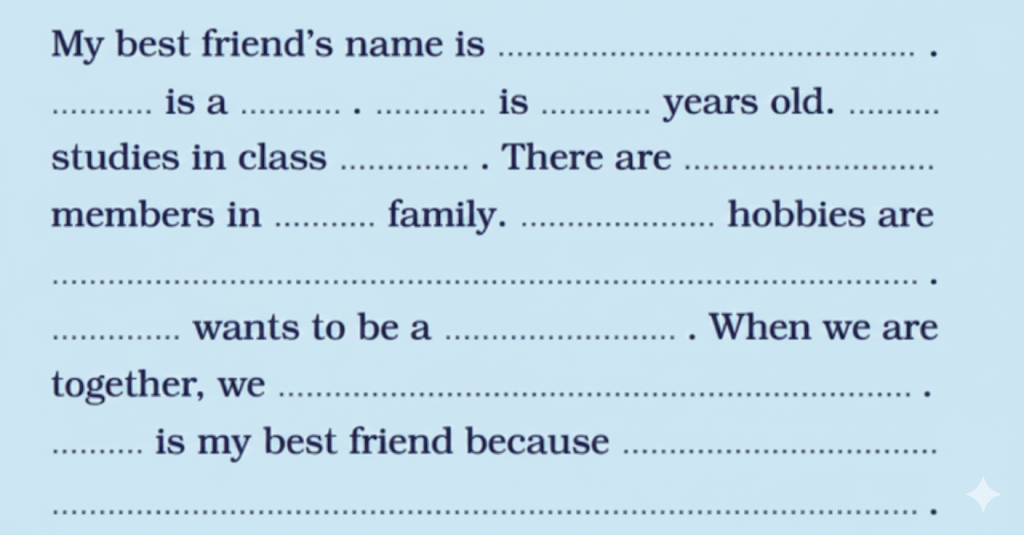
Answer: My best friend is named Hardik. He is a kind and well-behaved boy who is 9 years old and studies in Class 4. There are four members in his family. He enjoys drawing and playing cricket in his free time. He dreams of becoming a doctor one day. When we spend time together, we play games, share jokes, and help each other with our homework. He is my best friend because he is caring, helpful, and always brings a smile to my face.
Let us Speak (Page 53)
Look at this picture.
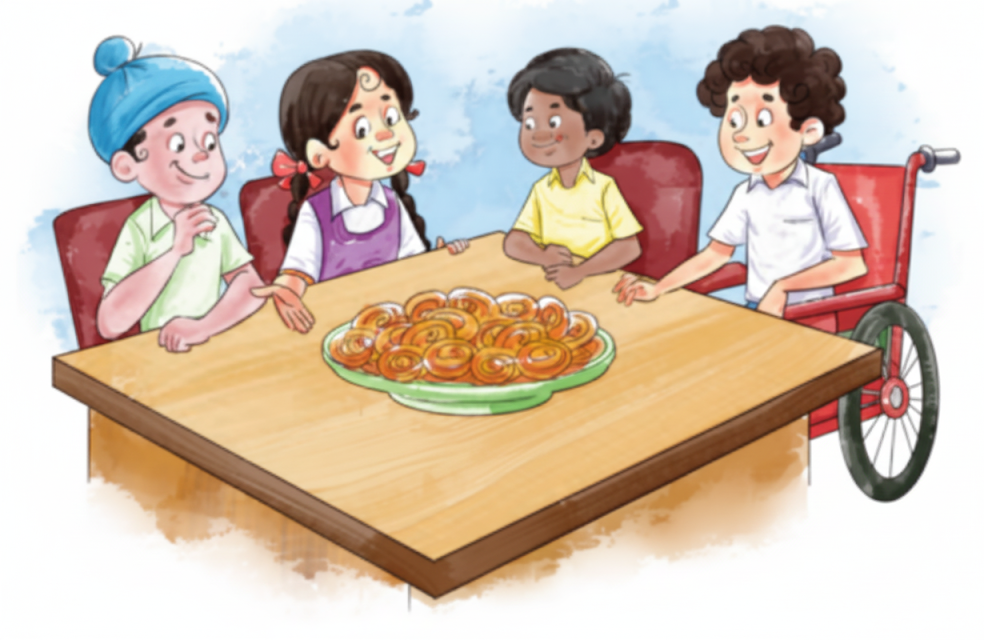
Imagine a large bowl of delicious jalebis is in your classroom. You and your friends start enjoying the sweets, one by one. Everyone loves the jalebis so much that you keep reaching for more. Now, think about what might happen next.
Discuss the following in the class:
Question 1. How would you feel if the jalebis were almost finished, but some friends hadn’t had enough yet?
Answer: I would feel a bit sad and guilty. Everyone deserves a chance to enjoy the jalebis, and I would want to make sure my friends also get their share.
Question 2. What will happen to the bowl of jelebis after some time?
Answer: After a while, the bowl will be empty if everyone keeps taking extra without considering others.
Question 3. Why is it important to share when we have something that everyone enjoys?
Answer: It is important to share because it shows kindness and care. Sharing brings happiness to everyone and helps us remain good friends.
Question 4. How can we make sure there are enough jalebis for everyone to enjoy.
Answer: We can count the jalebis and share them equally. Each person can take just one or two at first. This way, everyone gets a fair share and no one is left out.
Let us Do (Page 54)
Create a Thank You Card from the Old Stag.


Answer: Draw a picture on your own showing a stag surrounded by his friends in the forest.
Dear friends,
I am very grateful to all of you for supporting me during my illness. You stopped grazing on the hillock so that I could have enough food, and some of you even brought fresh green leaves for me. I will always remember and appreciate your kindness. Because of your help, I am now completely healthy.
From:
Stag
Key Highlights of NCERT Solutions Class 4 English Santoor Chapter 5 The Old Stag
The story "The Old Stag" from NCERT Class 4 English Santoor teaches us the value of kindness and sharing. By reviewing the chapter-wise solutions, students can build a clear understanding and improve their learning outcomes.
Practicing NCERT Solutions Class 4 English Santoor Chapter 5 The Old Stag (2026-27) helps students answer questions confidently in exams. These straightforward solutions simplify comprehension and enhance mastery over important concepts.
For best results, go through the NCERT book exercises regularly and revise key vocabulary and morals. Making regular practice a habit will boost your English skills and help you score well in your 2026-27 exams.
FAQs on NCERT Solutions For Class 4 English Santoor Chapter 5 The Old Stag - 2026-27 Free PDF Download (Sign-in Required)
1. How do I get NCERT Class 4 English Chapter 5 answers?
You can access NCERT Solutions for Class 4 English Chapter 5 The Old Stag online for free or download them as a PDF for offline study. These solutions include:
- Stepwise answers to all exercises
- Exam-ready formats with key definitions
- Summary and long answer guidance
- CBSE-syllabus compliance for 2026–27
Use these resources to practice and improve your exam performance.
2. Are these solutions CBSE exam-ready?
Yes, NCERT Solutions for Class 4 English Chapter 5 are designed as per the latest CBSE 2026–27 syllabus and marking scheme. They help you score full marks by providing:
- Step-by-step answers matching the CBSE evaluation style
- Sample presentation tips and answer structures
- Important keywords, definitions, and diagrams when needed
3. What is the summary of The Old Stag?
The Old Stag is a lesson in Class 4 English Santoor that teaches about wisdom, danger, and experience through a story of an old stag escaping hunters. Key points include:
- Animals warn the old stag about danger
- The stag uses its experience to survive
- The story emphasizes intelligence, alertness, and teamwork
- Students learn new vocabulary and story-telling skills
4. Where can I download PDF for Chapter 5?
You can download the free PDF of NCERT Solutions for Class 4 English Chapter 5 The Old Stag from trusted educational platforms. Look for:
- Chapterwise PDF download options
- Exercise-wise solutions for easy practice
- Resources aligned to the CBSE Class 4 English 2026–27 syllabus
5. Which questions are likely from this chapter in school exams?
Class 4 English Chapter 5 often includes these exam questions:
- Short answer questions about the story
- Word meanings and key definitions (e.g., 'stag', 'hunt')
- Long answer questions on the lesson theme or summary
- Drawing or labelling relevant story scenes/diagrams
Practicing back exercise questions is essential for exam preparation.
6. How to write stepwise answers for full marks in Class 4 English Santoor Chapter 5?
To score full marks, follow these exam-friendly steps for NCERT Solutions Class 4 English Chapter 5:
- Read the question carefully and start with a clear introduction
- Write answers in points or short, crisp sentences
- Include all keywords and definitions from the textbook
- Neatly underline important points (in exams)
7. Are diagrams or definitions mandatory in answers for The Old Stag?
Definitions are important for terms like ‘stag’, ‘hunter’, etc., and sometimes simple story illustrations or diagrams may be asked. Ensure you:
- Include definitions for new words
- Draw and label diagrammatic scenes if the question demands
- Keep diagrams neat and clearly labelled
8. How do I structure long answers for better marks in this chapter?
To structure long answers in Class 4 English Santoor Chapter 5 for maximum marks:
- Begin with a short introduction about the story
- Explain the main events in logical order
- Include the lesson or moral at the end
- Break into paragraphs and use bullet points for clarity
9. Why is it important to use NCERT Solutions for exam success?
NCERT Solutions for Class 4 English Chapter 5 help students by:
- Providing accurate, stepwise answers based on CBSE marking schemes
- Highlighting important definitions and themes
- Offering PDF downloads for revision anytime
- Improving answer presentation and exam timing
10. How can I revise Class 4 English Chapter 5 fast before exams?
The best way to revise NCERT Class 4 English Chapter 5 The Old Stag is to:
- Read the chapter summary and flash notes
- Practice all back exercise and intext questions
- Revise key definitions and any story diagrams
- Attempt sample and previous year questions for confidence
11. Are NCERT Solutions enough for Class 4 English exams?
NCERT Solutions for Class 4 English cover most of the exam syllabus and typical question patterns. For best results:
- Practice all exercise solutions
- Review important questions, revision notes, and sample papers
- Focus on key definitions, summaries, and answer presentation
12. Where to get chapterwise solutions PDF for offline study?
You can download chapterwise NCERT Solutions for Class 4 English as a PDF from major educational websites. These PDFs include:
- Stepwise, exercise-wise answers
- CBSE syllabus alignment
- Convenient for offline exam revision
13. What are the most important topics from this chapter?
Key topics in Class 4 English Santoor Chapter 5 The Old Stag include:
- Story summary and main events
- Key definitions (e.g., stag, hunter, experience)
- Moral of the story and what students learn
- Practice questions and diagrams
14. How to present long answers to match CBSE marking?
For long answers in Class 4 English Chapter 5:
- Introduce the topic in the first line
- Present answers with bullet points or short paragraphs
- Include all keywords, examples, and supporting details
- Conclude with the chapter's moral or lesson
15. Do examiners award partial marks for correct steps even if the final answer is wrong?
Yes, in CBSE marking scheme, examiners often give partial marks for correct steps or reasoning, even if the final answer is incorrect. Always:
- Show stepwise working
- Explain your thought process in the answer
- Highlight terms and important points for easy marking
16. Are references to textbook page numbers useful during revision?
Referring to textbook page numbers while revising NCERT Class 4 English Chapter 5 can be helpful for quick cross-checking. Benefits include:
- Fast location of important definitions, diagrams, and answers
- Easy navigation to related topics during last-minute revision
- More accurate and structured answers in exams
