



How to Write Full Marks Answers for Class 4 English Santoor Chapter 3?
Class 4 English Chapter 3 Be Smart, Be Safe Question Answer
Let us Think (Page 28)
A. Answer the following.
Question 1. What should you do before crossing a road?
Answer: Before crossing the road, we should use a zebra crossing if available. We must look to the right, then to the left, and again to the right to check for oncoming vehicles, and cross the road only when it is safe.
Question 2. Why should you not play on the footpath?
Answer: We should avoid playing on the footpath because it is meant for safe walking, and playing near roads can be risky and distracting.
Question 3. Why should you hold an adult’s hand while crossing the road?
Answer: We should hold an adult’s hand while crossing the road to remain safe and prevent accidents, as adults can guide and protect us in traffic.
Let us Learn (Pages 28-30)
A. True or False.
1. You should always walk on the footpath.
Answer: True
2. It is safe to run while crossing the road.
Answer: False
3. You should use the zebra crossing to cross the road.
Answer: True
4. Wearing dark clothes in the evening makes you more visible.
Answer: False
5. It is safe to play near the road.
Answer: False
6. You should wear headphones while walking on the road.
Answer: False
C. Encircle the correct option.
Question 1. What should you do before crossing a road?
(a) Run quickly
(b) Stop, look right, then left, again right
(c) Close your eyes
Answer: (b) Stop, look right, then left, again right
Question 2. Where should you walk near the road?
(a) On the footpath
(b) On the road
(c) In the middle of the vehicles
Answer: (a) On the footpath
Question 3. Why should you avoid using headphones on the road?
(a) It looks bad
(b) It makes you run faster
(c) It can distract you from traffic sounds
Answer: (c) It can distract you from traffic sounds
D. Identify the following symbols and write their meanings.
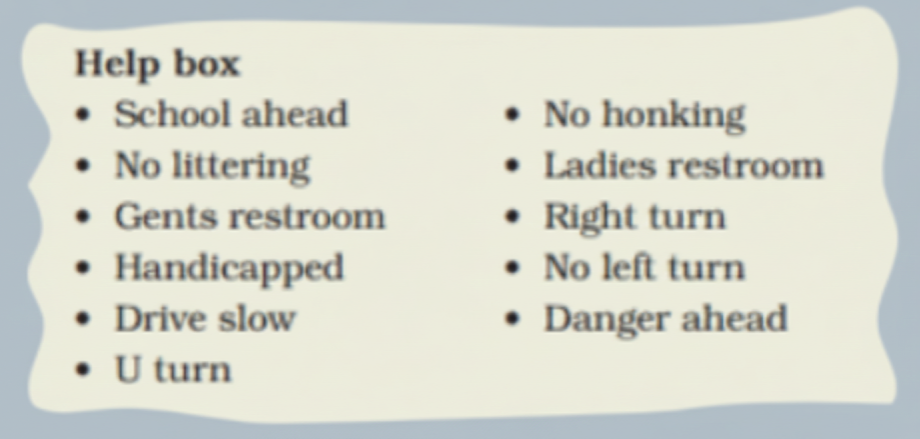
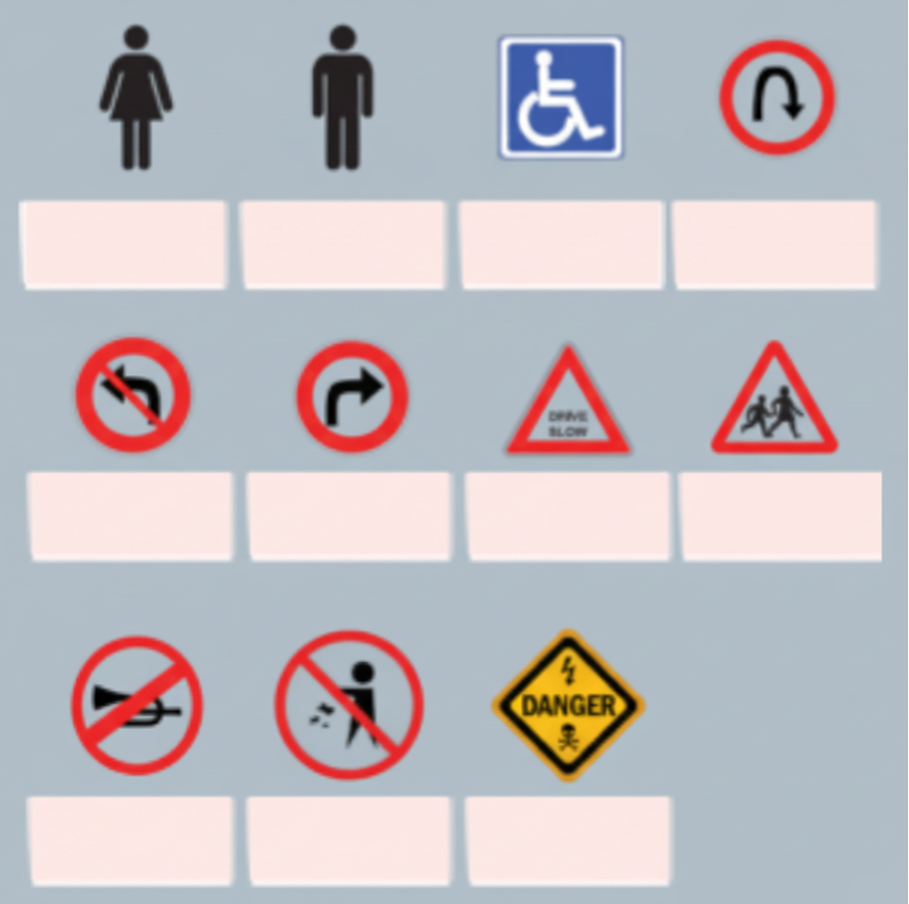
Answer:
Ladies restroom
Gents restroom
Handicapped
Uturn
No left turn
Right turn
Drive slow
School ahead
No honking
No littering
Danger ahead
Let us do (Pages 30-31)
A. Classify the following activities as “safe” and “unsafe”.
Looking right and left before crossing
Playing on the road
Crossing at a zebra crossing
Walking on the footpath
Listening to loud music on the road
Answer:
Safe:
Checking right and left before crossing the road
Using a zebra crossing
Walking on the footpath
Unsafe:
Playing on the road
Listening to loud music while on the road
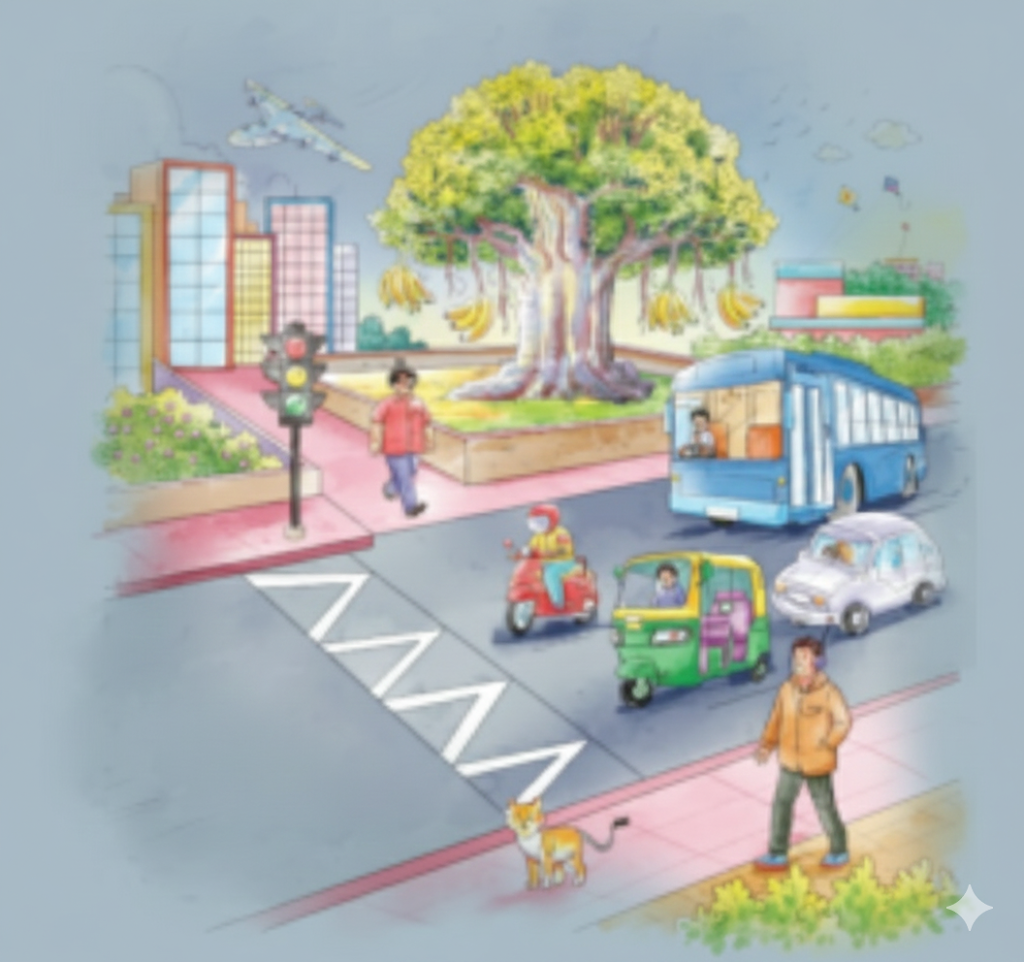
B. Spot what’s wrong with the picture. Look at the following picture below and spot six errors.
Answer:
Six errors in the Traffic Scene:
Zebra’s tail on cat
Aeroplane flying upside down
Bananas hanging on banyan tree,
Man walking with headphones and antennae on it
All traffic signals are working at the same time
Zig-zag zebra crossing
Let us Write (Pages 32-34)
A naming word/Noun is a word that names a person, place, thing or an idea. However, some nouns can be counted and some cannot.
The nouns that can be counted are known as countable nouns.
Example: apples, buses, chairs, etc.
Nouns that cannot be counted individually are known as uncountable nouns. They usually do not have a plural form.
Example: water, rice, air, etc.
A. Classify the following as “C” (Countable) and “U” (Uncountable).
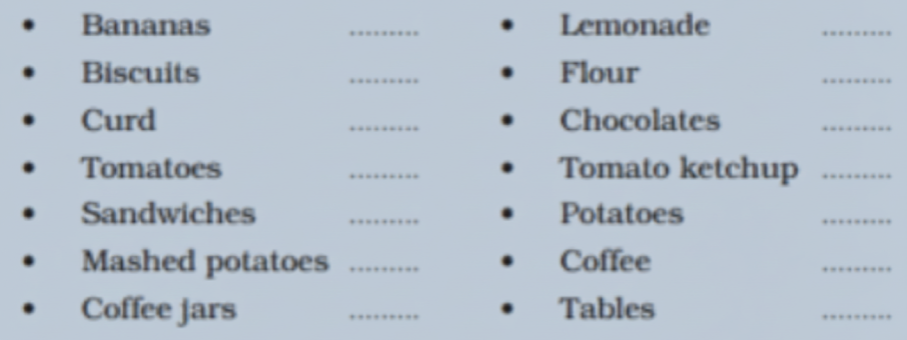
Answer:
C
C
U
C
C
U
C
U
U
C
U
C
U
C
B. Now, classify the following into countable and uncountable nouns.
Traffic, Pollution, Helmet, Buses, Cars, Speed, Pedestrian, Bicycle, Safety, Transportation, Fuel
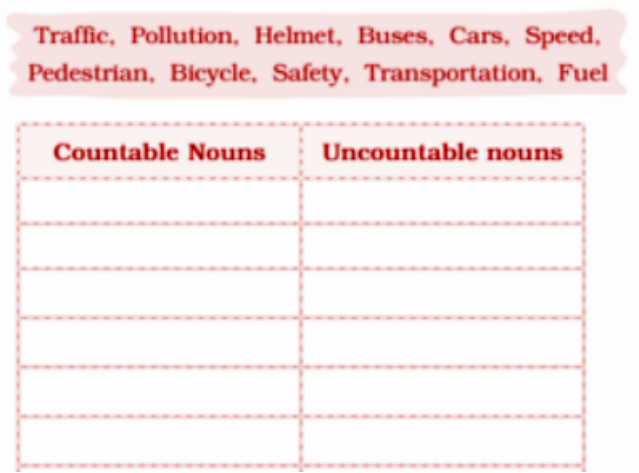
Answer:
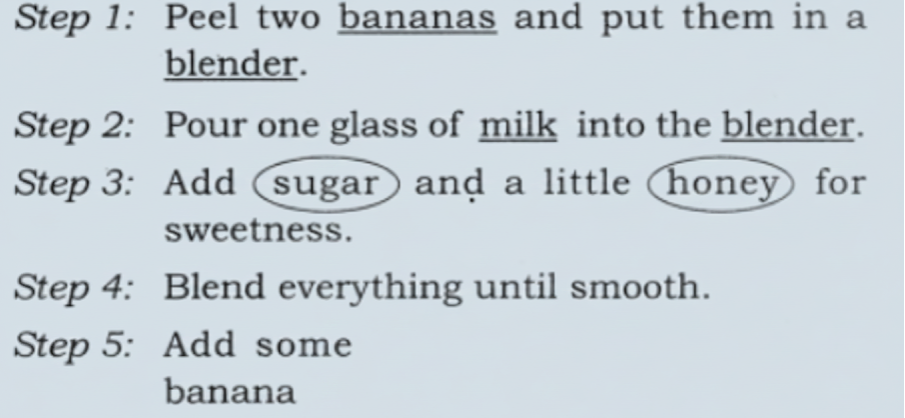
C. Read the recipe below. Underline the countable nouns and circle the uncountable nouns.
Recipe: Yummy banana milkshake
Step 1: Peel two bananas and put them in a blender.
Step 2: Pour one glass of milk into the blender.
Step 3: Add sugar and a little honey for sweetness.
Step 4: Blend everything until smooth.
Step 5: Add some ice cubes and enjoy your banana milkshake!
Answer: Recipe: Yummy banana milkshake
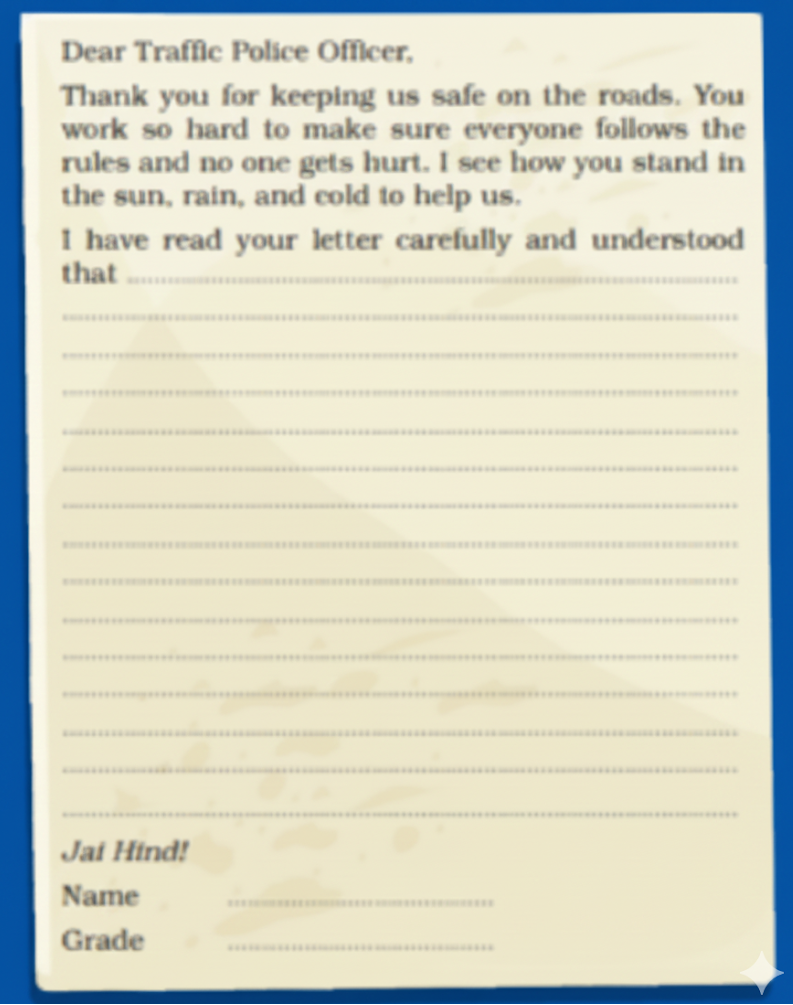
D. Write a letter to the traffic police of Bharat to thank them and promise to follow all the traffic rules and stay safe.
Answer:
Dear Traffic Police Officer,
Thank you for keeping us safe on the roads. You work tirelessly to ensure that everyone follows traffic rules and remains safe. I truly admire how you stand on duty in the sun, rain, and cold to protect us.
I have carefully read your letter and understood how important it is to follow traffic rules, such as using the zebra crossing, walking on the footpath, waiting for the green signal, and staying alert on the road. I also learned that wearing reflective stickers at night and avoiding the use of headphones while walking are important for our safety.
I promise to always follow traffic rules and stay safe. I will also encourage my friends and family to be careful and responsible on the roads.
Thank you once again for your dedication and care.
With respect and gratitude,
Ananya
Grade 4
Santoor School
Class 4 English Santoor Chapter 3: Be Smart, Be Safe – Overview & Exam Preparation Tips
The chapter Be Smart, Be Safe in NCERT Class 4 English teaches essential road safety rules for children. By carefully reading and practicing this chapter, students can understand how to protect themselves and others while crossing roads or traveling to school.
Mastering the key points about safety and countable & uncountable nouns is crucial for exams. Make sure to go through all examples, follow the safety checklists, and practice the writing activities to strengthen your grasp of the topic.
Regular practice of NCERT Class 4 English Santoor Chapter 3 questions helps you gain confidence. Revise every section, organize your notes, and focus on the highlighted safety rules for better marks in your 2026-27 school year.
FAQs on NCERT Solutions For Class 4 English Santoor Chapter 3 Be Smart, Be Safe - 2026-27 Free PDF Download (Sign-in Required)
1. What are the key points of Class 4 English Chapter 3?
Class 4 English Chapter 3, 'Be Smart, Be Safe', teaches important safety rules and smart habits every student should know.
Key points include:
- Understanding ways to stay safe at home, on the road, and outside
- Learning how to respond to strangers and emergencies
- Developing awareness of dangerous situations
- Importance of following safety signals and signs
- Building confidence to say 'No' to unsafe activities
2. How to answer questions in Be Smart Be Safe?
To answer questions in 'Be Smart Be Safe', use stepwise, clear, and CBSE-aligned points.
Follow these steps:
- Read the question to understand what is asked
- Begin with a summary sentence using keywords from the lesson
- Use simple sentences and pointwise answers for clarity
- Include definitions, examples, or diagrams if the question asks
- Underline key safety points or terms to get full marks
3. Are NCERT solutions reliable for exams?
NCERT Solutions are highly reliable for CBSE exams as they follow the official textbook and marking scheme for Class 4 English.
Benefits:
- Answers are written by subject experts and CBSE teachers
- Covers all textbook exercises for 'Be Smart Be Safe' thoroughly
- Helps with stepwise answers and key definitions
- Assures accuracy and exam readiness for 2026–27
4. What is the best way to write perfect answers for Class 4 English Santoor Chapter 3?
The best way is to write clear, step-by-step answers using keywords from the chapter and examples from the NCERT book.
Tips for perfect answers:
- Read the question twice and understand its requirement
- Start with a direct response mentioning the main idea
- List important safety points or actions
- Use bullets or short paragraphs for clarity
- Include diagrams only if asked
- Revise and check alignment with CBSE syllabus
5. Which questions are likely from this chapter in school exams?
Common questions from 'Be Smart, Be Safe' in exams focus on summaries, safety tips, definitions, and scenario-based actions.
Likely questions include:
- Summarize the chapter in your own words
- List any three safety rules for children
- What should you do if a stranger offers you a ride?
- Define safety signals/traffic lights
- Describe what to do during an emergency
6. Are diagrams or definitions mandatory in answers?
Diagrams and definitions are only required if the question specifically asks for them in your school exams or in NCERT exercises.
Key points:
- Write definitions for terms like 'safety', 'strangers', or 'signals' when asked
- Draw or label a diagram (e.g., a traffic light) only if the question demands
- Otherwise, focus on clear, pointwise answers with accurate information
7. How do I structure long answers for better marks?
Structure long answers for 'Be Smart, Be Safe' by dividing the answer into introduction, key points, and a summary.
Suggested format:
- Introduction: Short sentence about the topic (e.g., Why safety is important)
- Body: 3–5 main safety tips with examples
- Conclusion: Summarise how being smart helps you stay safe
8. Where can I download the chapter’s solutions PDF?
You can download the free PDF of NCERT Solutions for Class 4 English Chapter 3, 'Be Smart, Be Safe', from trusted educational platforms.
Steps:
- Visit the official NCERT solution websites
- Locate Class 4 English Santoor Chapter 3 page
- Click on 'Download PDF' for offline access
- Use the PDF for revision and exam practice
9. How to learn diagrams/maps for this chapter?
To learn diagrams for Chapter 3, focus on practicing neat, labelled drawings like traffic signals or safety signs.
Diagram learning tips:
- Study examples in the NCERT textbook or solutions
- Label key parts clearly (e.g., red, yellow, green lights)
- Use a ruler for straight lines and proper labels
- Practice 2–3 times before the exam
10. What are the most important topics from this chapter?
The most important topics in 'Be Smart, Be Safe' include:
- Rules for staying safe at home, school, and outside
- Responding to strangers and emergencies
- Understanding traffic lights, road safety, and signals
- Key safety terms and their definitions
- Practical examples/scenarios from the chapter
