




Which of the following gem diols is stable?
A. \[\;C{H_3} - C{\left( {OH} \right)_2} - H\]
B. \[\;CB{r_3} - C{\left( {OH} \right)_2} - H\]
C. \[\;C{F_3} - C{\left( {OH} \right)_2} - H\]
D. \[\;{C_6}{H_5} - C{\left( {OH} \right)_2} - {C_6}{H_5}\]
Answer
 Verified
296.7k+ views
Hint: Alcohol is an organic compound in which the hydroxyl group is bound with a saturated carbon atom. Primary alcohol(ethanol) is used as a drug. Based on the number of \[ - OH\] groups there are two kinds of alcohol, one is gem diol and the other one is a vicinal diol.
Complete step by step answer:
When the two \[ - OH\] groups are attached at the same carbon of the organic compound then it is called gem diol. And when the \[ - OH\] groups are in two different but neighboring carbon then it is called vicinal diol.
The gem diols are less stable than vicinal diols
The stability of gem diols can be increased in the presence of the electron-withdrawing group at the alpha position. +I effect decreases the stability of the gem diol and increases the extent of dehydration as follows.
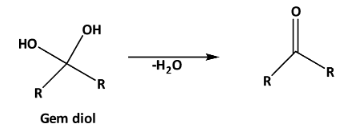
And -I effect increases the stability of gem diol. As well as the intramolecular hydrogen bonding also increases the stability of gem diol.
In the case of \[\;C{H_3} - C{\left( {OH} \right)_2} - H\] the methyl group shows the positive inductive effect, as a result, the stability decreases, and dehydration of this gem diol takes place.
In the case of \[\;{C_6}{H_5} - C{\left( {OH} \right)_2} - {C_6}{H_5}\] the two phenyl groups show a positive resonance effect, as a result, the stability decreases, and dehydration of this gem diol takes place.
In the case of \[\;CB{r_3} - C{\left( {OH} \right)_2} - H\] the electronegativity of bromine is less, as a result, the stability decreases, and dehydration of this gem diol takes place.
But in case of \[\;C{F_3} - C{\left( {OH} \right)_2} - H\] due to the highest electronegativity of fluorine this gem diol is stable.
Therefore, considering the stability factor of gem diol the most stable gem diol is \[\;C{F_3} - C{\left( {OH} \right)_2} - H\].
The correct answer is C.
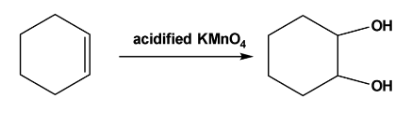
Note: The vicinal diols can be formed by oxidation of the double bonds. For example, when acidified \[\;KMn{O_4}\] reacts with cyclohexene oxidation of the double bonds takes place and vicinal diol is formed as follows,
Complete step by step answer:
When the two \[ - OH\] groups are attached at the same carbon of the organic compound then it is called gem diol. And when the \[ - OH\] groups are in two different but neighboring carbon then it is called vicinal diol.
The gem diols are less stable than vicinal diols
The stability of gem diols can be increased in the presence of the electron-withdrawing group at the alpha position. +I effect decreases the stability of the gem diol and increases the extent of dehydration as follows.
And -I effect increases the stability of gem diol. As well as the intramolecular hydrogen bonding also increases the stability of gem diol.
In the case of \[\;C{H_3} - C{\left( {OH} \right)_2} - H\] the methyl group shows the positive inductive effect, as a result, the stability decreases, and dehydration of this gem diol takes place.
In the case of \[\;{C_6}{H_5} - C{\left( {OH} \right)_2} - {C_6}{H_5}\] the two phenyl groups show a positive resonance effect, as a result, the stability decreases, and dehydration of this gem diol takes place.
In the case of \[\;CB{r_3} - C{\left( {OH} \right)_2} - H\] the electronegativity of bromine is less, as a result, the stability decreases, and dehydration of this gem diol takes place.
But in case of \[\;C{F_3} - C{\left( {OH} \right)_2} - H\] due to the highest electronegativity of fluorine this gem diol is stable.
Therefore, considering the stability factor of gem diol the most stable gem diol is \[\;C{F_3} - C{\left( {OH} \right)_2} - H\].
The correct answer is C.
Note: The vicinal diols can be formed by oxidation of the double bonds. For example, when acidified \[\;KMn{O_4}\] reacts with cyclohexene oxidation of the double bonds takes place and vicinal diol is formed as follows,
Recently Updated Pages
JEE Main 2025-26 Mock Test: Organic Compounds Containing Oxygen

Purification and Characterisation of Organic Compounds JEE Main 2025-26 Mock Test
JEE Main 2025-26 P Block Elements Mock test-2 Free Online Practice
JEE Main 2025-26 Mock Test: Organic Compounds Containing Oxygen
JEE Main Equilibrium Mock test-2 (2025-26) – Free Practice
JEE Main 2025-26 Equilibrium Mock Test: Free Practice Online
Trending doubts
JEE Main 2026: Exam Dates, Session 2 Updates, City Slip, Admit Card & Latest News
Understanding the Electric Field of a Uniformly Charged Ring
Understanding Atomic Structure for Beginners
Derivation of Equation of Trajectory Explained for Students
Electron Gain Enthalpy and Electron Affinity Explained
How to Convert a Galvanometer into an Ammeter or Voltmeter
Other Pages
NCERT Solutions For Class 12 Chemistry Chapter 2 Electrochemistry - 2026-27 Free PDF Download (Sign-in Required)
NCERT Solutions For Class 12 Chemistry Chapter 1 Solutions - 2026-27 Free PDF Download (Sign-in Required)
NCERT Solutions For Class 12 Chemistry Chapter 3 Chemical Kinetics - 2026-27 Free PDF Download (Login Required)
CBSE Notes Class 12 Chemistry Chapter 1 - Solutions - 2026-27 PDF Download (Login Required)
NCERT Solutions for Class 12 Chemistry Chapter 6 Haloalkanes and Haloarenes - 2026-27 Free PDF Download (Sign-In Required)
NCERT Solutions For Class 12 Chemistry Chapter 7 Alcohol Phenol And Ether - 2026-27 Free PDF Download (Login Required)
NCERT Solutions For Class 12 Chemistry Chapter 2 Electrochemistry - 2026-27 Free PDF Download (Sign-in Required)
NCERT Solutions For Class 12 Chemistry Chapter 1 Solutions - 2026-27 Free PDF Download (Sign-in Required)
NCERT Solutions For Class 12 Chemistry Chapter 3 Chemical Kinetics - 2026-27 Free PDF Download (Login Required)