




Which of the following figures is correct when a monochromatic light passes through a prism?
A)
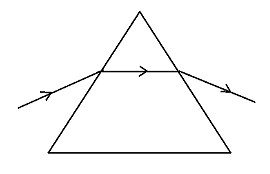
B)
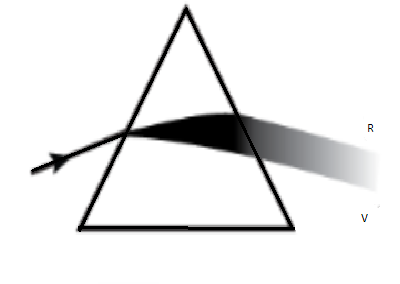
C)

D) None of the above
Answer
 Verified
263.7k+ views
Hint: Monochromatic light is a single colored light which is electromagnetic radiation derived from electromagnetic radiation from the atoms. Such lights have only one color and single wavelength. When white light passes through a prism it splits into its component colors. Monochromatic light has no such components.
Complete step by step solution:
Monochromatic lights are obtained when photons emission takes place. During this process the electromagnetic radiation leads to the production of monochromatic light. It is not made up of any components of visible light. When a monochromatic light is directed to pass through a substance or material, it induces transitions which are characteristic to the chemical properties of the constituent elements of such material.
When white light is made to pass through a prism it splits into its component colors. Since there are seven different colors of which visible light is made up of. Hence they split based on their wavelength. Similar thing happens when a monochromatic beam of light is made to pass through a prism. The monochromatic light will have some wavelength. The light will have some angle of deviation when it emerges out from the prism. Just like any single visible ray of light. The angle of deviation will depend on the wavelength of light.
From the above discussion, it is clear that monochromatic light when passed through prism will have some angle of deviation but it won’t split into any component of light. Also the light won't travel in a straight line when it emerges out of the prism.
Hence Option A is the correct option.
Note: It should be noted that monochromatic is single colored light ray.
Monochromatic light is one of the light as observed in the spectrum of visible light. As the spectrum of white light has some angle of deviation when it passes through prism, hence monochromatic light will also have some angle of deviation.
Complete step by step solution:
Monochromatic lights are obtained when photons emission takes place. During this process the electromagnetic radiation leads to the production of monochromatic light. It is not made up of any components of visible light. When a monochromatic light is directed to pass through a substance or material, it induces transitions which are characteristic to the chemical properties of the constituent elements of such material.
When white light is made to pass through a prism it splits into its component colors. Since there are seven different colors of which visible light is made up of. Hence they split based on their wavelength. Similar thing happens when a monochromatic beam of light is made to pass through a prism. The monochromatic light will have some wavelength. The light will have some angle of deviation when it emerges out from the prism. Just like any single visible ray of light. The angle of deviation will depend on the wavelength of light.
From the above discussion, it is clear that monochromatic light when passed through prism will have some angle of deviation but it won’t split into any component of light. Also the light won't travel in a straight line when it emerges out of the prism.
Hence Option A is the correct option.
Note: It should be noted that monochromatic is single colored light ray.
Monochromatic light is one of the light as observed in the spectrum of visible light. As the spectrum of white light has some angle of deviation when it passes through prism, hence monochromatic light will also have some angle of deviation.
Recently Updated Pages
JEE Main 2025-26 Experimental Skills Mock Test – Free Practice

JEE Main 2025-26 Electronic Devices Mock Test: Free Practice Online
JEE Main 2025-26 Mock Tests: Free Practice Papers & Solutions
JEE Main 2025-26: Magnetic Effects of Current & Magnetism Mock Test
JEE Main 2025-26 Atoms and Nuclei Mock Test – Free Practice Online
JEE Main Mock Test 2025-26: Experimental Skills Chapter Online Practice
Trending doubts
JEE Main 2026: Exam Dates, Session 2 Updates, City Slip, Admit Card & Latest News
JEE Main Participating Colleges 2026 - A Complete List of Top Colleges
Kinematics Mock Test for JEE Main 2025-26: Comprehensive Practice
Kinematics Mock Test for JEE Main 2025-26: Practice & Ace the Exam
Hybridisation in Chemistry – Concept, Types & Applications
Understanding the Electric Field of a Uniformly Charged Ring
Other Pages
CBSE Class 12 Physics Question Paper 2026: Download SET-wise PDF with Answer Key & Analysis
JEE Advanced 2026 Notification Out with Exam Date, Registration (Extended), Syllabus and More
JEE Advanced Marks vs Ranks 2025: Understanding Category-wise Qualifying Marks and Previous Year Cut-offs
JEE Advanced Weightage Chapter Wise 2026 for Physics, Chemistry, and Mathematics
Derivation of Equation of Trajectory Explained for Students
Understanding Atomic Structure for Beginners