




Using the truth table, examine whether the following statement pattern is tautology, contradiction and contingency.
$(p\wedge \sim q)\leftrightarrow (p\to q)$
Answer
 Verified
245.1k+ views
Hint: Construct the truth table for $(p\wedge \sim q)\leftrightarrow (p\to q)$ and if all the propositions are true in every row then it is tautology, if all the propositions are false in every row then contradiction and if there is at least one row with true condition and one row with false condition, then it is contingency.
Complete step-by-step answer:
A truth table is a mathematical table used in logic- specifically in connection with Boolean algebra, Boolean functions and propositional calculus- which sets out the functional values of logical expressions on each of their functional arguments, that is for each combination of values taken by their logical variables. A truth table can be used to show whether a propositional expression is true for all input values, that is logically valid.
Tautology: A tautology has a logical form that cannot possibly be false no matter what truth values are assigned to the sentence letters.
Contradiction: A tautology has a logical form that cannot possibly be true no matter what truth values are assigned to the sentence letters.
Contingency: A Contingency has a logical form that can be either true or false depending on what truth values are assigned to the sentence letters.
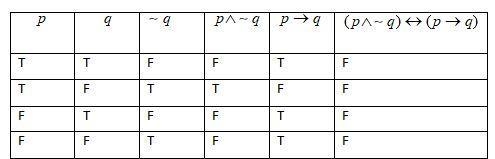
Note: $p\wedge q$ is true when both $p$ and $q$ are true. $p\to q$ is true when $q$ is true or both are false. $p\leftrightarrow q$ is true when both $p$ and $q$ are true or both are false. This is the rule used to draw the above truth table.
Complete step-by-step answer:
A truth table is a mathematical table used in logic- specifically in connection with Boolean algebra, Boolean functions and propositional calculus- which sets out the functional values of logical expressions on each of their functional arguments, that is for each combination of values taken by their logical variables. A truth table can be used to show whether a propositional expression is true for all input values, that is logically valid.
Tautology: A tautology has a logical form that cannot possibly be false no matter what truth values are assigned to the sentence letters.
Contradiction: A tautology has a logical form that cannot possibly be true no matter what truth values are assigned to the sentence letters.
Contingency: A Contingency has a logical form that can be either true or false depending on what truth values are assigned to the sentence letters.
Note: $p\wedge q$ is true when both $p$ and $q$ are true. $p\to q$ is true when $q$ is true or both are false. $p\leftrightarrow q$ is true when both $p$ and $q$ are true or both are false. This is the rule used to draw the above truth table.
Recently Updated Pages
JEE Main 2026 Session 2 City Intimation Slip Releasing Soon

JEE Main 2027 Exam Date, Syllabus, Pattern, Registration, Eligibility & Updates
JEE Main 2026 Question Papers with Solutions PDF – Free Download
Is a Calculator Allowed in JEE Main 2026? Complete NTA Guidelines
JEE Main 2027 Syllabus: Based on Latest NTA Syllabus with PDF Download
JEE Main Exam Countdown Timer: Track Days Until Exam 2026
Trending doubts
JEE Main 2026: Exam Dates, Session 2 Updates, City Slip, Admit Card & Latest News
Ideal and Non-Ideal Solutions Explained for Class 12 Chemistry
Understanding the Angle of Deviation in a Prism
Hybridisation in Chemistry – Concept, Types & Applications
Understanding the Electric Field of a Uniformly Charged Ring
Derivation of Equation of Trajectory Explained for Students
Other Pages
JEE Advanced Marks vs Ranks 2025: Understanding Category-wise Qualifying Marks and Previous Year Cut-offs
JEE Advanced 2026 - Exam Date (Released), Syllabus, Registration, Eligibility, Preparation, and More
JEE Advanced Weightage 2025 Chapter-Wise for Physics, Maths and Chemistry
Understanding Average and RMS Value in Electrical Circuits
NCERT Solutions For Class 11 Maths Chapter 8 Sequences And Series - 2025-26
NCERT Solutions For Class 11 Maths Chapter 6 Permutations And Combinations - 2025-26