




Uniformly charged long cylinder has volume charge density$\rho $. Find an electric field at a distance$x < R$from the axis of the cylinder.
(A) $\dfrac{{\rho x}}{{{\varepsilon _0}}}$
(B) $\dfrac{{\rho x}}{{2{\varepsilon _0}}}$
(C) $\dfrac{{\rho x}}{{3{\varepsilon _0}}}$
(D) $\dfrac{{\rho x}}{{4{\varepsilon _0}}}$
Answer
 Verified
283.8k+ views
Hint: For symmetric objects like a cylinder, it is very easy to apply Gauss’s law. In this specific problem, we have given that volume charge density $\rho $ is uniform throughout the cylinder. For calculation, take a cylinder of radius $x$ and then compute the required volume and surface area.
Formula used:
Gauss’s law is given as
\[\oint {\overrightarrow E .\overrightarrow {ds} = \dfrac{{{q_e}_n}}{{{\varepsilon _0}}}} \]
Where ${q_e}_n$ is the charge enclosed within the Gaussian surface.
$\overrightarrow E $ is the electric field.
$\overrightarrow {ds} $ is the surface area element
Complete step by step solution:
Consider a cylinder of radius $x$ and length $l$.
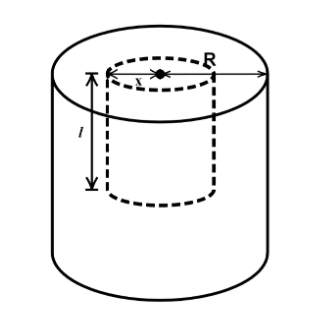
Here, the long cylinder with radius $R$ is shown in a solid line and the Gaussian surface that we have taken with radius $x$and length $l$is shown in the dotted line.
We know that,
\[\oint {\overrightarrow E .\overrightarrow {ds} = \dfrac{{{q_e}_n}}{{{\varepsilon _0}}}} \] $ - - - - (1)$
Here, we have volume charge density $\rho $and a cylinder (Gaussian surface) of radius$x$and length$l$.
So, the charge enclosed within this cylinder can be calculated as
${q_e}_n = \rho \times V$
Here,$V$is the volume of the cylinder.
$ \Rightarrow {q_e}_n = \rho \times \pi {x^2}l$
Using this in the equation$(1)$, we get
\[\oint {\overrightarrow E .\overrightarrow {ds} = \dfrac{{\rho \times \pi {x^2}l}}{{{\varepsilon _0}}}} \]
Here, the surface area element is
$\overrightarrow {ds} = 2\pi xl$
Using this in the above equation, we get
\[E2\pi xl = \dfrac{{\rho \times \pi {x^2}l}}{{{\varepsilon _0}}}\]
$ \Rightarrow E = \dfrac{{\rho \pi {x^2}l}}{{2\pi xl{\varepsilon _0}}}$
Solving this, we get
$E = \dfrac{{\rho x}}{{2{\varepsilon _0}}}$
Thus, option (B) is correct.
Additional information: While choosing the Gaussian surface, theoretically we can take any shape or size. But while calculating it would be difficult to calculate the surface area or volume of any arbitrary shape. Moreover, if the given charge density is cylindrical, it is suggested to take a cylindrical Gaussian surface. If you have any doubts, you can try to solve this simple question by taking a spherical Gaussian surface.
Note: In this problem, we have been given a constant volume charge density. But if the volume charge density is given like$\rho = {\rho _0}x$, then you simply can’t calculate the enclosed charge like this problem. You have to integrate over the whole volume of your Gaussian surface.
Formula used:
Gauss’s law is given as
\[\oint {\overrightarrow E .\overrightarrow {ds} = \dfrac{{{q_e}_n}}{{{\varepsilon _0}}}} \]
Where ${q_e}_n$ is the charge enclosed within the Gaussian surface.
$\overrightarrow E $ is the electric field.
$\overrightarrow {ds} $ is the surface area element
Complete step by step solution:
Consider a cylinder of radius $x$ and length $l$.
Here, the long cylinder with radius $R$ is shown in a solid line and the Gaussian surface that we have taken with radius $x$and length $l$is shown in the dotted line.
We know that,
\[\oint {\overrightarrow E .\overrightarrow {ds} = \dfrac{{{q_e}_n}}{{{\varepsilon _0}}}} \] $ - - - - (1)$
Here, we have volume charge density $\rho $and a cylinder (Gaussian surface) of radius$x$and length$l$.
So, the charge enclosed within this cylinder can be calculated as
${q_e}_n = \rho \times V$
Here,$V$is the volume of the cylinder.
$ \Rightarrow {q_e}_n = \rho \times \pi {x^2}l$
Using this in the equation$(1)$, we get
\[\oint {\overrightarrow E .\overrightarrow {ds} = \dfrac{{\rho \times \pi {x^2}l}}{{{\varepsilon _0}}}} \]
Here, the surface area element is
$\overrightarrow {ds} = 2\pi xl$
Using this in the above equation, we get
\[E2\pi xl = \dfrac{{\rho \times \pi {x^2}l}}{{{\varepsilon _0}}}\]
$ \Rightarrow E = \dfrac{{\rho \pi {x^2}l}}{{2\pi xl{\varepsilon _0}}}$
Solving this, we get
$E = \dfrac{{\rho x}}{{2{\varepsilon _0}}}$
Thus, option (B) is correct.
Additional information: While choosing the Gaussian surface, theoretically we can take any shape or size. But while calculating it would be difficult to calculate the surface area or volume of any arbitrary shape. Moreover, if the given charge density is cylindrical, it is suggested to take a cylindrical Gaussian surface. If you have any doubts, you can try to solve this simple question by taking a spherical Gaussian surface.
Note: In this problem, we have been given a constant volume charge density. But if the volume charge density is given like$\rho = {\rho _0}x$, then you simply can’t calculate the enclosed charge like this problem. You have to integrate over the whole volume of your Gaussian surface.
Recently Updated Pages
Properties of Solids and Liquids Mock Test 2025

JEE Main Mock Test 2025-26: Dual Nature of Matter & Radiation
JEE Main 2025-26 Work, Energy and Power Mock Test – Free Practice Online
JEE Main Mock Test 2025-26: Experimental Skills Chapter Online Practice
JEE Main 2025-26 Mock Test: Properties of Solids and Liquids
JEE Main 2025 Kinetic Theory Of Gases Mock Test: Practice & Solutions
Trending doubts
JEE Main 2026: Exam Dates, Session 2 Updates, City Slip, Admit Card & Latest News
Understanding the Electric Field of a Uniformly Charged Ring
Understanding Atomic Structure for Beginners
Derivation of Equation of Trajectory Explained for Students
Electron Gain Enthalpy and Electron Affinity Explained
How to Convert a Galvanometer into an Ammeter or Voltmeter
Other Pages
CBSE Class 12 Physics Question Paper 2026: Download SET-wise PDF with Answer Key & Analysis
JEE Advanced Percentile vs Marks 2026: JEE Main Cutoff, AIR & IIT Admission Guide
JEE Advanced 2026 Notification Out with Exam Date, Registration (Extended), Syllabus and More
Understanding Uniform Acceleration in Physics
Understanding Electromagnetic Waves and Their Importance
Understanding Instantaneous Velocity