




What is the type of deformation in plastic deformation?
A) Reversible
B) Permanent
C) Both
D) None
Answer
 Verified
282.6k+ views
Hint:The deformation in the elastic region is reversible as the material goes back to its original shape and size on the removal of stress.
Complete step by step solution:
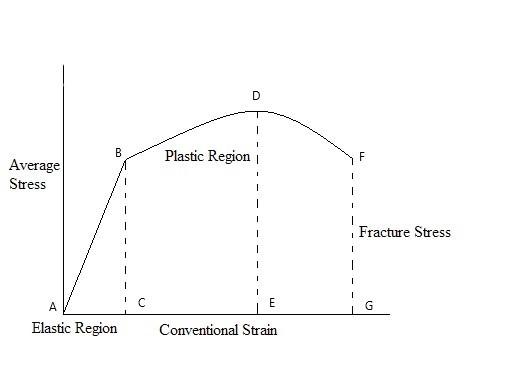
The above stress-strain curve is for a ductile material. In the given stress-strain curve, the part ABC represents the elastic region whereas the part BDFGEC represents the plastic region.
The point B is also known as the elastic limit or proportional limit. Point C on the x-axis represents the strain when stress corresponding to point B is applied on the material.
When stress greater than the elastic limit is applied, the material does not regain its original shape and size even after the removal of the applied stress. After the removal of stress greater than elastic limit, only elastic strain is recovered, the plastic strain remains. This strain that remains is known as a permanent set. It is not recoverable.
In brittle materials, the plastic region is smaller and the material cannot bear a stress much larger than the elastic limit of the material. However, the deformation in the plastic region of brittle materials is also non-recoverable.
Hence, plastic deformation in both brittle and ductile materials is permanent and irreversible.
Therefore, option B is the correct answer for this question.
Note: Deformation is the change in shape or size of an object. It is not the same as strain. Strain is change in dimension per unit dimension of the material or deformation per unit dimension. Deformation has the dimension of length whereas strain is dimensionless.
Complete step by step solution:
The above stress-strain curve is for a ductile material. In the given stress-strain curve, the part ABC represents the elastic region whereas the part BDFGEC represents the plastic region.
The point B is also known as the elastic limit or proportional limit. Point C on the x-axis represents the strain when stress corresponding to point B is applied on the material.
When stress greater than the elastic limit is applied, the material does not regain its original shape and size even after the removal of the applied stress. After the removal of stress greater than elastic limit, only elastic strain is recovered, the plastic strain remains. This strain that remains is known as a permanent set. It is not recoverable.
In brittle materials, the plastic region is smaller and the material cannot bear a stress much larger than the elastic limit of the material. However, the deformation in the plastic region of brittle materials is also non-recoverable.
Hence, plastic deformation in both brittle and ductile materials is permanent and irreversible.
Therefore, option B is the correct answer for this question.
Note: Deformation is the change in shape or size of an object. It is not the same as strain. Strain is change in dimension per unit dimension of the material or deformation per unit dimension. Deformation has the dimension of length whereas strain is dimensionless.
Recently Updated Pages
How to Calculate Moment of Inertia: Step-by-Step Guide & Formulas

Dimensions of Charge: Dimensional Formula, Derivation, SI Units & Examples
Mass vs Weight: Key Differences Explained for Students
Uniform Acceleration Explained: Formula, Examples & Graphs
JEE Main 2025-26 Mock Test: Binomial Theorem & Quick Practice
Properties of Solids and Liquids Mock Test 2025
Trending doubts
JEE Main 2026: Exam Dates, Session 2 Updates, City Slip, Admit Card & Latest News
Understanding the Electric Field of a Uniformly Charged Ring
Understanding Atomic Structure for Beginners
Derivation of Equation of Trajectory Explained for Students
Electron Gain Enthalpy and Electron Affinity Explained
How to Convert a Galvanometer into an Ammeter or Voltmeter
Other Pages
JEE Advanced Percentile vs Marks 2026: JEE Main Cutoff, AIR & IIT Admission Guide
CBSE Notes Class 11 Physics Chapter 1 - Units And Measurements - 2026-27
NCERT Solutions For Class 11 Physics Chapter 1 Units And Measurements - 2026-27 Free PDF Download (Login Required)
Important Questions For Class 11 Physics Chapter 1 Units and Measurement - 2026-27
NCERT Solutions For Class 11 Physics Chapter 2 Motion In A Straight Line - 2026-27 Free PDF Download (Login Required)
CBSE Notes Class 11 Physics Chapter 2 - Motion in a Straight Line - 2026-27