




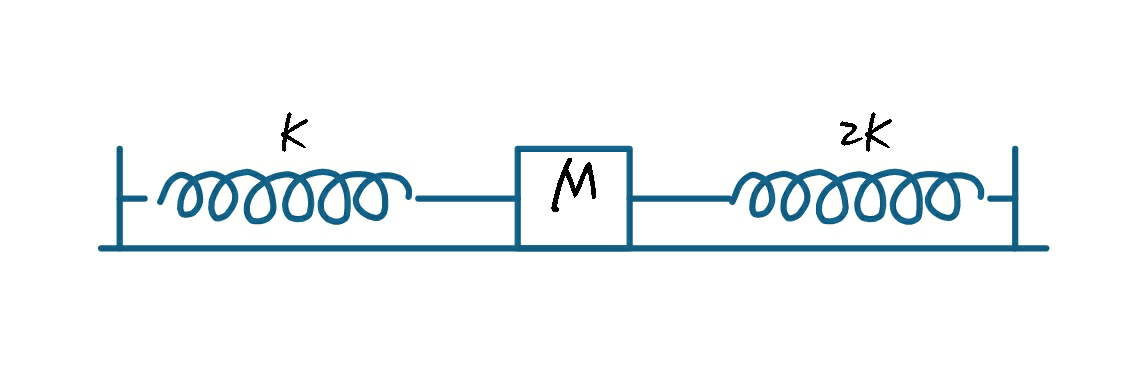
Two springs are connected in series and the combination is pulled by a constant force. If spring constant of two springs are $ $K\text{ and 2}K$ , then the ratio of potential energy stored in the springs is
Answer
 Verified
265.2k+ views
Hint We know that PE is the amount of energy started at the highest point.
Here, two springs are converted in series
Therefore, using $P.E=\dfrac{1}{2}{{K}_{2}}$
Complete Step by Step Solution
$2:1$
For spring ${{S}_{1}}\text{ the spring constant is }K$
For spring${{S}_{2}}$ the spring constant is $2K$
Now, applying the potential energy formula for spring ${{S}_{1}}$
i.e. $P{{E}_{1}}=\dfrac{1}{2}K{{r}^{2}}$ …… (1)
Similarly, we use the above formula for spring ${{S}_{2}}$
i.e.$P{{E}_{2}}=\dfrac{1}{2}2K\text{ }{{x}^{2}}$ …… (2)
Now, dividing equation (2) by equation (1)
We get $\dfrac{P{{E}_{2}}}{P{{E}_{1}}}=\dfrac{1}{2}K{{x}^{2}}\times \dfrac{2}{\left( 2K \right){{x}^{2}}}$
Now, cancelling all the common factors in the above equation we get
$\dfrac{P{{E}_{2}}}{P{{E}_{1}}}=\dfrac{1}{2}$
Or for simplicity we can write this as also
$\dfrac{P{{E}_{2}}}{P{{E}_{1}}}=\dfrac{1}{2}$
Therefore, the ratio of the two potential angles is $2:1$
Note Above discussion of Potential Energy that is stored in the spring can be found out using $\dfrac{1}{2}k{{x}^{2}}$formula in which$k=\text{Spring Constant}$.
In this case, we reciprocate this energy with respect to the other.
Here, two springs are converted in series
Therefore, using $P.E=\dfrac{1}{2}{{K}_{2}}$
Complete Step by Step Solution
$2:1$
For spring ${{S}_{1}}\text{ the spring constant is }K$
For spring${{S}_{2}}$ the spring constant is $2K$
Now, applying the potential energy formula for spring ${{S}_{1}}$
i.e. $P{{E}_{1}}=\dfrac{1}{2}K{{r}^{2}}$ …… (1)
Similarly, we use the above formula for spring ${{S}_{2}}$
i.e.$P{{E}_{2}}=\dfrac{1}{2}2K\text{ }{{x}^{2}}$ …… (2)
Now, dividing equation (2) by equation (1)
We get $\dfrac{P{{E}_{2}}}{P{{E}_{1}}}=\dfrac{1}{2}K{{x}^{2}}\times \dfrac{2}{\left( 2K \right){{x}^{2}}}$
Now, cancelling all the common factors in the above equation we get
$\dfrac{P{{E}_{2}}}{P{{E}_{1}}}=\dfrac{1}{2}$
Or for simplicity we can write this as also
$\dfrac{P{{E}_{2}}}{P{{E}_{1}}}=\dfrac{1}{2}$
Therefore, the ratio of the two potential angles is $2:1$
Note Above discussion of Potential Energy that is stored in the spring can be found out using $\dfrac{1}{2}k{{x}^{2}}$formula in which$k=\text{Spring Constant}$.
In this case, we reciprocate this energy with respect to the other.
Recently Updated Pages
JEE Main Mock Test 2025-26: Principles Related To Practical

JEE Main 2025-26 Experimental Skills Mock Test – Free Practice
JEE Main 2025-26 Electronic Devices Mock Test: Free Practice Online
JEE Main 2025-26 Mock Tests: Free Practice Papers & Solutions
JEE Main 2025-26: Magnetic Effects of Current & Magnetism Mock Test
JEE Main Statistics and Probability Mock Test 2025-26
Trending doubts
JEE Main 2026: Exam Dates, Session 2 Updates, City Slip, Admit Card & Latest News
JEE Main Participating Colleges 2026 - A Complete List of Top Colleges
Hybridisation in Chemistry – Concept, Types & Applications
Understanding the Electric Field of a Uniformly Charged Ring
Derivation of Equation of Trajectory Explained for Students
Understanding Atomic Structure for Beginners
Other Pages
JEE Advanced 2026 Notification Out with Exam Date, Registration (Extended), Syllabus and More
JEE Advanced Percentile vs Marks 2026: JEE Main Cutoff, AIR & IIT Admission Guide
CBSE Notes Class 11 Physics Chapter 1 - Units And Measurements - 2025-26
JEE Advanced Marks vs Rank 2025 - Predict Your IIT Rank Based on Score
NCERT Solutions For Class 11 Physics Chapter 1 Units And Measurements - 2025-26
Important Questions For Class 11 Physics Chapter 1 Units and Measurement - 2025-26