




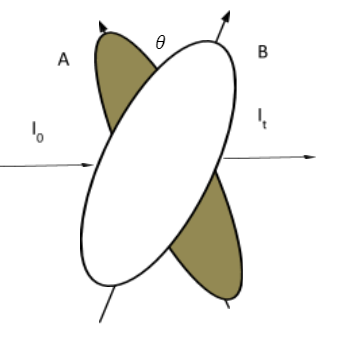
Two Polaroid A and B are kept with their transmission axis at an angle $\theta $ with respect to one another. If the transmitted intensity of light is $I_t$ = $0.75{I_0}$, where $I_0$ is the intensity of light incident on the system, then $\theta $ is:
A) $30^\circ$
B) $45^\circ$
C) $60^\circ$
D) $90^\circ$
Answer
 Verified
233.1k+ views
Hint: Transmission and incident intensity of the polarized light relation is given by Malus's Law:
$I_t$ = $I_0$ ${\cos ^2}\theta $ ($I_t$ and $I_0$ are the intensities of the transmitted and incident light, $\theta $)
is the angle formed between the two Polaroid)
Using the above relation we will calculate the value of $\theta $.
Complete step by step solution:
Let us discuss some facts about Polaroid and then we will proceed for the calculation part.
Polaroid is a large sheet of synthetic material packed with tiny crystals of a dichroic substance oriented parallel to one another so that it transmits light only in one direction of the electric vector.
Now we will calculate the value of $\theta $.
We have,
${I_t} = {I_0}0.75$ (Given in the question)...............(1)
According to the Malus's Law
${I_t} = {I_0}{\cos ^2}\theta $ ....................(2)
On substituting the value of equation 1 in equation 2
$ \Rightarrow 0.75{I_0} = {I_0}{\cos ^2}\theta $
$ \Rightarrow 0.75 = {\cos ^2}\theta $(Cancelled the common terms)
$ \Rightarrow {\cos ^2}\theta = \dfrac{3}{4}$ (we will remove the square from both sides)
$ \Rightarrow \theta = {\cos ^{ - 1}}\dfrac{{\sqrt 3 }}{2}$ ($\cos30^\circ$ is equal to the ratio of square root three to two)
$ \Rightarrow \theta = {30^\circ}$
Therefore, option (A) is correct.
Note: Polaroid has many applications which are: light usually scatters in all directions but when it's reflected from flat surfaces, it tends to become polarized, used in glass windows of an airplane to control the intensity of light, used to view three dimensional pictures and movies, used as filter in photographic camera, used in the production of plane polarized light, They are used to improve color contrast in oil paintings, used calculators, monitors of laptops having LCD screen, watches, sun glasses etc.
$I_t$ = $I_0$ ${\cos ^2}\theta $ ($I_t$ and $I_0$ are the intensities of the transmitted and incident light, $\theta $)
is the angle formed between the two Polaroid)
Using the above relation we will calculate the value of $\theta $.
Complete step by step solution:
Let us discuss some facts about Polaroid and then we will proceed for the calculation part.
Polaroid is a large sheet of synthetic material packed with tiny crystals of a dichroic substance oriented parallel to one another so that it transmits light only in one direction of the electric vector.
Now we will calculate the value of $\theta $.
We have,
${I_t} = {I_0}0.75$ (Given in the question)...............(1)
According to the Malus's Law
${I_t} = {I_0}{\cos ^2}\theta $ ....................(2)
On substituting the value of equation 1 in equation 2
$ \Rightarrow 0.75{I_0} = {I_0}{\cos ^2}\theta $
$ \Rightarrow 0.75 = {\cos ^2}\theta $(Cancelled the common terms)
$ \Rightarrow {\cos ^2}\theta = \dfrac{3}{4}$ (we will remove the square from both sides)
$ \Rightarrow \theta = {\cos ^{ - 1}}\dfrac{{\sqrt 3 }}{2}$ ($\cos30^\circ$ is equal to the ratio of square root three to two)
$ \Rightarrow \theta = {30^\circ}$
Therefore, option (A) is correct.
Note: Polaroid has many applications which are: light usually scatters in all directions but when it's reflected from flat surfaces, it tends to become polarized, used in glass windows of an airplane to control the intensity of light, used to view three dimensional pictures and movies, used as filter in photographic camera, used in the production of plane polarized light, They are used to improve color contrast in oil paintings, used calculators, monitors of laptops having LCD screen, watches, sun glasses etc.
Recently Updated Pages
JEE Main 2023 April 6 Shift 1 Question Paper with Answer Key

JEE Main 2023 April 6 Shift 2 Question Paper with Answer Key
JEE Main 2023 (January 31 Evening Shift) Question Paper with Solutions [PDF]
JEE Main 2023 January 30 Shift 2 Question Paper with Answer Key
JEE Main 2023 January 25 Shift 1 Question Paper with Answer Key
JEE Main 2023 January 24 Shift 2 Question Paper with Answer Key
Trending doubts
JEE Main 2026: Session 2 Registration Open, City Intimation Slip, Exam Dates, Syllabus & Eligibility
JEE Main 2026 Application Login: Direct Link, Registration, Form Fill, and Steps
JEE Main Marking Scheme 2026- Paper-Wise Marks Distribution and Negative Marking Details
Understanding the Angle of Deviation in a Prism
Hybridisation in Chemistry – Concept, Types & Applications
How to Convert a Galvanometer into an Ammeter or Voltmeter
Other Pages
JEE Advanced Marks vs Ranks 2025: Understanding Category-wise Qualifying Marks and Previous Year Cut-offs
Dual Nature of Radiation and Matter Class 12 Physics Chapter 11 CBSE Notes - 2025-26
Understanding Uniform Acceleration in Physics
Understanding the Electric Field of a Uniformly Charged Ring
JEE Advanced Weightage 2025 Chapter-Wise for Physics, Maths and Chemistry
Derivation of Equation of Trajectory Explained for Students