




To use a transistor as an amplifier:
(A) The emitter base junction is forward biased and the base collector junction is reverse biased
(B) No bias voltage are required
(C) Both junctions are forward biased
(D) Both junctions are reverse biased
Answer
 Verified
249.9k+ views
Hint: Transistor is made up of the semiconductor material and is of two types as $PNP$ transistor and the $NPN$ transistor. In these transistors, the $PN$ junction diode is connected back to back with the three terminals in it as base, collector and emitter.
Complete step by step solution
The work of the amplifier is to strengthen the weak signal and the transistor is used for this purpose. In this transistor, the emitter base junction is made forward biased by connecting the voltage across it to maintain the flow of the current by maintaining the polarity of the input current.
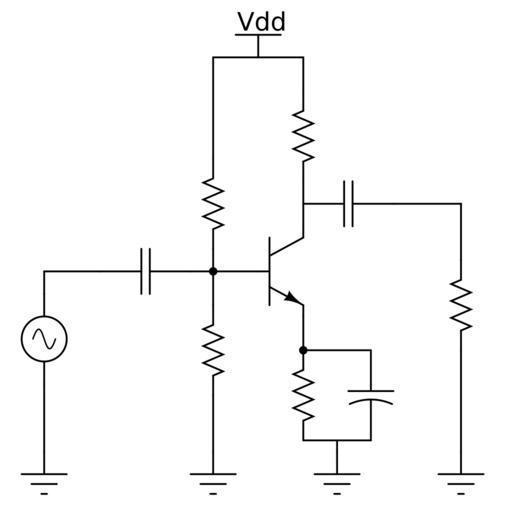
Due to the presence of the low resistance in the input, even the small change in it, can cause appreciable change in the output current. The collector is reversely biased by connecting the voltage in the reverse direction, this makes the large voltage drop in it. Hence this makes the transistor as an amplifier by large output voltage from small input voltage.
Thus the option (A) is correct.
Note: Transistors act as both the amplifier and the switch. When using the transistor as the amplifier, it should be properly biased for work. While using the transistor as the switch, the base connecting the emitter and the collector act as the controller or switch.
Complete step by step solution
The work of the amplifier is to strengthen the weak signal and the transistor is used for this purpose. In this transistor, the emitter base junction is made forward biased by connecting the voltage across it to maintain the flow of the current by maintaining the polarity of the input current.
Due to the presence of the low resistance in the input, even the small change in it, can cause appreciable change in the output current. The collector is reversely biased by connecting the voltage in the reverse direction, this makes the large voltage drop in it. Hence this makes the transistor as an amplifier by large output voltage from small input voltage.
Thus the option (A) is correct.
Note: Transistors act as both the amplifier and the switch. When using the transistor as the amplifier, it should be properly biased for work. While using the transistor as the switch, the base connecting the emitter and the collector act as the controller or switch.
Recently Updated Pages
JEE Isolation, Preparation and Properties of Non-metals Important Concepts and Tips for Exam Preparation

Isoelectronic Definition in Chemistry: Meaning, Examples & Trends
Ionisation Energy and Ionisation Potential Explained
Iodoform Reactions - Important Concepts and Tips for JEE
Introduction to Dimensions: Understanding the Basics
Instantaneous Velocity Explained: Formula, Examples & Graphs
Trending doubts
JEE Main 2026: Exam Dates, Session 2 Updates, City Slip, Admit Card & Latest News
Hybridisation in Chemistry – Concept, Types & Applications
JEE Main 2026 Application Login: Direct Link, Registration, Form Fill, and Steps
Understanding the Electric Field of a Uniformly Charged Ring
JEE Main Marking Scheme 2026- Paper-Wise Marks Distribution and Negative Marking Details
Derivation of Equation of Trajectory Explained for Students
Other Pages
CBSE Class 12 Physics Question Paper 2026: Download SET-wise PDF with Answer Key & Analysis
JEE Advanced Marks vs Ranks 2025: Understanding Category-wise Qualifying Marks and Previous Year Cut-offs
JEE Advanced 2026 - Exam Date (Released), Syllabus, Registration, Eligibility, Preparation, and More
JEE Advanced Weightage 2025 Chapter-Wise for Physics, Maths and Chemistry
Understanding the Angle of Deviation in a Prism
Understanding Electromagnetic Waves and Their Importance