




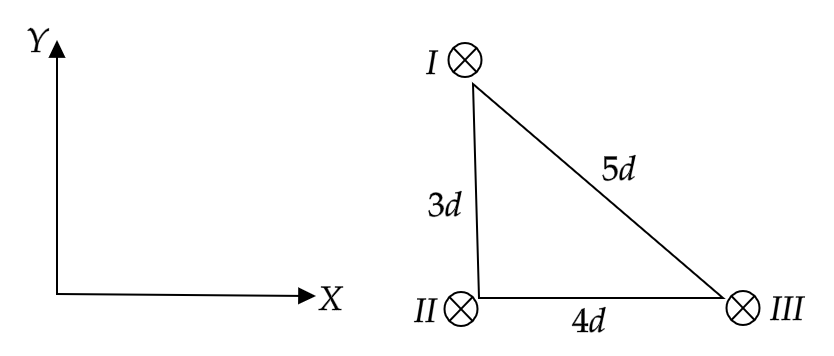
Three long wires, each carrying current are placed parallel to each other. The distance between I and II is \[3d\] , between II and III is \[4d\] and between III and I is \[5d\] . The magnetic field at the side of wire II is
(A) \[\dfrac{5{{\mu }_{0}}i}{24\pi d}\]
(B) \[\dfrac{10{{\mu }_{0}}i}{24\pi d}\]
(C) \[\dfrac{15{{\mu }_{0}}i}{24\pi d}\]
(D) \[\dfrac{20{{\mu }_{0}}i}{24\pi d}\]
Answer
 Verified
232.8k+ views
Hint: In the given question, we have been given an arrangement of current-carrying wires and we have been asked to find the magnetic field at the side of the wire II. Since the magnetic field is a vector quantity, in addition to finding the magnitude of the field caused by the wires, we need to find the direction of the field as well, as we will have to perform vector addition on the obtained magnetic fields to find the net or the resultant magnetic field.
Formula Used: \[M=\dfrac{{{\mu }_{0}}i}{2\pi d}\]
Complete step by step solution:
To find the direction of the magnetic field due to a current-carrying wire, we will make use of the right-hand rule which states that if the thumb is pointed in the direction of the current, then the direction in which the fingers would curl in the direction of the magnetic field.
According to the right-hand rule, the magnetic field due to III will be upwards and due to I, the magnetic field will be horizontal on the left side.
The magnetic field due to a current carrying wire is given as \[(M)=\dfrac{{{\mu }_{0}}i}{2\pi d}\] where \[\dfrac{{{\mu }_{0}}}{2\pi }\] is a constant value, \[i\] is the current flowing through the wire and \[d\] is the length of the wire
The magnetic field in the upward direction will be caused by the wire III, and can be given as
\[{{M}_{1}}=\dfrac{{{\mu }_{0}}i}{8\pi d}--equation(1)\]
The magnetic field in the left direction is caused by the wire I, and is given as
\[{{M}_{2}}=\dfrac{{{\mu }_{0}}i}{6\pi d}--equation(2)\]
Since the obtained fields are vector quantities and have specific directions, to find their resultant we will need to find the vector sum of the two magnetic fields calculated above. The vector field is given as the square root of the squares of the magnetic fields, that is
\[M=\sqrt{{{\left( {{M}_{1}} \right)}^{2}}+{{\left( {{M}_{2}} \right)}^{2}}}\]
Substituting the values in the above equation, we get
\[\begin{align}
& M=\sqrt{{{\left( \dfrac{{{\mu }_{0}}i}{8\pi d} \right)}^{2}}+{{\left( \dfrac{{{\mu }_{0}}i}{6\pi d} \right)}^{2}}} \\
& \Rightarrow M=\dfrac{{{\mu }_{0}}i}{\pi d}\sqrt{\dfrac{1}{64}+\dfrac{1}{36}} \\
& \Rightarrow M=\dfrac{{{\mu }_{0}}i}{\pi d}\sqrt{\dfrac{100}{64\times 36}} \\
& \Rightarrow M=\dfrac{10{{\mu }_{0}}i}{48\pi d}=\dfrac{5{{\mu }_{0}}i}{24\pi d} \\
\end{align}\]
Hence we can say that option (A) is the correct option.
Note:
To find the vector sum of two given vectors, we need the sine of the angle between the two vectors. Since one wire causes the magnetic field in the upward direction and the other wire causes the field in the left direction; the angle between the magnetic fields will be ninety degrees and its sine will be zero. Hence we have neglected it and simply squared the magnetic fields and found the sum and then taken the square root of the sum.
Formula Used: \[M=\dfrac{{{\mu }_{0}}i}{2\pi d}\]
Complete step by step solution:
To find the direction of the magnetic field due to a current-carrying wire, we will make use of the right-hand rule which states that if the thumb is pointed in the direction of the current, then the direction in which the fingers would curl in the direction of the magnetic field.
According to the right-hand rule, the magnetic field due to III will be upwards and due to I, the magnetic field will be horizontal on the left side.
The magnetic field due to a current carrying wire is given as \[(M)=\dfrac{{{\mu }_{0}}i}{2\pi d}\] where \[\dfrac{{{\mu }_{0}}}{2\pi }\] is a constant value, \[i\] is the current flowing through the wire and \[d\] is the length of the wire
The magnetic field in the upward direction will be caused by the wire III, and can be given as
\[{{M}_{1}}=\dfrac{{{\mu }_{0}}i}{8\pi d}--equation(1)\]
The magnetic field in the left direction is caused by the wire I, and is given as
\[{{M}_{2}}=\dfrac{{{\mu }_{0}}i}{6\pi d}--equation(2)\]
Since the obtained fields are vector quantities and have specific directions, to find their resultant we will need to find the vector sum of the two magnetic fields calculated above. The vector field is given as the square root of the squares of the magnetic fields, that is
\[M=\sqrt{{{\left( {{M}_{1}} \right)}^{2}}+{{\left( {{M}_{2}} \right)}^{2}}}\]
Substituting the values in the above equation, we get
\[\begin{align}
& M=\sqrt{{{\left( \dfrac{{{\mu }_{0}}i}{8\pi d} \right)}^{2}}+{{\left( \dfrac{{{\mu }_{0}}i}{6\pi d} \right)}^{2}}} \\
& \Rightarrow M=\dfrac{{{\mu }_{0}}i}{\pi d}\sqrt{\dfrac{1}{64}+\dfrac{1}{36}} \\
& \Rightarrow M=\dfrac{{{\mu }_{0}}i}{\pi d}\sqrt{\dfrac{100}{64\times 36}} \\
& \Rightarrow M=\dfrac{10{{\mu }_{0}}i}{48\pi d}=\dfrac{5{{\mu }_{0}}i}{24\pi d} \\
\end{align}\]
Hence we can say that option (A) is the correct option.
Note:
To find the vector sum of two given vectors, we need the sine of the angle between the two vectors. Since one wire causes the magnetic field in the upward direction and the other wire causes the field in the left direction; the angle between the magnetic fields will be ninety degrees and its sine will be zero. Hence we have neglected it and simply squared the magnetic fields and found the sum and then taken the square root of the sum.
Recently Updated Pages
JEE Main 2023 April 6 Shift 1 Question Paper with Answer Key

JEE Main 2023 April 6 Shift 2 Question Paper with Answer Key
JEE Main 2023 (January 31 Evening Shift) Question Paper with Solutions [PDF]
JEE Main 2023 January 30 Shift 2 Question Paper with Answer Key
JEE Main 2023 January 25 Shift 1 Question Paper with Answer Key
JEE Main 2023 January 24 Shift 2 Question Paper with Answer Key
Trending doubts
JEE Main 2026: Session 2 Registration Open, City Intimation Slip, Exam Dates, Syllabus & Eligibility
JEE Main 2026 Application Login: Direct Link, Registration, Form Fill, and Steps
JEE Main Marking Scheme 2026- Paper-Wise Marks Distribution and Negative Marking Details
Understanding the Angle of Deviation in a Prism
Hybridisation in Chemistry – Concept, Types & Applications
How to Convert a Galvanometer into an Ammeter or Voltmeter
Other Pages
JEE Advanced Marks vs Ranks 2025: Understanding Category-wise Qualifying Marks and Previous Year Cut-offs
Dual Nature of Radiation and Matter Class 12 Physics Chapter 11 CBSE Notes - 2025-26
Understanding Uniform Acceleration in Physics
Understanding the Electric Field of a Uniformly Charged Ring
JEE Advanced Weightage 2025 Chapter-Wise for Physics, Maths and Chemistry
Derivation of Equation of Trajectory Explained for Students