




Three charges $ - \sqrt 2 \mu C,2\sqrt 2 \mu C$and $ - \sqrt 2 \mu C$ are arranged as shown. Total electric field intensity at P is:
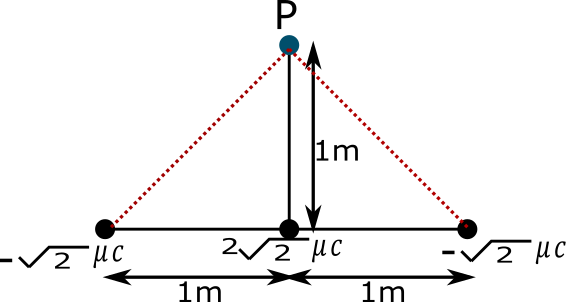
A) $18 \times {10^3}N/C$
B) $\left( {2\sqrt 2 - 1} \right) \times 9 \times {10^3}N/C$
C) Zero
D) $\left( {2\sqrt 2 + 1} \right) \times 9 \times {10^3}N/C$
Answer
 Verified
261k+ views
Hint: We simply apply here formula for electric field intensity at a point due to a point charge. Here in question three charges are given so we find three electric field intensity on point P. To find the net electric field on point P can be calculated by vector addition of all three electric fields.
Complete step by step solution:
Step 1
First we draw diagram mark electric field direction due to all three charges
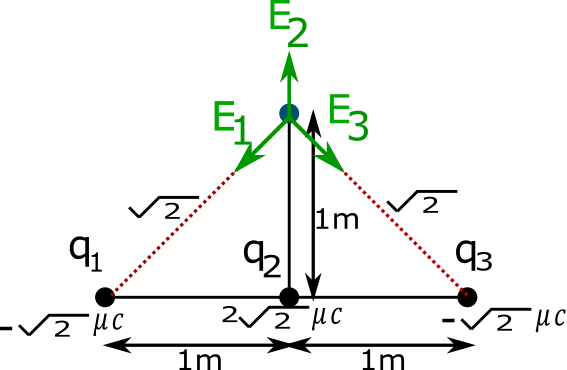
Here charge ${q_1} = - \sqrt 2 \mu C,{q_2} = 2\sqrt 2 \mu C$ and ${q_3} = - \sqrt 2 \mu C$
Electric field due to charge ${q_1}$ is ${E_1}$ toward charge because of negative charge
Electric field due to charge ${q_2}$ is ${E_2}$ away from ${q_2}$ because of positive charge
Electric field due to ${q_3}$ is ${E_3}$ toward ${q_3}$ because of negative charge
Electric field at a point due to a point charge is given by $E = \dfrac{{kq}}{{{r^2}}}$
Here E is the electric field
k is a constant $k = 9 \times {10^9}$
$r$ Is the distance between charge and point
Calculate ${E_1}$
$ \Rightarrow {E_1} = \dfrac{{k{q_1}}}{{{r^2}}}$
Here $r = \sqrt 2 $ from figure
$ \Rightarrow {E_1} = \dfrac{{k\sqrt 2 \times {{10}^{ - 6}}C}}{{{{\left( {\sqrt 2 } \right)}^2}}}$
$ \Rightarrow {E_1} = \dfrac{{k \times {{10}^{ - 6}}}}{{\sqrt 2 }}N/C$ At ${45^\circ }$ from negative y-axis toward negative x-axis
Electric field due to ${q_2}$
$ \Rightarrow {E_2} = \dfrac{{k{q_2}}}{{{r^2}}}$
Here $r = 1m$ given in question
$ \Rightarrow {E_2} = \dfrac{{k \times 2\sqrt 2 \times {{10}^{ - 6}}}}{1}$
$ \Rightarrow {E_2} = k\left( {2\sqrt 2 \times {{10}^{ - 6}}} \right)N/C$ Toward positive y- axis direction
Now ${E_3}$
$ \Rightarrow {E_3} = \dfrac{{k{q_3}}}{{{r^2}}}$
Here $r = \sqrt 2 m$ from diagram
$ \Rightarrow {E_3} = \dfrac{{k \times \sqrt 2 \times {{10}^{ - 6}}}}{{{{\left( {\sqrt 2 } \right)}^2}}}$
$ \Rightarrow {E_3} = \dfrac{{k \times {{10}^{ - 6}}}}{{\sqrt 2 }}N/C$ At ${45^\circ }$ from negative y-axis toward positive x- axis.
Step 2
We assume net electric field due to all three charges is $E$ then
$ \Rightarrow \overrightarrow E = {\overrightarrow E _1} + {\overrightarrow E _2} + {\overrightarrow E _3}$
We make diagram for ${E_1},{E_2}$ and ${E_3}$ with x-y axis
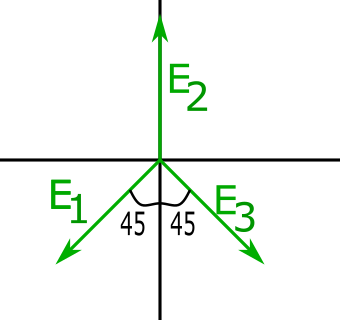
X component for net electric field ${E_x}$
$ \Rightarrow {E_x} = {E_{1x}} + {E_{2x}} + {E_{3x}}$
$ \Rightarrow {E_x} = - \dfrac{{k \times {{10}^{ - 6}}}}{{\sqrt 2 }}\sin 45 + 0 + \dfrac{{k \times {{10}^{ - 6}}}}{{\sqrt 2 }}\sin 45$
Solving this
$\therefore {E_x} = 0$
Y component of net electric field ${E_y}$
$ \Rightarrow {E_y} = {E_{1y}} + {E_{2y}} + {E_{3y}}$
$ \Rightarrow {E_y} = \left( { - \dfrac{{k \times {{10}^{ - 6}}}}{{\sqrt 2 }}\cos 45} \right) + \left( {k\left( {2\sqrt 2 \times {{10}^{ - 6}}} \right)} \right) + \left( { - \dfrac{{k \times {{10}^{ - 6}}}}{{\sqrt 2 }}\cos 45} \right)$
$ \Rightarrow {E_y} = \left( { - \dfrac{{k \times {{10}^{ - 6}}}}{{\sqrt 2 }} \times \dfrac{1}{{\sqrt 2 }}} \right) + \left( {k \times 2\sqrt 2 \times {{10}^{ - 6}}} \right) + \left( { - \dfrac{{k \times {{10}^{ - 6}}}}{{\sqrt 2 }} \times \dfrac{1}{{\sqrt 2 }}} \right)$
Solving this
$ \Rightarrow {E_y} = \left( {k \times {{10}^{ - 6}}} \right)\left( { - \dfrac{1}{2} + 2\sqrt 2 - \dfrac{1}{2}} \right)$
$ \Rightarrow {E_y} = \left( {k \times {{10}^{ - 6}}} \right)\left( {2\sqrt 2 - 1} \right)$
Put the value of constant k
$k = 9 \times {10^9}$
$ \Rightarrow {E_y} = \left( {9 \times {{10}^9} \times {{10}^{ - 6}}} \right)\left( {2\sqrt 2 - 1} \right)$
Solving again
$ \Rightarrow {E_y} = \left( {2\sqrt 2 - 1} \right)\left( {9 \times {{10}^3}} \right)N/C$
So net electric field
$ \Rightarrow E = \sqrt {{{\left( {{E_x}} \right)}^2} + {{\left( {{E_y}} \right)}^2}} $
$ \Rightarrow E = \sqrt {{{\left( 0 \right)}^2} + {{\left[ {\left( {2\sqrt 2 - 1} \right)\left( {9 \times {{10}^3}} \right)} \right]}^2}} $
Hence
$\therefore E = \left( {2\sqrt 2 - 1} \right)\left( {9 \times {{10}^3}} \right)N/C$
So we find net electric field $\left( {2\sqrt 2 - 1} \right) \times 9 \times {10^3}N/C$
Hence option B is correct
Note: In the question we take direction of electric field in positive charge away from the charge and in case of negative charge take toward the charge reason is electric field line
In positive charge electric field lines go away from the positive charge means appears to emit from positive charge and field lines appear to converse at negative charge. So we take the field direction according to this assumption.
Complete step by step solution:
Step 1
First we draw diagram mark electric field direction due to all three charges
Here charge ${q_1} = - \sqrt 2 \mu C,{q_2} = 2\sqrt 2 \mu C$ and ${q_3} = - \sqrt 2 \mu C$
Electric field due to charge ${q_1}$ is ${E_1}$ toward charge because of negative charge
Electric field due to charge ${q_2}$ is ${E_2}$ away from ${q_2}$ because of positive charge
Electric field due to ${q_3}$ is ${E_3}$ toward ${q_3}$ because of negative charge
Electric field at a point due to a point charge is given by $E = \dfrac{{kq}}{{{r^2}}}$
Here E is the electric field
k is a constant $k = 9 \times {10^9}$
$r$ Is the distance between charge and point
Calculate ${E_1}$
$ \Rightarrow {E_1} = \dfrac{{k{q_1}}}{{{r^2}}}$
Here $r = \sqrt 2 $ from figure
$ \Rightarrow {E_1} = \dfrac{{k\sqrt 2 \times {{10}^{ - 6}}C}}{{{{\left( {\sqrt 2 } \right)}^2}}}$
$ \Rightarrow {E_1} = \dfrac{{k \times {{10}^{ - 6}}}}{{\sqrt 2 }}N/C$ At ${45^\circ }$ from negative y-axis toward negative x-axis
Electric field due to ${q_2}$
$ \Rightarrow {E_2} = \dfrac{{k{q_2}}}{{{r^2}}}$
Here $r = 1m$ given in question
$ \Rightarrow {E_2} = \dfrac{{k \times 2\sqrt 2 \times {{10}^{ - 6}}}}{1}$
$ \Rightarrow {E_2} = k\left( {2\sqrt 2 \times {{10}^{ - 6}}} \right)N/C$ Toward positive y- axis direction
Now ${E_3}$
$ \Rightarrow {E_3} = \dfrac{{k{q_3}}}{{{r^2}}}$
Here $r = \sqrt 2 m$ from diagram
$ \Rightarrow {E_3} = \dfrac{{k \times \sqrt 2 \times {{10}^{ - 6}}}}{{{{\left( {\sqrt 2 } \right)}^2}}}$
$ \Rightarrow {E_3} = \dfrac{{k \times {{10}^{ - 6}}}}{{\sqrt 2 }}N/C$ At ${45^\circ }$ from negative y-axis toward positive x- axis.
Step 2
We assume net electric field due to all three charges is $E$ then
$ \Rightarrow \overrightarrow E = {\overrightarrow E _1} + {\overrightarrow E _2} + {\overrightarrow E _3}$
We make diagram for ${E_1},{E_2}$ and ${E_3}$ with x-y axis
X component for net electric field ${E_x}$
$ \Rightarrow {E_x} = {E_{1x}} + {E_{2x}} + {E_{3x}}$
$ \Rightarrow {E_x} = - \dfrac{{k \times {{10}^{ - 6}}}}{{\sqrt 2 }}\sin 45 + 0 + \dfrac{{k \times {{10}^{ - 6}}}}{{\sqrt 2 }}\sin 45$
Solving this
$\therefore {E_x} = 0$
Y component of net electric field ${E_y}$
$ \Rightarrow {E_y} = {E_{1y}} + {E_{2y}} + {E_{3y}}$
$ \Rightarrow {E_y} = \left( { - \dfrac{{k \times {{10}^{ - 6}}}}{{\sqrt 2 }}\cos 45} \right) + \left( {k\left( {2\sqrt 2 \times {{10}^{ - 6}}} \right)} \right) + \left( { - \dfrac{{k \times {{10}^{ - 6}}}}{{\sqrt 2 }}\cos 45} \right)$
$ \Rightarrow {E_y} = \left( { - \dfrac{{k \times {{10}^{ - 6}}}}{{\sqrt 2 }} \times \dfrac{1}{{\sqrt 2 }}} \right) + \left( {k \times 2\sqrt 2 \times {{10}^{ - 6}}} \right) + \left( { - \dfrac{{k \times {{10}^{ - 6}}}}{{\sqrt 2 }} \times \dfrac{1}{{\sqrt 2 }}} \right)$
Solving this
$ \Rightarrow {E_y} = \left( {k \times {{10}^{ - 6}}} \right)\left( { - \dfrac{1}{2} + 2\sqrt 2 - \dfrac{1}{2}} \right)$
$ \Rightarrow {E_y} = \left( {k \times {{10}^{ - 6}}} \right)\left( {2\sqrt 2 - 1} \right)$
Put the value of constant k
$k = 9 \times {10^9}$
$ \Rightarrow {E_y} = \left( {9 \times {{10}^9} \times {{10}^{ - 6}}} \right)\left( {2\sqrt 2 - 1} \right)$
Solving again
$ \Rightarrow {E_y} = \left( {2\sqrt 2 - 1} \right)\left( {9 \times {{10}^3}} \right)N/C$
So net electric field
$ \Rightarrow E = \sqrt {{{\left( {{E_x}} \right)}^2} + {{\left( {{E_y}} \right)}^2}} $
$ \Rightarrow E = \sqrt {{{\left( 0 \right)}^2} + {{\left[ {\left( {2\sqrt 2 - 1} \right)\left( {9 \times {{10}^3}} \right)} \right]}^2}} $
Hence
$\therefore E = \left( {2\sqrt 2 - 1} \right)\left( {9 \times {{10}^3}} \right)N/C$
So we find net electric field $\left( {2\sqrt 2 - 1} \right) \times 9 \times {10^3}N/C$
Hence option B is correct
Note: In the question we take direction of electric field in positive charge away from the charge and in case of negative charge take toward the charge reason is electric field line
In positive charge electric field lines go away from the positive charge means appears to emit from positive charge and field lines appear to converse at negative charge. So we take the field direction according to this assumption.
Recently Updated Pages
Circuit Switching vs Packet Switching: Key Differences Explained

JEE Extractive Metallurgy Important Concepts and Tips for Exam Preparation
JEE Atomic Structure and Chemical Bonding important Concepts and Tips
JEE Amino Acids and Peptides Important Concepts and Tips for Exam Preparation
Electricity and Magnetism Explained: Key Concepts & Applications
JEE Energetics Important Concepts and Tips for Exam Preparation
Trending doubts
JEE Main 2026: Exam Dates, Session 2 Updates, City Slip, Admit Card & Latest News
JEE Main Participating Colleges 2026 - A Complete List of Top Colleges
Hybridisation in Chemistry – Concept, Types & Applications
Understanding the Electric Field of a Uniformly Charged Ring
Derivation of Equation of Trajectory Explained for Students
Understanding Atomic Structure for Beginners
Other Pages
CBSE Class 12 Physics Question Paper 2026: Download SET-wise PDF with Answer Key & Analysis
JEE Advanced 2026 Notification Out with Exam Date, Registration (Extended), Syllabus and More
JEE Advanced Marks vs Ranks 2025: Understanding Category-wise Qualifying Marks and Previous Year Cut-offs
JEE Advanced Weightage Chapter Wise 2026 for Physics, Chemistry, and Mathematics
How to Convert a Galvanometer into an Ammeter or Voltmeter
Understanding Uniform Acceleration in Physics