




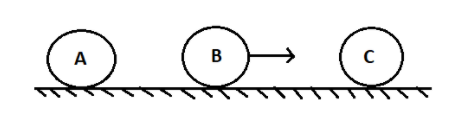
Three balls $A,B$ and $C$$\left( {{m_A} = {m_C} = 4{m_B}} \right)$ are placed on a smooth horizontal surface. The ball $B$ collides with a ball $C$ with an initial velocity $v$ as shown. The total number of collisions between the balls will be (all collisions are elastic)
(A) One
(B) Two
(C) Three
(D) Four
Answer
 Verified
260.1k+ views
Hint Given that three balls are placed on a smooth surface. Ball $A$ and ball $C$ are of equal mass. They have mass $4$ times that of the ball $B$. It says that the ball $B$ will collide with $C$. We have to find out the number of collisions between the balls. It is given that the collisions are elastic.
Complete Step by step solution
The velocity of the ball $B$ before the collision is given as $v$
After the collision,
Assume that the velocity of $C = {v_1}$
And the velocity of $B = {v_2}$
Hence we can write,
$v = {v_1} + {v_2}$
${v_2}$ will be in the opposite direction of ${v_1}$.
From the equation, $v = {v_1} + {v_2}$
We can write,
${v_1} = v - {v_2}$
We know that the momentum can be written as, $P = mv$
Here applying the conservation of momentum,
${m_B}v = {m_B}{v_2} + {m_C}{v_1}$
Since ${m_C} = 4{m_B}$
Substituting ${m_C} = 4{m_B}$in the above equation we get
${m_B}v = {m_B}{v_2} + 4{m_B}{v_1}$
Eliminating the common terms
We get,
$v = {v_2} + 4{v_1}$………………………………………………(1)
For an elastic collision, the coefficient of restitution is defined as the ratio of the velocity of separation and to the velocity of approach, i.e.
$e = \dfrac{{{v_S}}}{{{v_A}}}$
Where $e$ stands for the coefficient of restitution, ${v_S}$ stands for the velocity of separation, and ${v_A}$stands for the velocity of approach.
Here, we know that the velocity of separation will be, ${v_A} = - \left( {{v_2} - {v_1}} \right) = {v_1} - {v_2}$
The velocity of approach will be, ${v_A} = v$
Hence $e$ can be written as,
$e = \dfrac{{{v_1} - {v_2}}}{v}$
For elastic collision $e = 1$
Hence we can write,
$\dfrac{{{v_1} - {v_2}}}{v} = 1$
$ \Rightarrow {v_1} - {v_2} = v$…………………………………………………………………….(2)
Adding equation (1) and equation (2) we get,
$ {v_2} + 4{v_1} = v +$
${v_1} - {v_2} = v$
$ \Rightarrow 5{v_1} = 2v$
Solving the above equation,
${v_1} = \dfrac{2}{5}v$
Substituting the value of ${v_1}$ in equation (2) we get,
$\dfrac{2}{5}v - {v_2} = v$
$ \Rightarrow \dfrac{2}{5}v - v = {v_2}$
From this we get,
${v_2} = - \dfrac{3}{5}v$
Now the ball $C$ will move with a velocity $\dfrac{2}{5}v$ and the ball $B$ will move with a velocity $\dfrac{3}{5}v$ in opposite directions.
The ball $B$ will hit the ball $A$ with a velocity $ - \dfrac{3}{5}v$
Let ${v_3}$be the velocity of the ball $A$
Applying the law of conservation of momentum again, we get
${m_B}\left( { - \dfrac{{3v}}{5}} \right) = - {m_A}{v_3} + {m_B}{\bar v_2}$
We know that ${m_A} = 4{m_B}$
Substituting, we get
${m_B}\left( { - \dfrac{{3v}}{5}} \right) = - 4{m_B}{v_3} + {m_B}{v_2}$
Canceling common terms,
$ - \dfrac{{3v}}{5} = - 4{v_3} + {\bar v_2}$………………………………………………………………………………..(3)
Again considering the coefficient of restitution,
$e = \dfrac{{{v_S}}}{{{v_A}}}$
Where $e$ stands for the coefficient of restitution, ${v_S}$ stands for the velocity of separation, and ${v_A}$ stands for the velocity of approach.
Here, we know that the velocity of separation will be, \[{v_A} = - \left( { - {v_3} - {{\bar v}_2}} \right) = {v_3} + {\bar v_2}\]
The velocity of approach will be, ${v_A} = \dfrac{{3v}}{5}$
$e = \dfrac{{{v_3} + {{\bar v}_2}}}{{\dfrac{{3v}}{5}}}$
Here also the collision is elastic, hence $e = 1$
$\dfrac{{3v}}{5} = {v_3} + {\bar v_2}$……………………………………………………………………………..(4)
Multiplying $4$with equation (4) and adding with equation (3), we get
$ \dfrac{{12v}}{5} = 4{v_3} + 4{{\bar v}_2} +$
$\dfrac{{ - 3v}}{5} = - 4{v_3} + {{\bar v}_2}$
This will give us,
$\dfrac{{9v}}{5} = 5{\bar v_2}$
From this, we get
${\bar v_2} = \dfrac{{9v}}{{25}}$
Substituting in equation (4)
$\dfrac{{3v}}{5} = {v_3} + \dfrac{{9v}}{{25}}$
From this,
${v_3} = \dfrac{{3v}}{5} - \dfrac{{9v}}{{25}}$
$ \Rightarrow {v_3} = \dfrac{{6v}}{{25}}$
Now the ball $A$ will be moving with a velocity $\dfrac{{6v}}{{25}}$ and the ball $B$ will be moving with a velocity $\dfrac{{9v}}{{25}}$ in the opposite direction. The state will be as shown below
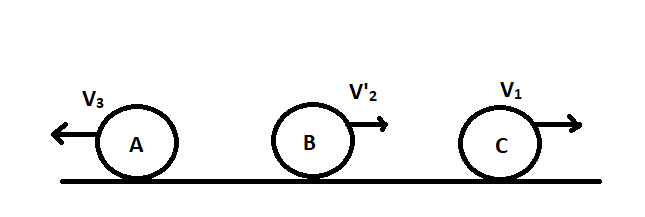
We know that ${\bar v_2} = \dfrac{{9v}}{{25}}$and ${v_1} = \dfrac{{2v}}{5}$
$ \Rightarrow {\bar v_2} \ll {v_1}$
Hence there will not be the third collision. Therefore there will only be two collisions.
The answer is Option (B): Two
Note
In all collisions, the total linear momentum will always be conserved. But the kinetic energy of the system is not always conserved. If the total kinetic energy of a system is conserved after collision such collisions are called elastic collisions and if the total kinetic energy of a system is not conserved after collision then the collision is called an inelastic collision.
Complete Step by step solution
The velocity of the ball $B$ before the collision is given as $v$
After the collision,
Assume that the velocity of $C = {v_1}$
And the velocity of $B = {v_2}$
Hence we can write,
$v = {v_1} + {v_2}$
${v_2}$ will be in the opposite direction of ${v_1}$.
From the equation, $v = {v_1} + {v_2}$
We can write,
${v_1} = v - {v_2}$
We know that the momentum can be written as, $P = mv$
Here applying the conservation of momentum,
${m_B}v = {m_B}{v_2} + {m_C}{v_1}$
Since ${m_C} = 4{m_B}$
Substituting ${m_C} = 4{m_B}$in the above equation we get
${m_B}v = {m_B}{v_2} + 4{m_B}{v_1}$
Eliminating the common terms
We get,
$v = {v_2} + 4{v_1}$………………………………………………(1)
For an elastic collision, the coefficient of restitution is defined as the ratio of the velocity of separation and to the velocity of approach, i.e.
$e = \dfrac{{{v_S}}}{{{v_A}}}$
Where $e$ stands for the coefficient of restitution, ${v_S}$ stands for the velocity of separation, and ${v_A}$stands for the velocity of approach.
Here, we know that the velocity of separation will be, ${v_A} = - \left( {{v_2} - {v_1}} \right) = {v_1} - {v_2}$
The velocity of approach will be, ${v_A} = v$
Hence $e$ can be written as,
$e = \dfrac{{{v_1} - {v_2}}}{v}$
For elastic collision $e = 1$
Hence we can write,
$\dfrac{{{v_1} - {v_2}}}{v} = 1$
$ \Rightarrow {v_1} - {v_2} = v$…………………………………………………………………….(2)
Adding equation (1) and equation (2) we get,
$ {v_2} + 4{v_1} = v +$
${v_1} - {v_2} = v$
$ \Rightarrow 5{v_1} = 2v$
Solving the above equation,
${v_1} = \dfrac{2}{5}v$
Substituting the value of ${v_1}$ in equation (2) we get,
$\dfrac{2}{5}v - {v_2} = v$
$ \Rightarrow \dfrac{2}{5}v - v = {v_2}$
From this we get,
${v_2} = - \dfrac{3}{5}v$
Now the ball $C$ will move with a velocity $\dfrac{2}{5}v$ and the ball $B$ will move with a velocity $\dfrac{3}{5}v$ in opposite directions.
The ball $B$ will hit the ball $A$ with a velocity $ - \dfrac{3}{5}v$
Let ${v_3}$be the velocity of the ball $A$
Applying the law of conservation of momentum again, we get
${m_B}\left( { - \dfrac{{3v}}{5}} \right) = - {m_A}{v_3} + {m_B}{\bar v_2}$
We know that ${m_A} = 4{m_B}$
Substituting, we get
${m_B}\left( { - \dfrac{{3v}}{5}} \right) = - 4{m_B}{v_3} + {m_B}{v_2}$
Canceling common terms,
$ - \dfrac{{3v}}{5} = - 4{v_3} + {\bar v_2}$………………………………………………………………………………..(3)
Again considering the coefficient of restitution,
$e = \dfrac{{{v_S}}}{{{v_A}}}$
Where $e$ stands for the coefficient of restitution, ${v_S}$ stands for the velocity of separation, and ${v_A}$ stands for the velocity of approach.
Here, we know that the velocity of separation will be, \[{v_A} = - \left( { - {v_3} - {{\bar v}_2}} \right) = {v_3} + {\bar v_2}\]
The velocity of approach will be, ${v_A} = \dfrac{{3v}}{5}$
$e = \dfrac{{{v_3} + {{\bar v}_2}}}{{\dfrac{{3v}}{5}}}$
Here also the collision is elastic, hence $e = 1$
$\dfrac{{3v}}{5} = {v_3} + {\bar v_2}$……………………………………………………………………………..(4)
Multiplying $4$with equation (4) and adding with equation (3), we get
$ \dfrac{{12v}}{5} = 4{v_3} + 4{{\bar v}_2} +$
$\dfrac{{ - 3v}}{5} = - 4{v_3} + {{\bar v}_2}$
This will give us,
$\dfrac{{9v}}{5} = 5{\bar v_2}$
From this, we get
${\bar v_2} = \dfrac{{9v}}{{25}}$
Substituting in equation (4)
$\dfrac{{3v}}{5} = {v_3} + \dfrac{{9v}}{{25}}$
From this,
${v_3} = \dfrac{{3v}}{5} - \dfrac{{9v}}{{25}}$
$ \Rightarrow {v_3} = \dfrac{{6v}}{{25}}$
Now the ball $A$ will be moving with a velocity $\dfrac{{6v}}{{25}}$ and the ball $B$ will be moving with a velocity $\dfrac{{9v}}{{25}}$ in the opposite direction. The state will be as shown below
We know that ${\bar v_2} = \dfrac{{9v}}{{25}}$and ${v_1} = \dfrac{{2v}}{5}$
$ \Rightarrow {\bar v_2} \ll {v_1}$
Hence there will not be the third collision. Therefore there will only be two collisions.
The answer is Option (B): Two
Note
In all collisions, the total linear momentum will always be conserved. But the kinetic energy of the system is not always conserved. If the total kinetic energy of a system is conserved after collision such collisions are called elastic collisions and if the total kinetic energy of a system is not conserved after collision then the collision is called an inelastic collision.
Recently Updated Pages
Circuit Switching vs Packet Switching: Key Differences Explained

Dimensions of Pressure in Physics: Formula, Derivation & SI Unit
JEE General Topics in Chemistry Important Concepts and Tips
JEE Extractive Metallurgy Important Concepts and Tips for Exam Preparation
JEE Atomic Structure and Chemical Bonding important Concepts and Tips
JEE Amino Acids and Peptides Important Concepts and Tips for Exam Preparation
Trending doubts
JEE Main 2026: Exam Dates, Session 2 Updates, City Slip, Admit Card & Latest News
JEE Main Participating Colleges 2026 - A Complete List of Top Colleges
Hybridisation in Chemistry – Concept, Types & Applications
Understanding the Electric Field of a Uniformly Charged Ring
Derivation of Equation of Trajectory Explained for Students
Understanding Atomic Structure for Beginners
Other Pages
JEE Advanced 2026 Notification Out with Exam Date, Registration (Extended), Syllabus and More
JEE Advanced Marks vs Ranks 2025: Understanding Category-wise Qualifying Marks and Previous Year Cut-offs
CBSE Notes Class 11 Physics Chapter 1 - Units And Measurements - 2025-26
NCERT Solutions For Class 11 Physics Chapter 1 Units And Measurements - 2025-26
Important Questions For Class 11 Physics Chapter 1 Units and Measurement - 2025-26
JEE Advanced Weightage Chapter Wise 2026 for Physics, Chemistry, and Mathematics