




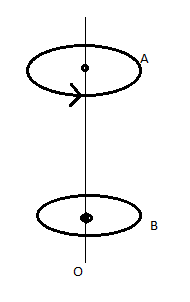
There are two loops $A$ and $B$ placed coaxially along a vertical line. Loop $A$ is allowed to fall freely towards the loop $B$. If the constant current flowing in the loop $A$ is as shown in the figure, then find the direction of flow of induced current in the loop $B$ as seen from the bottom of the loop $B$.
(A) Clockwise
(B) Anticlockwise
(C) No current will induce
(D) Can’t be determined
Answer
 Verified
271.2k+ views
Hint: As the loop $A$ will fall, magnetic flux will be there in the loop $B$ due to magnetic lines pointing upwards. To counter this increase of flux, a current will be induced in the loop $B$ such that induced magnetic field lines point downwards. The direction of current is found from the right hand rule.
Complete step by step answer: :
Here we will use Lenz’s law to understand what happens when the loop $A$ comes close to the loop $B$. By the right hand thumb rule, we get the direction of the magnetic field and the magnetic lines of flux of the loop $A$. As the loop $A$ goes downward, the number of flux lines in the lower loop $B$ increases. This can now be analyzed using Lenz’s law which is basically Newton’s third law for magnetism saying that the induced electric current flows in the direction such that the magnetic flux lines it creates are opposite to the magnetic flux lines which caused the induction of the current in the first place.
Therefore the new flux lines will be directed vertically downward, to oppose the original increasing flux lines of the loop $A$ which are directed upwards. Therefore using the right hand thumb rule again and this time, pointing the thumb downward along the new reversed lines of flux, which have been generated by the new induced current in the loop $B$, we get the fingers curling clockwise when seen from the top of the loop $B$. This can also be imagined as the right hand screw rule being applied along the loop $B$ with the tip of the screw along the new reversed flux lines pointing downwards.
Therefore since the direction of the current from the top is clockwise, looking from the bottom of the loop $B$, its direction will be anticlockwise.
Thus, the correct option is (B).
Note: Nature abhors change of flux. Therefore as the magnetic flux lines of the loop $A$ passing through the loop $B$ increases, the current is induced to create a change in it so that the new flux lines oppose the original increasing lines of flux. If the flux would have been decreasing, then the induced magnetic field would try to increase those flux lines.
Complete step by step answer: :
Here we will use Lenz’s law to understand what happens when the loop $A$ comes close to the loop $B$. By the right hand thumb rule, we get the direction of the magnetic field and the magnetic lines of flux of the loop $A$. As the loop $A$ goes downward, the number of flux lines in the lower loop $B$ increases. This can now be analyzed using Lenz’s law which is basically Newton’s third law for magnetism saying that the induced electric current flows in the direction such that the magnetic flux lines it creates are opposite to the magnetic flux lines which caused the induction of the current in the first place.
Therefore the new flux lines will be directed vertically downward, to oppose the original increasing flux lines of the loop $A$ which are directed upwards. Therefore using the right hand thumb rule again and this time, pointing the thumb downward along the new reversed lines of flux, which have been generated by the new induced current in the loop $B$, we get the fingers curling clockwise when seen from the top of the loop $B$. This can also be imagined as the right hand screw rule being applied along the loop $B$ with the tip of the screw along the new reversed flux lines pointing downwards.
Therefore since the direction of the current from the top is clockwise, looking from the bottom of the loop $B$, its direction will be anticlockwise.
Thus, the correct option is (B).
Note: Nature abhors change of flux. Therefore as the magnetic flux lines of the loop $A$ passing through the loop $B$ increases, the current is induced to create a change in it so that the new flux lines oppose the original increasing lines of flux. If the flux would have been decreasing, then the induced magnetic field would try to increase those flux lines.
Recently Updated Pages
JoSAA Counselling 2026: JoSAA 2026 Mock Seat Allotment LIVE: Round 2 Result Released, Registration, Choice Filling and Ranks

Circuit Switching vs Packet Switching: Key Differences Explained
JEE General Topics in Chemistry Important Concepts and Tips
JEE Extractive Metallurgy Important Concepts and Tips for Exam Preparation
JEE Atomic Structure and Chemical Bonding important Concepts and Tips
JEE Amino Acids and Peptides Important Concepts and Tips for Exam Preparation
Trending doubts
JEE Main 2026: Exam Dates, Session 2 Updates, City Slip, Admit Card & Latest News
JEE Main Participating Colleges 2026 - A Complete List of Top Colleges
Kinematics Mock Test for JEE Main 2025-26: Comprehensive Practice
Understanding the Electric Field of a Uniformly Charged Ring
Understanding Atomic Structure for Beginners
Derivation of Equation of Trajectory Explained for Students
Other Pages
CBSE Class 12 Physics Question Paper 2026: Download SET-wise PDF with Answer Key & Analysis
JEE Advanced 2026 Notification Out with Exam Date, Registration (Extended), Syllabus and More
JEE Advanced Percentile vs Marks 2026: JEE Main Cutoff, AIR & IIT Admission Guide
JEE Advanced Weightage Chapter Wise 2026 for Physics, Chemistry, and Mathematics
JEE Main Marking Scheme 2026- Paper-Wise Marks Distribution and Negative Marking Details
Kinematics Mock Test for JEE Main 2025-26: Practice & Ace the Exam