




What should be the width of each slit to obtain $10$ maxima of double slit interference pattern within the central maximum of single slit diffraction pattern?
Answer
 Verified
253.8k+ views
Hint: This is a complicated question the students should have a deep knowledge on the single and double slit experiment to understand the question. We should know about the relation between the double and single slit experiment so that we can understand the question properly.
Complete step by step answer
Single slit diffraction: Single slit diffraction occurs in a single slit experiment where light waves from a source passes through a single slit of width ‘w’ which is in the order of the wavelength of the light wave passing through it to get a distinctive pattern called diffraction pattern.
Double slit experiment: double slit diffraction occurs in a when where light waves from a source passes through a two slits of width ‘w’ which is in the order of the wavelength of the light wave passing through it to get a diffraction pattern.
When the double slit in Young’s experiment is replaced by a single narrow slit (illuminated by a monochromatic source), a broad pattern with a central bright region is observed. On both sides, there are alternate dark and bright regions, the intensity becoming weaker away from the centre the angular size of the central maximum increases when the slit width decreases. The double-slit experiment, is actually a superposition of single-slit diffraction from each slit or hole.
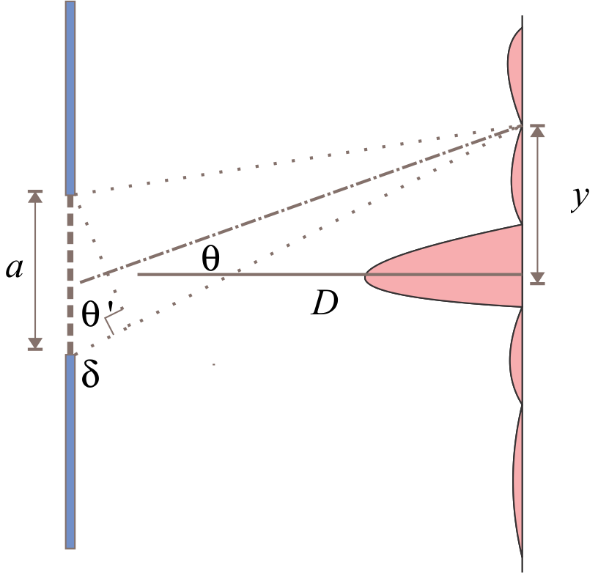
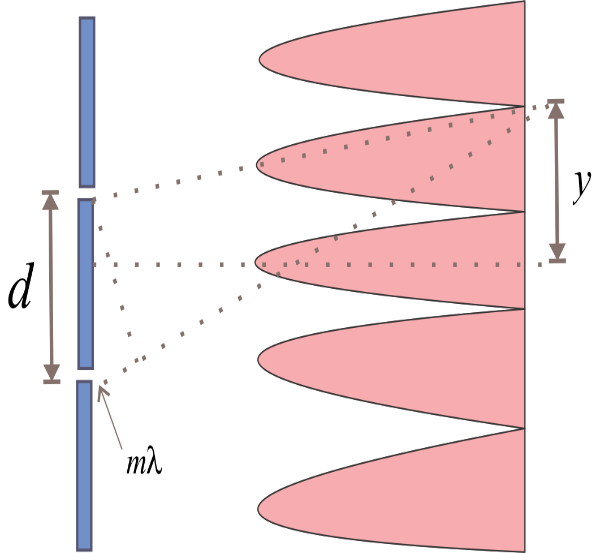
Single slit experiment Double slit experiment
In the diagram,
a and d are the width of the slit.
y is the central maximum.
The angular width of the central maximum of single slit diffraction is $2\theta = \dfrac{{2\lambda }}{a}$
Where,
$\lambda $ is the wavelength
$a$ is the width of the slit
The angular width of the central maximum of double slit diffraction is $2\theta = \dfrac{\lambda }{d}$
$\lambda $ is the wavelength
$d$ is the width of the slit
The angular width of the central maximum of single slit diffraction is $2\theta = \dfrac{{2\lambda }}{a}{\text{ }} \to {\text{1}}$
Width of each slit to obtain $10$ maxima of double slit interference pattern within the central maximum of single slit diffraction pattern $ \Rightarrow 2\theta = 10 \times \dfrac{\lambda }{d}{\text{ }} \to {\text{2}}$
The double slit interference pattern of 10 maxima (The envelope shows the single slit experiment)
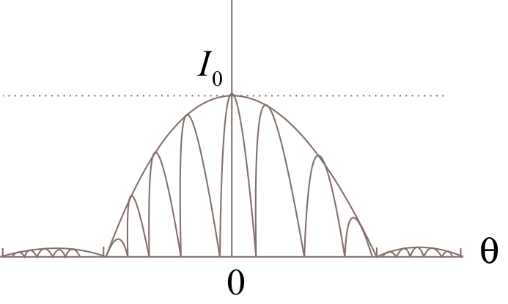
We have to find the width of each slit to obtain $10$ maxima of double slit interference pattern within the central maximum of single slit diffraction pattern.
Equate 1 and 2
$ \Rightarrow \dfrac{{2\lambda }}{a} = 10 \times \dfrac{\lambda }{d}$
$ \Rightarrow a = \dfrac{d}{5}$
$a$ is the width of the single slit.
$d$ is the width of the double slit.
We have to find the width of both single and double slit which have the same width.
So, let us take the width of slit as $a$ in common.
$ \Rightarrow a = \dfrac{1}{5}$
$ \Rightarrow a = 0.2mm$
Note: Students should be aware that here the width of the slit is written in millimetres. Generally we write the measurement of slit width in millimetres, we follow the same when we do the problem.
Complete step by step answer
Single slit diffraction: Single slit diffraction occurs in a single slit experiment where light waves from a source passes through a single slit of width ‘w’ which is in the order of the wavelength of the light wave passing through it to get a distinctive pattern called diffraction pattern.
Double slit experiment: double slit diffraction occurs in a when where light waves from a source passes through a two slits of width ‘w’ which is in the order of the wavelength of the light wave passing through it to get a diffraction pattern.
When the double slit in Young’s experiment is replaced by a single narrow slit (illuminated by a monochromatic source), a broad pattern with a central bright region is observed. On both sides, there are alternate dark and bright regions, the intensity becoming weaker away from the centre the angular size of the central maximum increases when the slit width decreases. The double-slit experiment, is actually a superposition of single-slit diffraction from each slit or hole.
Single slit experiment Double slit experiment
In the diagram,
a and d are the width of the slit.
y is the central maximum.
The angular width of the central maximum of single slit diffraction is $2\theta = \dfrac{{2\lambda }}{a}$
Where,
$\lambda $ is the wavelength
$a$ is the width of the slit
The angular width of the central maximum of double slit diffraction is $2\theta = \dfrac{\lambda }{d}$
$\lambda $ is the wavelength
$d$ is the width of the slit
The angular width of the central maximum of single slit diffraction is $2\theta = \dfrac{{2\lambda }}{a}{\text{ }} \to {\text{1}}$
Width of each slit to obtain $10$ maxima of double slit interference pattern within the central maximum of single slit diffraction pattern $ \Rightarrow 2\theta = 10 \times \dfrac{\lambda }{d}{\text{ }} \to {\text{2}}$
The double slit interference pattern of 10 maxima (The envelope shows the single slit experiment)
We have to find the width of each slit to obtain $10$ maxima of double slit interference pattern within the central maximum of single slit diffraction pattern.
Equate 1 and 2
$ \Rightarrow \dfrac{{2\lambda }}{a} = 10 \times \dfrac{\lambda }{d}$
$ \Rightarrow a = \dfrac{d}{5}$
$a$ is the width of the single slit.
$d$ is the width of the double slit.
We have to find the width of both single and double slit which have the same width.
So, let us take the width of slit as $a$ in common.
$ \Rightarrow a = \dfrac{1}{5}$
$ \Rightarrow a = 0.2mm$
Note: Students should be aware that here the width of the slit is written in millimetres. Generally we write the measurement of slit width in millimetres, we follow the same when we do the problem.
Recently Updated Pages
Mass vs Weight: Key Differences Explained for Students

Uniform Acceleration Explained: Formula, Examples & Graphs
JEE Main 2022 (June 25th Shift 2) Chemistry Question Paper with Answer Key
Average Atomic Mass - Important Concepts and Tips for JEE
JEE Main 2023 (April 15th Shift 1) Physics Question Paper with Answer Key
JEE Main 2022 (June 27th Shift 2) Chemistry Question Paper with Answer Key
Trending doubts
JEE Main 2026: Exam Dates, Session 2 Updates, City Slip, Admit Card & Latest News
JEE Main Marking Scheme 2026- Paper-Wise Marks Distribution and Negative Marking Details
JEE Main 2026 Application Login: Direct Link, Registration, Form Fill, and Steps
Hybridisation in Chemistry – Concept, Types & Applications
Understanding the Electric Field of a Uniformly Charged Ring
Derivation of Equation of Trajectory Explained for Students
Other Pages
CBSE Class 12 Physics Question Paper 2026: Download SET-wise PDF with Answer Key & Analysis
JEE Advanced 2026 - Exam Date (Released), Syllabus, Registration, Eligibility, Preparation, and More
JEE Advanced Marks vs Ranks 2025: Understanding Category-wise Qualifying Marks and Previous Year Cut-offs
JEE Advanced Weightage 2025 Chapter-Wise for Physics, Maths and Chemistry
Understanding Atomic Structure for Beginners
Ideal and Non-Ideal Solutions Explained for Class 12 Chemistry