




The tangent at $P$ to a parabola \[{{y}^{2}}=4ax\] meets the directrix at \[U\] and the base of the latus rectum at \[V\], then $SUV$ (where $S$ is the focus) must be a/an
(a). right triangle
(b). equilateral triangle
(c). isosceles triangle
(d). right isosceles triangle
Answer
 Verified
283.5k+ views
Hint: We have to find the coordinates of the points $S$, \[U\] and \[V\], for which the equation of a tangent to the parabola given by $yt=x+a{{t}^{2}}$ would be required.
Complete step-by-step solution -
In the question, the equation of the parabola is given as ${{y}^{2}}=4ax$. The tangent at a point $P$ is said to meet the directrix at point $U$ and the base of latus rectum at $V$.
The directrix of the parabola of the form ${{y}^{2}}=4ax$ is given by $x=-a$. The latus rectum is given by $x=a$. The focus, $S$ of the parabola is $\left( a,0 \right)$. Also, we know that the latus rectum passes through the focus.
The coordinates of the tangent at point $P$ on the parabola can be taken in the parametric form as $\left( a{{t}^{2}},2at \right)$.
The figure showing all these details can be drawn as below,
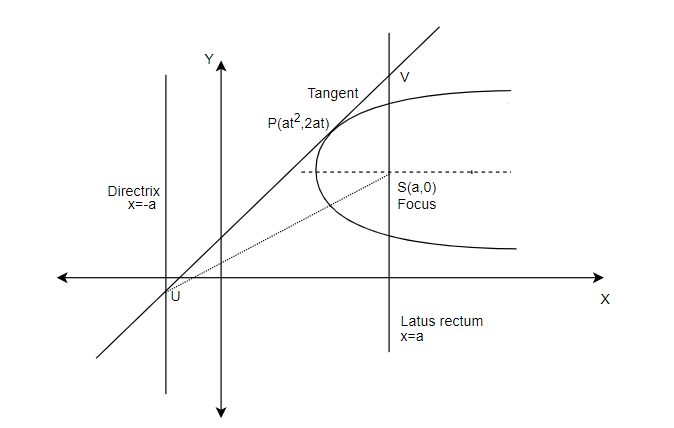
We know that the equation of a tangent to the parabola is given by,
$yt=x+a{{t}^{2}}\ldots \ldots \ldots \left( i \right)$
We have to find the coordinates of the points $U$ and $V$.
Since the point $U$ lies on the directrix, it is clear that it will have the $x$ coordinate as $-a$, so the $y$ coordinate can be obtained by substituting $x=-a$ in equation $\left( i \right)$,
$\begin{align}
& yt=-a+a{{t}^{2}} \\
& y=\dfrac{-a+a{{t}^{2}}}{t} \\
\end{align}$
Therefore, the coordinates of point $U$ are $\left( -a,\dfrac{-a+a{{t}^{2}}}{t} \right)$.
Since the point $V$ lies on the latus rectum, it is clear that it will have the $x$ coordinate as $a$, so the $y$ coordinate can be obtained by substituting $x=a$ in equation $\left( i \right)$,
$\begin{align}
& yt=a+a{{t}^{2}} \\
& y=\dfrac{a+a{{t}^{2}}}{t} \\
\end{align}$
Therefore, the coordinates of point $V$ are $\left( a,\dfrac{a+a{{t}^{2}}}{t} \right)$.
Looking at the options, it is clear that we have to find what type of triangle is formed by $SUV$. For which we will have to compute the length of the sides $SU,SV$ and $UV$.
The distance formula is used for finding the length. For two points with coordinates $\left( {{x}_{1}},{{y}_{1}} \right)$ and $\left( {{x}_{2}},{{y}_{2}} \right)$, it is given by,
$D=\sqrt{{{\left( {{x}_{2}}-{{x}_{1}} \right)}^{2}}+{{\left( {{y}_{2}}-{{y}_{1}} \right)}^{2}}}$
So, we can find the length of $SU$ with coordinates $\left( a,0 \right)$ and $\left( -a,\dfrac{-a+a{{t}^{2}}}{t} \right)$ as
$\begin{align}
& SU=\sqrt{{{\left( -a-a \right)}^{2}}+{{\left( \dfrac{-a+a{{t}^{2}}}{t}-0 \right)}^{2}}} \\
& SU=\sqrt{{{\left( -2a \right)}^{2}}+{{\left( \dfrac{-a+a{{t}^{2}}}{t} \right)}^{2}}} \\
& SU=\sqrt{4{{a}^{2}}+\dfrac{{{\left( -a+a{{t}^{2}} \right)}^{2}}}{{{t}^{2}}}} \\
\end{align}$
Taking $a$ outside from the numerator of the second term, we get
$\begin{align}
& SU=\sqrt{4{{a}^{2}}+\dfrac{{{\left( a\left( -1+{{t}^{2}} \right) \right)}^{2}}}{{{t}^{2}}}} \\
& SU=\sqrt{4{{a}^{2}}+\dfrac{{{a}^{2}}{{\left( -1+{{t}^{2}} \right)}^{2}}}{{{t}^{2}}}} \\
\end{align}$
Taking the common term ${{a}^{2}}$ outside the root, we get
$SU=a\sqrt{4+\dfrac{{{\left( -1+{{t}^{2}} \right)}^{2}}}{{{t}^{2}}}}$
Taking the LCM and simplifying, we get
$\begin{align}
& SU=a\sqrt{\dfrac{4{{t}^{2}}+{{\left( -1+{{t}^{2}} \right)}^{2}}}{{{t}^{2}}}} \\
& SU=a\sqrt{\dfrac{4{{t}^{2}}+1+{{t}^{4}}-2{{t}^{2}}}{{{t}^{2}}}} \\
& SU=a\sqrt{\dfrac{1+{{t}^{4}}+2{{t}^{2}}}{{{t}^{2}}}} \\
\end{align}$
Since we know that ${{\left( a+b \right)}^{2}}={{a}^{2}}+2ab+{{b}^{2}}$, we can simplify as
$\begin{align}
& SU=a\sqrt{\dfrac{{{\left( 1+{{t}^{2}} \right)}^{2}}}{{{t}^{2}}}} \\
& SU=a\dfrac{\left( 1+{{t}^{2}} \right)}{t}\ldots \ldots \ldots \left( ii \right) \\
\end{align}$
Now, we can get the length of $SV$ with coordinates $\left( a,0 \right)$ and $\left( a,\dfrac{a+a{{t}^{2}}}{t} \right)$ as
\[\begin{align}
& SV=\sqrt{{{\left( a-a \right)}^{2}}+{{\left( \dfrac{a+a{{t}^{2}}}{t}-0 \right)}^{2}}} \\
& SV=\sqrt{{{0}^{2}}+{{\left( \dfrac{a+a{{t}^{2}}}{t} \right)}^{2}}} \\
& SV=\sqrt{\dfrac{{{\left( a+a{{t}^{2}} \right)}^{2}}}{{{t}^{2}}}} \\
\end{align}\]
Taking the term ${{a}^{2}}$ outside from the numerator,
\[\begin{align}
& SV=\sqrt{\dfrac{{{a}^{2}}{{\left( 1+{{t}^{2}} \right)}^{2}}}{{{t}^{2}}}} \\
& SV=\dfrac{a\left( 1+{{t}^{2}} \right)}{t}\ldots \ldots \ldots \left( iii \right) \\
\end{align}\]
The length of $UV$ with coordinates $\left( -a,\dfrac{-a+a{{t}^{2}}}{t} \right)$ and $\left( a,\dfrac{a+a{{t}^{2}}}{t} \right)$ is
$\begin{align}
& UV=\sqrt{{{\left( a+a \right)}^{2}}+{{\left( \dfrac{a+a{{t}^{2}}}{t}-\dfrac{-a+a{{t}^{2}}}{t} \right)}^{2}}} \\
& UV=\sqrt{{{\left( 2a \right)}^{2}}+{{\left( \dfrac{a+a{{t}^{2}}+a-a{{t}^{2}}}{t} \right)}^{2}}} \\
& UV=\sqrt{{{\left( 2a \right)}^{2}}+{{\left( \dfrac{2a}{t} \right)}^{2}}} \\
& UV=\sqrt{{{\left( 2a \right)}^{2}}+\dfrac{{{\left( 2a \right)}^{2}}}{{{t}^{2}}}} \\
\end{align}$
Taking out the common term ${{\left( 2a \right)}^{2}}$ outside the root,
$UV=2a\sqrt{1+\dfrac{1}{{{t}^{2}}}}\ldots \ldots \ldots \left( iv \right)$
From equations $\left( ii \right)$ and $\left( iii \right)$, we get that $SU=SV$. The side $UV$ is different from the other sides. Since two sides of the triangle are equal, it can be an isosceles triangle.
To check if it is a right isosceles triangle, we have to apply the Pythagoras theorem,
$U{{V}^{2}}=S{{U}^{2}}+S{{V}^{2}}$
Since we know that$SU=SV$,
$U{{V}^{2}}=2S{{U}^{2}}$
Substituting the values, we get
$\begin{align}
& {{\left[ 2a\sqrt{1+\dfrac{1}{{{t}^{2}}}} \right]}^{2}}=2{{\left[ \dfrac{a\left( 1+{{t}^{2}} \right)}{t} \right]}^{2}} \\
& 4{{a}^{2}}\left( 1+\dfrac{1}{{{t}^{2}}} \right)\ne 2{{a}^{2}}\dfrac{{{\left( 1+{{t}^{2}} \right)}^{2}}}{{{t}^{2}}} \\
\end{align}$
Since both sides are not equal, it does not satisfy the Pythagoras theorem and is not a right isosceles triangle.
Therefore, we get that the triangle formed by points $SUV$ is an isosceles triangle.
Hence, the correct answer is option (c).
Note: Whenever we get this type of question, the first step is to find the coordinates of the points that form the shape, in this case, the triangle. The equation of the tangent must be known to solve this question. Once we have the coordinates, the length can be computed and the answer can be obtained. Another point to keep in mind is to simplify the lengths obtained to the simplest form and then check if they are equal or not.
Complete step-by-step solution -
In the question, the equation of the parabola is given as ${{y}^{2}}=4ax$. The tangent at a point $P$ is said to meet the directrix at point $U$ and the base of latus rectum at $V$.
The directrix of the parabola of the form ${{y}^{2}}=4ax$ is given by $x=-a$. The latus rectum is given by $x=a$. The focus, $S$ of the parabola is $\left( a,0 \right)$. Also, we know that the latus rectum passes through the focus.
The coordinates of the tangent at point $P$ on the parabola can be taken in the parametric form as $\left( a{{t}^{2}},2at \right)$.
The figure showing all these details can be drawn as below,
We know that the equation of a tangent to the parabola is given by,
$yt=x+a{{t}^{2}}\ldots \ldots \ldots \left( i \right)$
We have to find the coordinates of the points $U$ and $V$.
Since the point $U$ lies on the directrix, it is clear that it will have the $x$ coordinate as $-a$, so the $y$ coordinate can be obtained by substituting $x=-a$ in equation $\left( i \right)$,
$\begin{align}
& yt=-a+a{{t}^{2}} \\
& y=\dfrac{-a+a{{t}^{2}}}{t} \\
\end{align}$
Therefore, the coordinates of point $U$ are $\left( -a,\dfrac{-a+a{{t}^{2}}}{t} \right)$.
Since the point $V$ lies on the latus rectum, it is clear that it will have the $x$ coordinate as $a$, so the $y$ coordinate can be obtained by substituting $x=a$ in equation $\left( i \right)$,
$\begin{align}
& yt=a+a{{t}^{2}} \\
& y=\dfrac{a+a{{t}^{2}}}{t} \\
\end{align}$
Therefore, the coordinates of point $V$ are $\left( a,\dfrac{a+a{{t}^{2}}}{t} \right)$.
Looking at the options, it is clear that we have to find what type of triangle is formed by $SUV$. For which we will have to compute the length of the sides $SU,SV$ and $UV$.
The distance formula is used for finding the length. For two points with coordinates $\left( {{x}_{1}},{{y}_{1}} \right)$ and $\left( {{x}_{2}},{{y}_{2}} \right)$, it is given by,
$D=\sqrt{{{\left( {{x}_{2}}-{{x}_{1}} \right)}^{2}}+{{\left( {{y}_{2}}-{{y}_{1}} \right)}^{2}}}$
So, we can find the length of $SU$ with coordinates $\left( a,0 \right)$ and $\left( -a,\dfrac{-a+a{{t}^{2}}}{t} \right)$ as
$\begin{align}
& SU=\sqrt{{{\left( -a-a \right)}^{2}}+{{\left( \dfrac{-a+a{{t}^{2}}}{t}-0 \right)}^{2}}} \\
& SU=\sqrt{{{\left( -2a \right)}^{2}}+{{\left( \dfrac{-a+a{{t}^{2}}}{t} \right)}^{2}}} \\
& SU=\sqrt{4{{a}^{2}}+\dfrac{{{\left( -a+a{{t}^{2}} \right)}^{2}}}{{{t}^{2}}}} \\
\end{align}$
Taking $a$ outside from the numerator of the second term, we get
$\begin{align}
& SU=\sqrt{4{{a}^{2}}+\dfrac{{{\left( a\left( -1+{{t}^{2}} \right) \right)}^{2}}}{{{t}^{2}}}} \\
& SU=\sqrt{4{{a}^{2}}+\dfrac{{{a}^{2}}{{\left( -1+{{t}^{2}} \right)}^{2}}}{{{t}^{2}}}} \\
\end{align}$
Taking the common term ${{a}^{2}}$ outside the root, we get
$SU=a\sqrt{4+\dfrac{{{\left( -1+{{t}^{2}} \right)}^{2}}}{{{t}^{2}}}}$
Taking the LCM and simplifying, we get
$\begin{align}
& SU=a\sqrt{\dfrac{4{{t}^{2}}+{{\left( -1+{{t}^{2}} \right)}^{2}}}{{{t}^{2}}}} \\
& SU=a\sqrt{\dfrac{4{{t}^{2}}+1+{{t}^{4}}-2{{t}^{2}}}{{{t}^{2}}}} \\
& SU=a\sqrt{\dfrac{1+{{t}^{4}}+2{{t}^{2}}}{{{t}^{2}}}} \\
\end{align}$
Since we know that ${{\left( a+b \right)}^{2}}={{a}^{2}}+2ab+{{b}^{2}}$, we can simplify as
$\begin{align}
& SU=a\sqrt{\dfrac{{{\left( 1+{{t}^{2}} \right)}^{2}}}{{{t}^{2}}}} \\
& SU=a\dfrac{\left( 1+{{t}^{2}} \right)}{t}\ldots \ldots \ldots \left( ii \right) \\
\end{align}$
Now, we can get the length of $SV$ with coordinates $\left( a,0 \right)$ and $\left( a,\dfrac{a+a{{t}^{2}}}{t} \right)$ as
\[\begin{align}
& SV=\sqrt{{{\left( a-a \right)}^{2}}+{{\left( \dfrac{a+a{{t}^{2}}}{t}-0 \right)}^{2}}} \\
& SV=\sqrt{{{0}^{2}}+{{\left( \dfrac{a+a{{t}^{2}}}{t} \right)}^{2}}} \\
& SV=\sqrt{\dfrac{{{\left( a+a{{t}^{2}} \right)}^{2}}}{{{t}^{2}}}} \\
\end{align}\]
Taking the term ${{a}^{2}}$ outside from the numerator,
\[\begin{align}
& SV=\sqrt{\dfrac{{{a}^{2}}{{\left( 1+{{t}^{2}} \right)}^{2}}}{{{t}^{2}}}} \\
& SV=\dfrac{a\left( 1+{{t}^{2}} \right)}{t}\ldots \ldots \ldots \left( iii \right) \\
\end{align}\]
The length of $UV$ with coordinates $\left( -a,\dfrac{-a+a{{t}^{2}}}{t} \right)$ and $\left( a,\dfrac{a+a{{t}^{2}}}{t} \right)$ is
$\begin{align}
& UV=\sqrt{{{\left( a+a \right)}^{2}}+{{\left( \dfrac{a+a{{t}^{2}}}{t}-\dfrac{-a+a{{t}^{2}}}{t} \right)}^{2}}} \\
& UV=\sqrt{{{\left( 2a \right)}^{2}}+{{\left( \dfrac{a+a{{t}^{2}}+a-a{{t}^{2}}}{t} \right)}^{2}}} \\
& UV=\sqrt{{{\left( 2a \right)}^{2}}+{{\left( \dfrac{2a}{t} \right)}^{2}}} \\
& UV=\sqrt{{{\left( 2a \right)}^{2}}+\dfrac{{{\left( 2a \right)}^{2}}}{{{t}^{2}}}} \\
\end{align}$
Taking out the common term ${{\left( 2a \right)}^{2}}$ outside the root,
$UV=2a\sqrt{1+\dfrac{1}{{{t}^{2}}}}\ldots \ldots \ldots \left( iv \right)$
From equations $\left( ii \right)$ and $\left( iii \right)$, we get that $SU=SV$. The side $UV$ is different from the other sides. Since two sides of the triangle are equal, it can be an isosceles triangle.
To check if it is a right isosceles triangle, we have to apply the Pythagoras theorem,
$U{{V}^{2}}=S{{U}^{2}}+S{{V}^{2}}$
Since we know that$SU=SV$,
$U{{V}^{2}}=2S{{U}^{2}}$
Substituting the values, we get
$\begin{align}
& {{\left[ 2a\sqrt{1+\dfrac{1}{{{t}^{2}}}} \right]}^{2}}=2{{\left[ \dfrac{a\left( 1+{{t}^{2}} \right)}{t} \right]}^{2}} \\
& 4{{a}^{2}}\left( 1+\dfrac{1}{{{t}^{2}}} \right)\ne 2{{a}^{2}}\dfrac{{{\left( 1+{{t}^{2}} \right)}^{2}}}{{{t}^{2}}} \\
\end{align}$
Since both sides are not equal, it does not satisfy the Pythagoras theorem and is not a right isosceles triangle.
Therefore, we get that the triangle formed by points $SUV$ is an isosceles triangle.
Hence, the correct answer is option (c).
Note: Whenever we get this type of question, the first step is to find the coordinates of the points that form the shape, in this case, the triangle. The equation of the tangent must be known to solve this question. Once we have the coordinates, the length can be computed and the answer can be obtained. Another point to keep in mind is to simplify the lengths obtained to the simplest form and then check if they are equal or not.
Recently Updated Pages
Geometry of Complex Numbers Explained

JEE Main 2025-26 Mock Test: Binomial Theorem & Quick Practice
Properties of Solids and Liquids Mock Test 2025
JEE Main Mock Test 2025-26: Principles Related To Practical
JEE Main Mock Test 2025-26: Dual Nature of Matter & Radiation
JEE Main 2025-26 Work, Energy and Power Mock Test – Free Practice Online
Trending doubts
JEE Main 2026: Exam Dates, Session 2 Updates, City Slip, Admit Card & Latest News
Understanding the Electric Field of a Uniformly Charged Ring
Understanding Atomic Structure for Beginners
Derivation of Equation of Trajectory Explained for Students
Electron Gain Enthalpy and Electron Affinity Explained
How to Convert a Galvanometer into an Ammeter or Voltmeter
Other Pages
JEE Advanced Percentile vs Marks 2026: JEE Main Cutoff, AIR & IIT Admission Guide
JEE Advanced 2026 Notification Out with Exam Date, Registration (Extended), Syllabus and More
NCERT Solutions For Class 11 Maths Chapter 4 Complex Numbers And Quadratic Equations - 2026-27
Understanding Electromagnetic Waves and Their Importance
NCERT Solutions For Class 11 Maths In Hindi Chapter 1 Sets - 2026-27
Understanding Instantaneous Velocity