




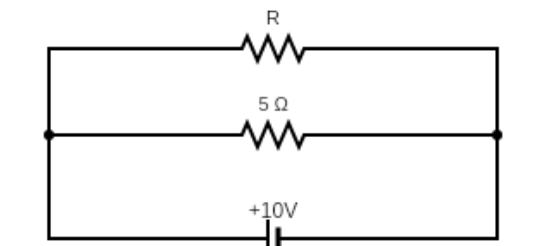
The power dissipated in the circuit shown in the figure is 30 watts. The value of \[R\] is
(A) \[15\Omega \]
(B) \[10\Omega \]
(C) \[30\Omega \]
(D) \[20\Omega \]
Answer
 Verified
284.1k+ views
Hint: The voltage across resistors in parallel is the same. The total power consumed is the sum of the power consumed by the individual resistor
Formula used: In this solution we will be using the following formulae;
\[P = \dfrac{{{V^2}}}{R}\] where \[P\] is the power consumed in a circuit, \[V\]is the voltage connected to the circuit, \[R\] is the effective or equivalent resistance in the circuit.
\[\dfrac{1}{{{R_{eq}}}} = \dfrac{1}{{{R_1}}} + \dfrac{1}{{{R_2}}}\] where \[{R_{eq}}\] is the equivalent resistance of two resistors, and \[{R_1}\] and \[{R_2}\] are the individual resistances of the resistor.
Complete Step-by-Step Solution:
We are given the total power consumed in the circuit, and asked to find the resistance \[R\].
We see that the resistance \[R\] is connected in parallel to the resistance \[5\Omega \]. Hence, the voltage across both of them are equal. And the voltage is equal to 10 V.
The total power consumed in the circuit can be given as
\[P = \dfrac{{{V^2}}}{R}\] where \[P\] is the power consumed in a circuit, \[V\]is the voltage connected to the circuit, \[R\] is the effective or equivalent resistance in the circuit.
We find the equivalent resistance in the circuit.
Equivalent resistance of a circuit can be given as
\[\dfrac{1}{{{R_{eq}}}} = \dfrac{1}{{{R_1}}} + \dfrac{1}{{{R_2}}}\] where \[{R_1}\] and \[{R_2}\] are the individual resistances of the resistor.
Hence,
\[\dfrac{1}{{{R_{eq}}}} = \dfrac{1}{R} + \dfrac{1}{5}\]
\[ \Rightarrow \dfrac{1}{{{R_{eq}}}} = \dfrac{{5 + R}}{{5R}}\]
Hence, inverting it, we get
\[{R_{eq}} = \dfrac{{5R}}{{5 + R}}\]
Hence, the power is given as
\[P = \dfrac{{{V^2}}}{{\dfrac{{5R}}{{5 + R}}}}\]
Hence,
\[30 = \dfrac{{{{10}^2}}}{{\dfrac{{5R}}{{5 + R}}}} = \dfrac{{100(5 + R)}}{{5R}}\]
Dividing both sides by 10, and cross multiplying, we have
\[3R = 10 + 2R\]
\[R = 10\Omega \]
Hence, the correct option is B.
Note: Alternatively, the total power consumed in the circuit is the sum of the power consumed in the individual resistance, hence, we can write that
\[P = \dfrac{{{V^2}}}{{{R_5}}} + \dfrac{{{V^2}}}{R}\] where \[{R_5}\] is the 5 ohms resistance.
If we factorize out \[{V^2}\]and put the value of the 5 ohms we have
\[P = {V^2}\left( {\dfrac{1}{5} + \dfrac{1}{R}} \right)\]
\[P = {V^2}\left( {\dfrac{{5 + R}}{{5R}}} \right)\] which can be written as
\[P = \dfrac{{{V^2}}}{{\dfrac{{5R}}{{5 + R}}}}\] which is identical to the formula in the solution.
Formula used: In this solution we will be using the following formulae;
\[P = \dfrac{{{V^2}}}{R}\] where \[P\] is the power consumed in a circuit, \[V\]is the voltage connected to the circuit, \[R\] is the effective or equivalent resistance in the circuit.
\[\dfrac{1}{{{R_{eq}}}} = \dfrac{1}{{{R_1}}} + \dfrac{1}{{{R_2}}}\] where \[{R_{eq}}\] is the equivalent resistance of two resistors, and \[{R_1}\] and \[{R_2}\] are the individual resistances of the resistor.
Complete Step-by-Step Solution:
We are given the total power consumed in the circuit, and asked to find the resistance \[R\].
We see that the resistance \[R\] is connected in parallel to the resistance \[5\Omega \]. Hence, the voltage across both of them are equal. And the voltage is equal to 10 V.
The total power consumed in the circuit can be given as
\[P = \dfrac{{{V^2}}}{R}\] where \[P\] is the power consumed in a circuit, \[V\]is the voltage connected to the circuit, \[R\] is the effective or equivalent resistance in the circuit.
We find the equivalent resistance in the circuit.
Equivalent resistance of a circuit can be given as
\[\dfrac{1}{{{R_{eq}}}} = \dfrac{1}{{{R_1}}} + \dfrac{1}{{{R_2}}}\] where \[{R_1}\] and \[{R_2}\] are the individual resistances of the resistor.
Hence,
\[\dfrac{1}{{{R_{eq}}}} = \dfrac{1}{R} + \dfrac{1}{5}\]
\[ \Rightarrow \dfrac{1}{{{R_{eq}}}} = \dfrac{{5 + R}}{{5R}}\]
Hence, inverting it, we get
\[{R_{eq}} = \dfrac{{5R}}{{5 + R}}\]
Hence, the power is given as
\[P = \dfrac{{{V^2}}}{{\dfrac{{5R}}{{5 + R}}}}\]
Hence,
\[30 = \dfrac{{{{10}^2}}}{{\dfrac{{5R}}{{5 + R}}}} = \dfrac{{100(5 + R)}}{{5R}}\]
Dividing both sides by 10, and cross multiplying, we have
\[3R = 10 + 2R\]
\[R = 10\Omega \]
Hence, the correct option is B.
Note: Alternatively, the total power consumed in the circuit is the sum of the power consumed in the individual resistance, hence, we can write that
\[P = \dfrac{{{V^2}}}{{{R_5}}} + \dfrac{{{V^2}}}{R}\] where \[{R_5}\] is the 5 ohms resistance.
If we factorize out \[{V^2}\]and put the value of the 5 ohms we have
\[P = {V^2}\left( {\dfrac{1}{5} + \dfrac{1}{R}} \right)\]
\[P = {V^2}\left( {\dfrac{{5 + R}}{{5R}}} \right)\] which can be written as
\[P = \dfrac{{{V^2}}}{{\dfrac{{5R}}{{5 + R}}}}\] which is identical to the formula in the solution.
Recently Updated Pages
Properties of Solids and Liquids Mock Test 2025

JEE Main Mock Test 2025-26: Dual Nature of Matter & Radiation
JEE Main 2025-26 Work, Energy and Power Mock Test – Free Practice Online
JEE Main Mock Test 2025-26: Experimental Skills Chapter Online Practice
JEE Main 2025-26 Mock Test: Properties of Solids and Liquids
JEE Main 2025 Kinetic Theory Of Gases Mock Test: Practice & Solutions
Trending doubts
JEE Main 2026: Exam Dates, Session 2 Updates, City Slip, Admit Card & Latest News
Understanding the Electric Field of a Uniformly Charged Ring
Understanding Atomic Structure for Beginners
Derivation of Equation of Trajectory Explained for Students
Electron Gain Enthalpy and Electron Affinity Explained
How to Convert a Galvanometer into an Ammeter or Voltmeter
Other Pages
CBSE Class 12 Physics Question Paper 2026: Download SET-wise PDF with Answer Key & Analysis
JEE Advanced Percentile vs Marks 2026: JEE Main Cutoff, AIR & IIT Admission Guide
JEE Advanced 2026 Notification Out with Exam Date, Registration (Extended), Syllabus and More
Understanding Uniform Acceleration in Physics
Understanding Electromagnetic Waves and Their Importance
Understanding Instantaneous Velocity