




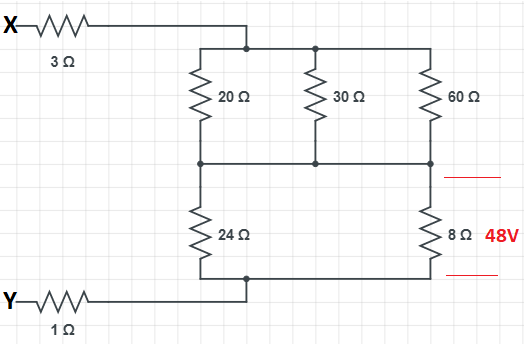
The potential difference across $8\Omega $ resistance is $48V$ as shown in the figure. The value of potential difference across $X$ and $Y$ points will be
(A) $128V$
(B) $160V$
(C) $80V$
(D) $62V$
Answer
 Verified
274.5k+ views
Hint: In the given circuit the resistors are connected in both parallel and series connection from the point X to the point Y. In this connection a particular parallel connection has a potential difference of $48V$. We have to find the net potential difference across X and Y. Find the current through the circuit using the given potential difference across the parallel connection and also find the net resistance across X and Y. Now we have the net current and the net resistance across X and Y. Apply ohm’s law to find the net potential.
Complete step by step answer:
Given,
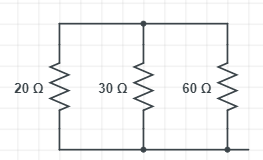
In the given circuit, the below mentioned resistors are connected in parallel
Here,
${R_{P1}} = 20\Omega $
${R_{P2}} = 30\Omega $
${R_{P3}} = 60\Omega $
The total resistance of the above circuit is ${R_p}$
The total resistance of the resistors connected parallel is given by
\[ \Rightarrow \dfrac{1}{{{R_P}}} = \dfrac{1}{{{R_1}}} + \dfrac{1}{{{R_2}}} + \dfrac{1}{{{R_3}}}\]
$ \Rightarrow \dfrac{1}{{{R_P}}} = \dfrac{1}{{20}} + \dfrac{1}{{30}} + \dfrac{1}{{60}}$
$ \Rightarrow \dfrac{1}{{{R_P}}} = \dfrac{3}{{60}} + \dfrac{2}{{60}} + \dfrac{1}{{60}}$
$ \Rightarrow \dfrac{1}{{{R_P}}} = \dfrac{6}{{60}}$
$ \Rightarrow \dfrac{1}{{{R_{P1}}}} = \dfrac{1}{{10}}$
$ \Rightarrow {R_{P1}} = 10$
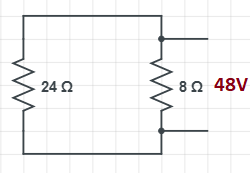
In the given circuit, the below mentioned resistors are also connected in parallel.
Here,
${R_{P1}} = 24\Omega $
${R_{P2}} = 8\Omega $
$ \Rightarrow \dfrac{1}{{{R_P}}} = \dfrac{1}{{{R_1}}} + \dfrac{1}{{{R_2}}}$
$ \Rightarrow \dfrac{1}{{{R_P}}} = \dfrac{1}{{24}} + \dfrac{1}{8}$
$ \Rightarrow \dfrac{1}{{{R_P}}} = \dfrac{1}{{24}} + \dfrac{3}{{24}}$
$ \Rightarrow \dfrac{1}{{{R_P}}} = \dfrac{4}{{24}}$
$ \Rightarrow \dfrac{1}{{{R_{P2}}}} = \dfrac{1}{6}$
$ \Rightarrow {R_{P2}} = 6$
And also,
Given that the potential difference across $8\Omega $ is $48V$
Since ${R_{P2}} = 8\Omega $ and ${R_{P1}} = 24\Omega $ are connected in parallel the potential difference $48V$ is applied to both the resistors, we found the net resistance of this resistor circuit
$ \Rightarrow {R_{P2}} = 6$
Given, $V = 48V$
According to ohm’s law we know that
$ \Rightarrow V = IR$
$ \Rightarrow I = \dfrac{V}{R}$
Substitute the given values
$ \Rightarrow I = \dfrac{{48}}{6}$
$ \Rightarrow I = 8A$
The current through the circuit is $I = 8A$
And the circuit becomes

The resistors are in series connection
The total resistance of the resistors connected parallel is given by
\[ \Rightarrow {R_S} = {R_1} + {R_2} + {R_3} + ... + {R_n}\]
\[ \Rightarrow {R_S} = {R_{S1}} + {R_{P1}} + {R_{P2}} + {R_{S2}}\]
\[ \Rightarrow {R_S} = 3 + 10 + 6 + 1\]
\[ \Rightarrow {R_S} = 20\]
The total resistance across X and Y is \[{R_S} = 20\]
The current through the circuit is $I = 8A$
The potential difference across X and Y is given by the ohm’s law
$ \Rightarrow V = IR$
$ \Rightarrow V = 8 \times 20$
$ \Rightarrow V = 160V$
Hence the correct answer is option (B), $160V$.
Note: Ohm’s law states that at constant temperature the potential difference across the conductor is proportional to the steady current flowing through the conductor.
$ \Rightarrow V \propto I$
$ \Rightarrow V = IR$
$V$ is the potential difference
$I$ is the current
$R$ is the resistance
Complete step by step answer:
Given,
In the given circuit, the below mentioned resistors are connected in parallel
Here,
${R_{P1}} = 20\Omega $
${R_{P2}} = 30\Omega $
${R_{P3}} = 60\Omega $
The total resistance of the above circuit is ${R_p}$
The total resistance of the resistors connected parallel is given by
\[ \Rightarrow \dfrac{1}{{{R_P}}} = \dfrac{1}{{{R_1}}} + \dfrac{1}{{{R_2}}} + \dfrac{1}{{{R_3}}}\]
$ \Rightarrow \dfrac{1}{{{R_P}}} = \dfrac{1}{{20}} + \dfrac{1}{{30}} + \dfrac{1}{{60}}$
$ \Rightarrow \dfrac{1}{{{R_P}}} = \dfrac{3}{{60}} + \dfrac{2}{{60}} + \dfrac{1}{{60}}$
$ \Rightarrow \dfrac{1}{{{R_P}}} = \dfrac{6}{{60}}$
$ \Rightarrow \dfrac{1}{{{R_{P1}}}} = \dfrac{1}{{10}}$
$ \Rightarrow {R_{P1}} = 10$
In the given circuit, the below mentioned resistors are also connected in parallel.
Here,
${R_{P1}} = 24\Omega $
${R_{P2}} = 8\Omega $
$ \Rightarrow \dfrac{1}{{{R_P}}} = \dfrac{1}{{{R_1}}} + \dfrac{1}{{{R_2}}}$
$ \Rightarrow \dfrac{1}{{{R_P}}} = \dfrac{1}{{24}} + \dfrac{1}{8}$
$ \Rightarrow \dfrac{1}{{{R_P}}} = \dfrac{1}{{24}} + \dfrac{3}{{24}}$
$ \Rightarrow \dfrac{1}{{{R_P}}} = \dfrac{4}{{24}}$
$ \Rightarrow \dfrac{1}{{{R_{P2}}}} = \dfrac{1}{6}$
$ \Rightarrow {R_{P2}} = 6$
And also,
Given that the potential difference across $8\Omega $ is $48V$
Since ${R_{P2}} = 8\Omega $ and ${R_{P1}} = 24\Omega $ are connected in parallel the potential difference $48V$ is applied to both the resistors, we found the net resistance of this resistor circuit
$ \Rightarrow {R_{P2}} = 6$
Given, $V = 48V$
According to ohm’s law we know that
$ \Rightarrow V = IR$
$ \Rightarrow I = \dfrac{V}{R}$
Substitute the given values
$ \Rightarrow I = \dfrac{{48}}{6}$
$ \Rightarrow I = 8A$
The current through the circuit is $I = 8A$
And the circuit becomes
The resistors are in series connection
The total resistance of the resistors connected parallel is given by
\[ \Rightarrow {R_S} = {R_1} + {R_2} + {R_3} + ... + {R_n}\]
\[ \Rightarrow {R_S} = {R_{S1}} + {R_{P1}} + {R_{P2}} + {R_{S2}}\]
\[ \Rightarrow {R_S} = 3 + 10 + 6 + 1\]
\[ \Rightarrow {R_S} = 20\]
The total resistance across X and Y is \[{R_S} = 20\]
The current through the circuit is $I = 8A$
The potential difference across X and Y is given by the ohm’s law
$ \Rightarrow V = IR$
$ \Rightarrow V = 8 \times 20$
$ \Rightarrow V = 160V$
Hence the correct answer is option (B), $160V$.
Note: Ohm’s law states that at constant temperature the potential difference across the conductor is proportional to the steady current flowing through the conductor.
$ \Rightarrow V \propto I$
$ \Rightarrow V = IR$
$V$ is the potential difference
$I$ is the current
$R$ is the resistance
Recently Updated Pages
Wheatstone Bridge – Principle, Formula, Diagram & Applications

Mass vs Weight: Key Differences Explained for Students
Circuit Switching vs Packet Switching: Key Differences Explained
Uniform Acceleration Explained: Formula, Examples & Graphs
Young’s Double Slit Experiment Derivation Explained
Classification of Drugs in Chemistry: Types, Examples & Exam Guide
Trending doubts
JEE Main 2026: Exam Dates, Session 2 Updates, City Slip, Admit Card & Latest News
Understanding the Electric Field of a Uniformly Charged Ring
Understanding Atomic Structure for Beginners
Derivation of Equation of Trajectory Explained for Students
Electron Gain Enthalpy and Electron Affinity Explained
How to Convert a Galvanometer into an Ammeter or Voltmeter
Other Pages
CBSE Class 12 Physics Question Paper 2026: Download SET-wise PDF with Answer Key & Analysis
JEE Advanced 2026 Notification Out with Exam Date, Registration (Extended), Syllabus and More
JEE Advanced Percentile vs Marks 2026: JEE Main Cutoff, AIR & IIT Admission Guide
JEE Advanced Weightage Chapter Wise 2026 for Physics, Chemistry, and Mathematics
Understanding Electromagnetic Waves and Their Importance
Class 12 Physics Formulas: Complete Chapter-wise PDF Guide