




The photon radiated from hydrogen corresponding to the second line of Lyman series is absorbed by a hydrogen-like atom $X$ in the second excited state. Then, the hydrogen-like atom $X$ makes a transition to ${n^{th}}$ orbit
A. $X = H{e^ + },\,\,n = 4$
B. $X = L{i^{ + + }},\,\,n = 6$
C. $X = H{e^ + },\,\,n = 6$
D. $X = L{i^{ + + }},\,\,n = 9$
Answer
 Verified
292.5k+ views
Hint:In this problem, to determine the hydrogen-like atom $X$ that makes a transition to ${n^{th}}$ orbit from the second excited state, we have to evaluate the energy released during the transition of hydrogen and since the same energy is absorbed by $X$ during its transition (that is released before) therefore, we can compare the energies obtained during the two transitions to get the correct solution.
Formula used:
The formula used in this problem is of the energy obtained due to the transition between two energy levels which is given as: -
$E = - 13.6{Z^2}\left( {\dfrac{1}{{n_1^2}} - \dfrac{1}{{n_2^2}}} \right)$
Here, ${n_1}{\text{ }}and{\text{ }}{n_2}$ are the principal quantum numbers for high energy level and low energy level respectively.
Complete step by step solution:
We know that the expression for obtaining energy during the transition between two energy levels can be stated as: -
$E = - 13.6{Z^2}\left( {\dfrac{1}{{n_1^2}} - \dfrac{1}{{n_2^2}}} \right)\,\,\,\,\,\,\,\,\,\,\,\,\,\,\,\,\,...\,(1)$
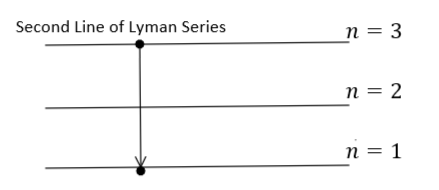
It is given that the photon radiated from hydrogen $(Z = 1)$ corresponding to the second line of the Lyman series. Therefore, the transition will be from ${n_1} = 3$ to ${n_2} = 1$ as shown in the figure:
During this transition, the energy will be released which can be calculated using equation $(1)$ as: -
${E_{released}} = - 13.6{\left( 1 \right)^2}\left( {\dfrac{1}{{{3^2}}} - \dfrac{1}{{{1^2}}}} \right) = - 13.6\left( {\dfrac{1}{{{3^2}}} - \dfrac{1}{{{1^2}}}} \right)\,\,\,\,\,\,\,\,\,\,\,\,\,\,\,\,\,\,\,\,\,\,\,\,\,\,\,\,\,\,\,\,...\,(2)$
$ \Rightarrow {E_{released}} = - 13.6\left( {\dfrac{1}{9} - \dfrac{1}{1}} \right) = 13.6\left( {\dfrac{8}{9}} \right)\,eV \\ $
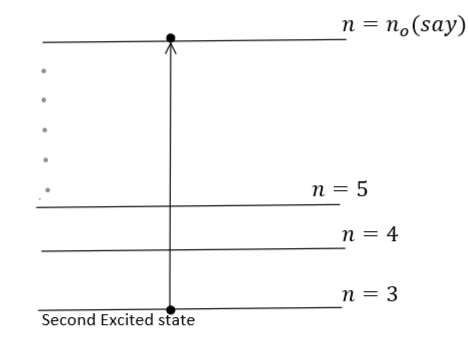
Now, the same amount of energy is absorbed by a hydrogen-like atom $X\,(Z = Z)$ in the second excited state that makes a transition to ${n^{th}}$ orbit $(say\,{n_o})$ as described with the help of below-given diagram: -
During this transition, the energy is absorbed. Therefore, using equation $(1)$, we get
${E_{absorbed}} = - 13.6{\left( Z \right)^2}\left( {\dfrac{1}{{{n_o}^2}} - \dfrac{1}{{{3^2}}}} \right) = - 13.6\left( {\dfrac{{{Z^2}}}{{{n_o}^2}} - \dfrac{{{Z^2}}}{{{3^2}}}} \right)\,\,\,\,\,\,\,\,\,\,\,\,\,\,...\,(3)$
As the energy absorbed by hydrogen-like atom $X$ is same as the energy released by hydrogen hence, on comparing equations $(2)$ and $(3)$ , we get
${E_{released}} = {E_{absorbed}}$
$\Rightarrow - 13.6\left( {\dfrac{1}{{{3^2}}} - \dfrac{1}{{{1^2}}}} \right) = - 13.6\left( {\dfrac{{{Z^2}}}{{{n_o}^2}} - \dfrac{{{Z^2}}}{{{3^2}}}} \right)$
On comparing both the sides, we get
$\dfrac{1}{{{3^2}}} = \dfrac{{{Z^2}}}{{{n_o}^2}}\,\,and\,\,\dfrac{1}{{{1^2}}} = \dfrac{{{Z^2}}}{{{3^2}}}$
$\Rightarrow \dfrac{1}{3} = \dfrac{Z}{{{n_o}}}\,\,and\,\,1 = \dfrac{Z}{3}$
Simplifying both the equations, we get $Z = 3$ and ${n_o} = 9$. Thus, the hydrogen-like atom $X$ is Lithium ion $L{i^{ + + }}(Z = 3)$ that makes a transition to ${9^{th}}$ orbit from second excited state i.e., $X = L{i^{ + + }},\,\,n = 9$.
Hence, the correct option is D.
Note: In this kind of problem, we can answer the problem by using the concept of $\dfrac{Z}{n}$ ratio like it is given that energy released in transition of hydrogen is same as that of energy absorbed in the transition of hydrogen-like atom and since transition of hydrogen is from ${n_1} = 3$ to ${n_2} = 1$ , then $3 \to 1$ transition in $H$ would give same energy as the $3 \times 3 \to 1 \times 3$ transition in $L{i^{ + + }}$ to main same $\dfrac{Z}{n}$ ratio.
Formula used:
The formula used in this problem is of the energy obtained due to the transition between two energy levels which is given as: -
$E = - 13.6{Z^2}\left( {\dfrac{1}{{n_1^2}} - \dfrac{1}{{n_2^2}}} \right)$
Here, ${n_1}{\text{ }}and{\text{ }}{n_2}$ are the principal quantum numbers for high energy level and low energy level respectively.
Complete step by step solution:
We know that the expression for obtaining energy during the transition between two energy levels can be stated as: -
$E = - 13.6{Z^2}\left( {\dfrac{1}{{n_1^2}} - \dfrac{1}{{n_2^2}}} \right)\,\,\,\,\,\,\,\,\,\,\,\,\,\,\,\,\,...\,(1)$
It is given that the photon radiated from hydrogen $(Z = 1)$ corresponding to the second line of the Lyman series. Therefore, the transition will be from ${n_1} = 3$ to ${n_2} = 1$ as shown in the figure:
During this transition, the energy will be released which can be calculated using equation $(1)$ as: -
${E_{released}} = - 13.6{\left( 1 \right)^2}\left( {\dfrac{1}{{{3^2}}} - \dfrac{1}{{{1^2}}}} \right) = - 13.6\left( {\dfrac{1}{{{3^2}}} - \dfrac{1}{{{1^2}}}} \right)\,\,\,\,\,\,\,\,\,\,\,\,\,\,\,\,\,\,\,\,\,\,\,\,\,\,\,\,\,\,\,\,...\,(2)$
$ \Rightarrow {E_{released}} = - 13.6\left( {\dfrac{1}{9} - \dfrac{1}{1}} \right) = 13.6\left( {\dfrac{8}{9}} \right)\,eV \\ $
Now, the same amount of energy is absorbed by a hydrogen-like atom $X\,(Z = Z)$ in the second excited state that makes a transition to ${n^{th}}$ orbit $(say\,{n_o})$ as described with the help of below-given diagram: -
During this transition, the energy is absorbed. Therefore, using equation $(1)$, we get
${E_{absorbed}} = - 13.6{\left( Z \right)^2}\left( {\dfrac{1}{{{n_o}^2}} - \dfrac{1}{{{3^2}}}} \right) = - 13.6\left( {\dfrac{{{Z^2}}}{{{n_o}^2}} - \dfrac{{{Z^2}}}{{{3^2}}}} \right)\,\,\,\,\,\,\,\,\,\,\,\,\,\,...\,(3)$
As the energy absorbed by hydrogen-like atom $X$ is same as the energy released by hydrogen hence, on comparing equations $(2)$ and $(3)$ , we get
${E_{released}} = {E_{absorbed}}$
$\Rightarrow - 13.6\left( {\dfrac{1}{{{3^2}}} - \dfrac{1}{{{1^2}}}} \right) = - 13.6\left( {\dfrac{{{Z^2}}}{{{n_o}^2}} - \dfrac{{{Z^2}}}{{{3^2}}}} \right)$
On comparing both the sides, we get
$\dfrac{1}{{{3^2}}} = \dfrac{{{Z^2}}}{{{n_o}^2}}\,\,and\,\,\dfrac{1}{{{1^2}}} = \dfrac{{{Z^2}}}{{{3^2}}}$
$\Rightarrow \dfrac{1}{3} = \dfrac{Z}{{{n_o}}}\,\,and\,\,1 = \dfrac{Z}{3}$
Simplifying both the equations, we get $Z = 3$ and ${n_o} = 9$. Thus, the hydrogen-like atom $X$ is Lithium ion $L{i^{ + + }}(Z = 3)$ that makes a transition to ${9^{th}}$ orbit from second excited state i.e., $X = L{i^{ + + }},\,\,n = 9$.
Hence, the correct option is D.
Note: In this kind of problem, we can answer the problem by using the concept of $\dfrac{Z}{n}$ ratio like it is given that energy released in transition of hydrogen is same as that of energy absorbed in the transition of hydrogen-like atom and since transition of hydrogen is from ${n_1} = 3$ to ${n_2} = 1$ , then $3 \to 1$ transition in $H$ would give same energy as the $3 \times 3 \to 1 \times 3$ transition in $L{i^{ + + }}$ to main same $\dfrac{Z}{n}$ ratio.
Recently Updated Pages
JEE Main 2025-26 Electrostatics Mock Test: Free Practice Online

Electrostatics Mock Test 2025: Practice Questions & Answers
JEE Main 2026-27 Kinematics Mock Test – Free Practice Online
JEE Main Mock Test 2025-26: Chapter-Wise Practice Papers
Wheatstone Bridge – Principle, Formula, Diagram & Applications
Kinematics Mock Test 2025: Free Practice Questions & Answers
Trending doubts
JEE Main 2026: Exam Dates, Session 2 Updates, City Slip, Admit Card & Latest News
Understanding the Electric Field of a Uniformly Charged Ring
Understanding Atomic Structure for Beginners
Electron Gain Enthalpy and Electron Affinity Explained
Derivation of Equation of Trajectory Explained for Students
How to Convert a Galvanometer into an Ammeter or Voltmeter
Other Pages
CBSE Class 12 Physics Question Paper 2026: Download SET-wise PDF with Answer Key & Analysis
JEE Advanced Percentile vs Marks 2026: JEE Main Cutoff, AIR & IIT Admission Guide
JEE Advanced 2026 Notification Out with Exam Date, Registration (Extended), Syllabus and More
JEE Advanced Weightage Chapter Wise 2026 for Physics, Chemistry, and Mathematics
What Are Current and Potential Difference in Electricity?
Hybridisation in Chemistry – Concept, Types & Applications