




The number of ways of selecting two squares on chessboard such that they have a side in common is
A. 225
B. 112
C. 56
D. 68
Answer
 Verified
260.1k+ views
Hint: Here, we will first start with drawing a diagram of chess-board and find the total number of rows in a chess board and then make pairs of two consecutive rows to find the number of ways of selecting two squares on the chessboard such that they have a side in common.
Complete step by step answer
Let us examine the figure of the chessboard given below.
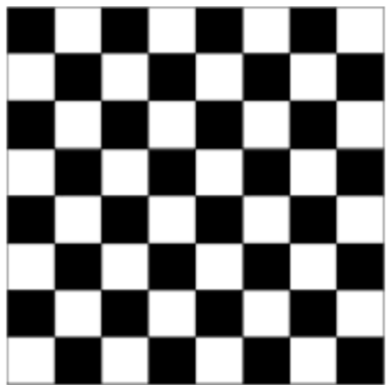
Now consider the first and the second row of the chessboard in the diagram above.
In the first and second row, we have 14 ways to select two squares that have only one common side.
Similarly for the second and third row, we have 14 ways to select the squares.
Since there are only 8 rows, so we can pick 8 such pairs of rows in a chessboard.
Now we will find the number of ways of selecting two squares in a chess board that have only one common side.
\[14 \times 7 = 112\]
Thus, there are 112 numbers of ways to select such squares.
Hence, the option B is correct.
Note: In this question, we have to examine the chessboard carefully.
We know that the chessboard is symmetrical in shape. So if the number of two squares having one side common in two consecutive rows is 14 then we just have to calculate the number of consecutive rows than can be taken.
Complete step by step answer
Let us examine the figure of the chessboard given below.
Now consider the first and the second row of the chessboard in the diagram above.
In the first and second row, we have 14 ways to select two squares that have only one common side.
Similarly for the second and third row, we have 14 ways to select the squares.
Since there are only 8 rows, so we can pick 8 such pairs of rows in a chessboard.
Now we will find the number of ways of selecting two squares in a chess board that have only one common side.
\[14 \times 7 = 112\]
Thus, there are 112 numbers of ways to select such squares.
Hence, the option B is correct.
Note: In this question, we have to examine the chessboard carefully.
We know that the chessboard is symmetrical in shape. So if the number of two squares having one side common in two consecutive rows is 14 then we just have to calculate the number of consecutive rows than can be taken.
Recently Updated Pages
Algebra Made Easy: Step-by-Step Guide for Students

JEE Isolation, Preparation and Properties of Non-metals Important Concepts and Tips for Exam Preparation
JEE Energetics Important Concepts and Tips for Exam Preparation
Chemical Properties of Hydrogen - Important Concepts for JEE Exam Preparation
JEE General Topics in Chemistry Important Concepts and Tips
JEE Amino Acids and Peptides Important Concepts and Tips for Exam Preparation
Trending doubts
JEE Main 2026: Exam Dates, Session 2 Updates, City Slip, Admit Card & Latest News
JEE Main Participating Colleges 2026 - A Complete List of Top Colleges
Hybridisation in Chemistry – Concept, Types & Applications
Understanding the Electric Field of a Uniformly Charged Ring
Derivation of Equation of Trajectory Explained for Students
Understanding Atomic Structure for Beginners
Other Pages
JEE Advanced 2026 Notification Out with Exam Date, Registration (Extended), Syllabus and More
JEE Advanced Marks vs Ranks 2025: Understanding Category-wise Qualifying Marks and Previous Year Cut-offs
JEE Advanced Weightage Chapter Wise 2026 for Physics, Chemistry, and Mathematics
How to Convert a Galvanometer into an Ammeter or Voltmeter
Understanding Electromagnetic Waves and Their Importance
Ideal and Non-Ideal Solutions Explained for Class 12 Chemistry