




The locus of a point which divides a chord of slope 2 of the parabola \[{{y}^{2}}=4x\] internally in the ratio 1:2 is
(a) \[{{\left( y+\dfrac{4}{9} \right)}^{2}}=\dfrac{4}{9}\left( x-\dfrac{2}{9} \right)\]
(b) \[{{\left( y-\dfrac{8}{9} \right)}^{2}}=\dfrac{4}{9}\left( x-\dfrac{2}{9} \right)\]
(c) \[{{\left( y-\dfrac{8}{9} \right)}^{2}}=\dfrac{4}{9}\left( x+\dfrac{2}{9} \right)\]
(d) \[{{\left( y+\dfrac{8}{9} \right)}^{2}}=\dfrac{4}{9}\left( x+\dfrac{2}{9} \right)\]
Answer
 Verified
243.9k+ views
Hint: To find the locus of point which divides a chord of given slope of the parabola internally in the ratio 1:2, write the equation of chord joining any two points of the parabola and then find the point which divides these two points on the parabola internally in the ratio 1:2.
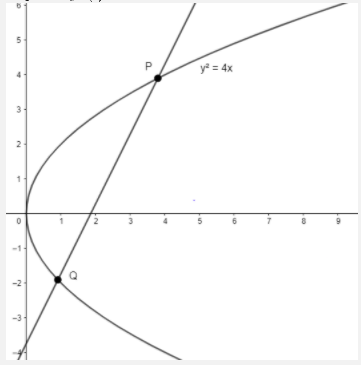
We have a parabola \[{{y}^{2}}=4x\].We have to find the locus of point on a chord of slope 2 which divides the chord internally in the ratio 1:2.
Let’s assume that there are two points on parabola \[P\left( {{t}_{1}} \right)\]and\[Q\left( {{t}_{2}}
\right)\].
The equation of chord of the parabola \[{{y}^{2}}=4ax\] joining these two points \[P\left( {{t}_{1}}
\right)\] and \[Q\left( {{t}_{2}} \right)\]is\[y\left( {{t}_{1}}+{{t}_{2}} \right)=2x+2a{{t}_{1}}{{t}_{2}}\].
We observe that \[a=1\] in our case.
By substituting the value, we have \[y\left( {{t}_{1}}+{{t}_{2}} \right)=2x+2{{t}_{1}}{{t}_{2}}\]
Dividing the equation by \[\left( {{t}_{1}}+{{t}_{2}} \right)\], we get
\[y=\dfrac{2x}{{{t}_{1}}+{{t}_{2}}}+\dfrac{2{{t}_{1}}{{t}_{2}}}{{{t}_{1}}+{{t}_{2}}}\]
We know the slope of this chord is 2, thus, \[\dfrac{2}{{{t}_{1}}+{{t}_{2}}}=2\]
\[\Rightarrow {{t}_{1}}+{{t}_{2}}=1\]
\[\Rightarrow {{t}_{2}}=1-{{t}_{1}}\] \[-\left( 1 \right)\]
Now, we know that the formula of point which internally divides two points \[\left( a,b \right)\]and \[\left( c,d \right)\]in the ratio \[m:n\] is\[\left( \dfrac{am+cn}{m+n},\dfrac{bm+dn}{m+n} \right)\].
If a point divides any two points externally, then we replace + by - in the above formula.
So, let’s assume that the locus of our point which divides the chord with end points\[\left( t_{1}^{2},2{{t}_{1}} \right)\]and \[\left( t_{2}^{2},2{{t}_{2}} \right)\] in the ratio \[1:2\] is \[\left( x,y \right)\]
\[\Rightarrow \left( x,y \right)=\left( \dfrac{t_{2}^{2}+2t_{1}^{2}}{3},\dfrac{2{{t}_{2}}+4{{t}_{1}}}{3} \right)\]
\[\Rightarrow x=\dfrac{t_{2}^{2}+2t_{1}^{2}}{3}\] and \[y=\dfrac{2{{t}_{2}}+4{{t}_{1}}}{3}\]
Substituting using equation \[\left( 1 \right)\],we get
\[\Rightarrow x=\dfrac{{{\left( 1-{{t}_{1}} \right)}^{2}}+2t_{1}^{2}}{3}=\dfrac{3t_{1}^{2}+1-2{{t}_{1}}}{3}\]\[=t_{1}^{2}+\dfrac{1}{3}-\dfrac{2{{t}_{1}}}{3}\] \[\left( 2 \right)\]
\[\Rightarrow y=\dfrac{2\left( 1-{{t}_{1}} \right)+4{{t}_{1}}}{3}=\dfrac{2+2{{t}_{1}}}{3}\]
Solving \[{{t}_{1}}\] in terms of \[y\] by multiplying the equation by 3, subtracting 2 and then dividing by 2 on both sides, we get \[\dfrac{3y-2}{2}={{t}_{1}}\] \[\left( 3 \right)\]
Substituting using equation \[\left( 3 \right)\]in equation\[\left( 2 \right)\], we get\[x={{\left( \dfrac{3y}{2}-1 \right)}^{2}}+\dfrac{1}{3}-\left( \dfrac{3y-2}{3} \right)=\dfrac{9{{y}^{2}}}{4}+1-3y+\dfrac{1}{3}-y+\dfrac{2}{3}=\dfrac{9{{y}^{2}}}{4}-4y+2\].
Multiplying the equation by \[\dfrac{4}{9}\], we get \[\dfrac{4x}{9}={{y}^{2}}-\dfrac{16y}{9}+\dfrac{8}{9}\]
Subtracting \[\dfrac{8}{81}\]from both side of the equation, we get \[\dfrac{4x}{9}-\dfrac{8}{81}={{y}^{2}}-\dfrac{16y}{9}+\dfrac{64}{81}\]
Rearranging the terms, we get \[\dfrac{4}{9}\left( x-\dfrac{2}{9} \right)={{\left( y-\dfrac{8}{9} \right)}^{2}}\]
Hence, the correct answer is \[{{\left( y-\dfrac{8}{9} \right)}^{2}}=\dfrac{4}{9}\left( x-\dfrac{2}{9} \right)\]
Option (B) is the correct answer.
Note: We can also write the equation of chord in terms of a variable slope and then use it to find the locus of point which divides the chord in the ratio 1:2.
We have a parabola \[{{y}^{2}}=4x\].We have to find the locus of point on a chord of slope 2 which divides the chord internally in the ratio 1:2.
Let’s assume that there are two points on parabola \[P\left( {{t}_{1}} \right)\]and\[Q\left( {{t}_{2}}
\right)\].
The equation of chord of the parabola \[{{y}^{2}}=4ax\] joining these two points \[P\left( {{t}_{1}}
\right)\] and \[Q\left( {{t}_{2}} \right)\]is\[y\left( {{t}_{1}}+{{t}_{2}} \right)=2x+2a{{t}_{1}}{{t}_{2}}\].
We observe that \[a=1\] in our case.
By substituting the value, we have \[y\left( {{t}_{1}}+{{t}_{2}} \right)=2x+2{{t}_{1}}{{t}_{2}}\]
Dividing the equation by \[\left( {{t}_{1}}+{{t}_{2}} \right)\], we get
\[y=\dfrac{2x}{{{t}_{1}}+{{t}_{2}}}+\dfrac{2{{t}_{1}}{{t}_{2}}}{{{t}_{1}}+{{t}_{2}}}\]
We know the slope of this chord is 2, thus, \[\dfrac{2}{{{t}_{1}}+{{t}_{2}}}=2\]
\[\Rightarrow {{t}_{1}}+{{t}_{2}}=1\]
\[\Rightarrow {{t}_{2}}=1-{{t}_{1}}\] \[-\left( 1 \right)\]
Now, we know that the formula of point which internally divides two points \[\left( a,b \right)\]and \[\left( c,d \right)\]in the ratio \[m:n\] is\[\left( \dfrac{am+cn}{m+n},\dfrac{bm+dn}{m+n} \right)\].
If a point divides any two points externally, then we replace + by - in the above formula.
So, let’s assume that the locus of our point which divides the chord with end points\[\left( t_{1}^{2},2{{t}_{1}} \right)\]and \[\left( t_{2}^{2},2{{t}_{2}} \right)\] in the ratio \[1:2\] is \[\left( x,y \right)\]
\[\Rightarrow \left( x,y \right)=\left( \dfrac{t_{2}^{2}+2t_{1}^{2}}{3},\dfrac{2{{t}_{2}}+4{{t}_{1}}}{3} \right)\]
\[\Rightarrow x=\dfrac{t_{2}^{2}+2t_{1}^{2}}{3}\] and \[y=\dfrac{2{{t}_{2}}+4{{t}_{1}}}{3}\]
Substituting using equation \[\left( 1 \right)\],we get
\[\Rightarrow x=\dfrac{{{\left( 1-{{t}_{1}} \right)}^{2}}+2t_{1}^{2}}{3}=\dfrac{3t_{1}^{2}+1-2{{t}_{1}}}{3}\]\[=t_{1}^{2}+\dfrac{1}{3}-\dfrac{2{{t}_{1}}}{3}\] \[\left( 2 \right)\]
\[\Rightarrow y=\dfrac{2\left( 1-{{t}_{1}} \right)+4{{t}_{1}}}{3}=\dfrac{2+2{{t}_{1}}}{3}\]
Solving \[{{t}_{1}}\] in terms of \[y\] by multiplying the equation by 3, subtracting 2 and then dividing by 2 on both sides, we get \[\dfrac{3y-2}{2}={{t}_{1}}\] \[\left( 3 \right)\]
Substituting using equation \[\left( 3 \right)\]in equation\[\left( 2 \right)\], we get\[x={{\left( \dfrac{3y}{2}-1 \right)}^{2}}+\dfrac{1}{3}-\left( \dfrac{3y-2}{3} \right)=\dfrac{9{{y}^{2}}}{4}+1-3y+\dfrac{1}{3}-y+\dfrac{2}{3}=\dfrac{9{{y}^{2}}}{4}-4y+2\].
Multiplying the equation by \[\dfrac{4}{9}\], we get \[\dfrac{4x}{9}={{y}^{2}}-\dfrac{16y}{9}+\dfrac{8}{9}\]
Subtracting \[\dfrac{8}{81}\]from both side of the equation, we get \[\dfrac{4x}{9}-\dfrac{8}{81}={{y}^{2}}-\dfrac{16y}{9}+\dfrac{64}{81}\]
Rearranging the terms, we get \[\dfrac{4}{9}\left( x-\dfrac{2}{9} \right)={{\left( y-\dfrac{8}{9} \right)}^{2}}\]
Hence, the correct answer is \[{{\left( y-\dfrac{8}{9} \right)}^{2}}=\dfrac{4}{9}\left( x-\dfrac{2}{9} \right)\]
Option (B) is the correct answer.
Note: We can also write the equation of chord in terms of a variable slope and then use it to find the locus of point which divides the chord in the ratio 1:2.
Recently Updated Pages
JEE Main 2026 Admit Card OUT LIVE | Session 1 Direct Download Link

JEE Main 2026 Session 2 City Intimation Slip Expected Soon: Check How to Download
JEE Main 2026 Session 2 Application Form: Reopened Registration, Dates & Fees
JEE Main 2026 Session 2 Registration (Reopened): Last Date, Fees, Link & Process
WBJEE 2026 Registration Started: Important Dates Eligibility Syllabus Exam Pattern
Geometry of Complex Numbers Explained
Trending doubts
JEE Main 2026: Exam Dates, Session 2 Updates, City Slip, Admit Card & Latest News
Ideal and Non-Ideal Solutions Explained for Class 12 Chemistry
Understanding the Angle of Deviation in a Prism
Understanding Differential Equations: A Complete Guide
Hybridisation in Chemistry – Concept, Types & Applications
Understanding the Electric Field of a Uniformly Charged Ring
Other Pages
JEE Advanced Marks vs Ranks 2025: Understanding Category-wise Qualifying Marks and Previous Year Cut-offs
CBSE Class 12 Maths 2026 Question Paper: Free PDF & Solutions
JEE Advanced 2026 - Exam Date (Released), Syllabus, Registration, Eligibility, Preparation, and More
CBSE Class 12 Maths Board Question Paper Set 1 (65/1/1) 2025
CBSE Class 12 Maths Set 3 (65/5/3) 2025 Question Paper, Solutions & Analysis
JEE Advanced Weightage 2025 Chapter-Wise for Physics, Maths and Chemistry