




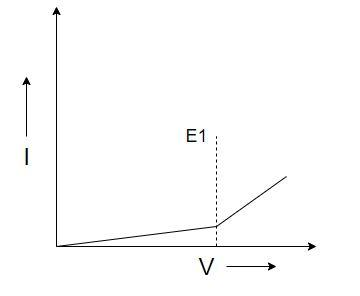
The graph represents a current- voltage behavior of a water- voltmeter. Spot the correct explanation:
A) Dissociation takes place till ${E_1}$ and it obeys Ohm’s law thereafter
B) Ohm’s law is not valid for low voltage
C) Ohm’s law is obeyed but only for potential difference larger than back emf
D) Electrolytes do not obey Ohm’s law
Answer
 Verified
284.1k+ views
Hint: The ohm’s law can be interpreted in a graph with voltage in the X- axis and current in the Y- axis. When the Ohm’s law is obeyed, the graph will be linearly increasing with voltage.
Complete solution:
Let’s look at what Ohm's law discusses about. According to Ohm’s law, the current across the conductor is directly proportional to the voltage across the two points. Therefore drawing a graph plotting voltage on the X- axis and current on the Y- axis, the graph will be a linear graph. The current increases linearly with the voltage. And the slope of the graph will give the resistance.
Thus $R = \dfrac{{\Delta I}}{{\Delta V}}$
The value of the resistance will be constant according to the Ohm's law. If it has different values it says that the Ohm’s law is not obeyed.
Here, in this graph before the back emf ${E_1}$ is induced, the current is increasing at a smaller rate with respect to voltage. For larger increases in current, only a small change in current. Thus the graph is not linear. The Ohm’s law is not obeyed here. But when a back emf is induced, the current changes with respect to the voltage. The graph is linear and it obeys the Ohm’s law.
Therefore, Ohm’s law is obeyed but only for potential differences larger than back emf.
The answer is option C.
Note: The back emf is the electro motive force which is induced due to the potential difference. It will oppose the change in current induced due to the voltage. The resistance of any conductor is the slope of the I-V curve. For a resistive circuit the resistance i.e. the slope is constant.
Complete solution:
Let’s look at what Ohm's law discusses about. According to Ohm’s law, the current across the conductor is directly proportional to the voltage across the two points. Therefore drawing a graph plotting voltage on the X- axis and current on the Y- axis, the graph will be a linear graph. The current increases linearly with the voltage. And the slope of the graph will give the resistance.
Thus $R = \dfrac{{\Delta I}}{{\Delta V}}$
The value of the resistance will be constant according to the Ohm's law. If it has different values it says that the Ohm’s law is not obeyed.
Here, in this graph before the back emf ${E_1}$ is induced, the current is increasing at a smaller rate with respect to voltage. For larger increases in current, only a small change in current. Thus the graph is not linear. The Ohm’s law is not obeyed here. But when a back emf is induced, the current changes with respect to the voltage. The graph is linear and it obeys the Ohm’s law.
Therefore, Ohm’s law is obeyed but only for potential differences larger than back emf.
The answer is option C.
Note: The back emf is the electro motive force which is induced due to the potential difference. It will oppose the change in current induced due to the voltage. The resistance of any conductor is the slope of the I-V curve. For a resistive circuit the resistance i.e. the slope is constant.
Recently Updated Pages
Properties of Solids and Liquids Mock Test 2025

JEE Main Mock Test 2025-26: Dual Nature of Matter & Radiation
JEE Main 2025-26 Work, Energy and Power Mock Test – Free Practice Online
JEE Main Mock Test 2025-26: Experimental Skills Chapter Online Practice
JEE Main 2025-26 Mock Test: Properties of Solids and Liquids
JEE Main 2025 Kinetic Theory Of Gases Mock Test: Practice & Solutions
Trending doubts
JEE Main 2026: Exam Dates, Session 2 Updates, City Slip, Admit Card & Latest News
Understanding the Electric Field of a Uniformly Charged Ring
Understanding Atomic Structure for Beginners
Derivation of Equation of Trajectory Explained for Students
Electron Gain Enthalpy and Electron Affinity Explained
How to Convert a Galvanometer into an Ammeter or Voltmeter
Other Pages
CBSE Class 12 Physics Question Paper 2026: Download SET-wise PDF with Answer Key & Analysis
JEE Advanced Percentile vs Marks 2026: JEE Main Cutoff, AIR & IIT Admission Guide
JEE Advanced 2026 Notification Out with Exam Date, Registration (Extended), Syllabus and More
Understanding Uniform Acceleration in Physics
Understanding Electromagnetic Waves and Their Importance
Understanding Instantaneous Velocity