




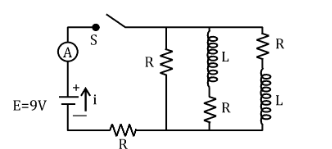
The figure shows a circuit that contains four identical resistors with resistance R = 2.0 Ω. Two identical inductors with inductance L = 2.0 mH and an ideal battery with emf E = 9.V. The current ‘i’ just after the switch ‘s’ is closed will be
A. 9A
B. 3.0 A
C. 2.25 A
D. 3.37 A
Answer
 Verified
268.2k+ views
Hint: At the instant when the switch is closed, it is derived from basic concepts that the inductor behaves like a resistance of infinite value. Based on the above inference the circuit can be redrawn to analyse its behavior just as the switch is closed.
Formula used:
Basic form of Ohm’s Law assuming ideal conditions is written below
\[V = I \times R\] ………… (1)
Where, V= Voltage across a resistive element in Volts
I= Current through the resistive element in Amperes
R= Resistance offered to the flow of current by the element in Ohms
Complete answer:
Here, after redrawing the circuit to represent the state just after the switch is closed. The inductor is assumed to be a resistance of infinite value.
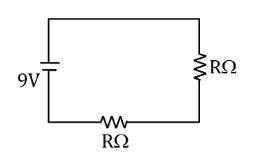
Image: Circuit just after switch is closed
Data given:
R= 2.0 ohm
L= 2mH (milli Henry)
E=9 V
Putting the values given above and using Ohm’s Law (1) for the circuit drawn above (2), we can write ,
\[\dfrac{V}{I} = R\]
\[R = \]\[2 + 2 = 4\] Ohm
Here, The equivalent resistance is added because the resistances given are in series.
\[I = \dfrac{V}{R} = \dfrac{9}{4} = 2.25\] Amperes
Hence, the current just after the switch is closed is 2.25 Amperes.
The correct answer is C.
Note: This problem deals with transient state analysis. During the transient state there is a change in the variables or process, but this stage is temporary and finally the system reaches a steady state. As the circuit is in a transient state just after the switch is closed, the inductor behaves as open circuit. Students often make a common mistake to solve the given question. They used a second loop to solve. Here we need to use the first loop.
Formula used:
Basic form of Ohm’s Law assuming ideal conditions is written below
\[V = I \times R\] ………… (1)
Where, V= Voltage across a resistive element in Volts
I= Current through the resistive element in Amperes
R= Resistance offered to the flow of current by the element in Ohms
Complete answer:
Here, after redrawing the circuit to represent the state just after the switch is closed. The inductor is assumed to be a resistance of infinite value.
Image: Circuit just after switch is closed
Data given:
R= 2.0 ohm
L= 2mH (milli Henry)
E=9 V
Putting the values given above and using Ohm’s Law (1) for the circuit drawn above (2), we can write ,
\[\dfrac{V}{I} = R\]
\[R = \]\[2 + 2 = 4\] Ohm
Here, The equivalent resistance is added because the resistances given are in series.
\[I = \dfrac{V}{R} = \dfrac{9}{4} = 2.25\] Amperes
Hence, the current just after the switch is closed is 2.25 Amperes.
The correct answer is C.
Note: This problem deals with transient state analysis. During the transient state there is a change in the variables or process, but this stage is temporary and finally the system reaches a steady state. As the circuit is in a transient state just after the switch is closed, the inductor behaves as open circuit. Students often make a common mistake to solve the given question. They used a second loop to solve. Here we need to use the first loop.
Recently Updated Pages
Algebra Made Easy: Step-by-Step Guide for Students

JEE Isolation, Preparation and Properties of Non-metals Important Concepts and Tips for Exam Preparation
JEE Energetics Important Concepts and Tips for Exam Preparation
Chemical Properties of Hydrogen - Important Concepts for JEE Exam Preparation
JEE General Topics in Chemistry Important Concepts and Tips
JEE Amino Acids and Peptides Important Concepts and Tips for Exam Preparation
Trending doubts
JEE Main 2026: Exam Dates, Session 2 Updates, City Slip, Admit Card & Latest News
JEE Main Participating Colleges 2026 - A Complete List of Top Colleges
Kinematics Mock Test for JEE Main 2025-26: Comprehensive Practice
Understanding the Electric Field of a Uniformly Charged Ring
Derivation of Equation of Trajectory Explained for Students
Understanding Atomic Structure for Beginners
Other Pages
CBSE Class 12 Physics Question Paper 2026: Download SET-wise PDF with Answer Key & Analysis
JEE Advanced 2026 Notification Out with Exam Date, Registration (Extended), Syllabus and More
JEE Advanced Percentile vs Marks 2026: JEE Main Cutoff, AIR & IIT Admission Guide
JEE Advanced 2026 Marks vs Rank: Estimate IIT Rank from Your Score
JEE Advanced Weightage Chapter Wise 2026 for Physics, Chemistry, and Mathematics
JEE Main Marking Scheme 2026- Paper-Wise Marks Distribution and Negative Marking Details